Du Fu Pavilion
⭐ 4.20
Xiangjiang River Scenic Belt, Yuelu District, Changsha, Hunan, China
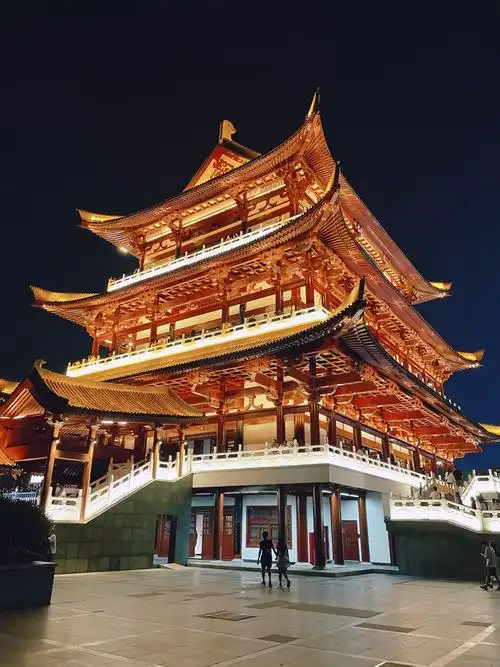 Dufu Pavilion (Du Fu Jiang Ge) was completed in 2005 to commemorate the Tang dynasty poet Du Fu (712–770), often called China's "Poet-Sage" and ranked alongside Dante and Shakespeare in literary stature. During the Dali era, the aging poet wandered south after years of war and exile, taking refuge in Changsha, where he composed over fifty poems, including "Setting Out from Tanzhou." The pavilion takes its name from his Changsha-era imagery of waterside pavilions, creating a cultural shrine for visitors to honor a literary giant whose work shaped East Asian letters as profoundly as Homer shaped the Western canon.
Modeled on Tang dynasty palace architecture, the four-story main hall rises about 19 meters (62 feet) and spans roughly 6,000 square meters of gardens and terraces. Upturned flying eaves, deep bracketed eaves, and a tiered roofline echo the imperial aesthetic seen at the reconstructed Tang palaces of Xi'an. Inside, the second and third floors house the Du Fu Memorial Hall, a stone-paved poetry corridor, and rotating cultural exhibits. Compact yet refined, the interior layout guides visitors chronologically through the poet's life, his Hunan poems, and works of calligraphy inspired by his verses.
The memorial hall displays a bronze statue of the poet, monumental bas-relief murals, a detailed biographical timeline, and a curated collection of classical paintings and calligraphy by celebrated literati. Beyond the permanent exhibits, the open-air poetry corridor features stone tablets engraved with Du Fu's finest Changsha verses—an immersive way to connect scenic views with classical verse. For visitors interested in Chinese literary traditions, the pavilion offers a focused introduction to Tang poetry and broader Hunan literary heritage, much like visiting the Petrarch House in Italy connects travelers to Renaissance humanism.
The site is open daily from 9:00 a.m. to 10:00 p.m., with ticket sales ending at 9:30 p.m. Standard daytime admission runs a modest 11–18 RMB (about $1.50–$2.50 USD), while themed evening tickets cost around 58 RMB. Children, students, and seniors qualify for discounts or free entry. The easiest approach is via Changsha Metro Line 1 to Nanmenkou Station, followed by a short walk. The pavilion sits within walking distance of Taiping Old Street, Pozi Street's food vendors, and the historic Tianxin Pavilion, making it easy to combine into a half-day cultural and culinary circuit.
The top-floor observation deck delivers an unobstructed 270-degree panorama of the Xiang River, with Orange Isle's leafy expanse in the foreground and the forested ridges of Yuelu Mountain rising across the water—a composition reminiscent of Istanbul's Golden Horn vistas or the river panoramas from Paris's Trocadéro. After sunset, warm golden lighting traces the pavilion's curved eaves, mirrored in the still river below, creating a layered nightscape prized by photographers. Visitors are advised to arrive between 5:30 and 6:30 p.m. to catch the sunset, then stay for the illumination at roughly 7:00 p.m., capturing both daylight and illuminated views in a single visit.
Dufu Pavilion (Du Fu Jiang Ge) was completed in 2005 to commemorate the Tang dynasty poet Du Fu (712–770), often called China's "Poet-Sage" and ranked alongside Dante and Shakespeare in literary stature. During the Dali era, the aging poet wandered south after years of war and exile, taking refuge in Changsha, where he composed over fifty poems, including "Setting Out from Tanzhou." The pavilion takes its name from his Changsha-era imagery of waterside pavilions, creating a cultural shrine for visitors to honor a literary giant whose work shaped East Asian letters as profoundly as Homer shaped the Western canon.
Modeled on Tang dynasty palace architecture, the four-story main hall rises about 19 meters (62 feet) and spans roughly 6,000 square meters of gardens and terraces. Upturned flying eaves, deep bracketed eaves, and a tiered roofline echo the imperial aesthetic seen at the reconstructed Tang palaces of Xi'an. Inside, the second and third floors house the Du Fu Memorial Hall, a stone-paved poetry corridor, and rotating cultural exhibits. Compact yet refined, the interior layout guides visitors chronologically through the poet's life, his Hunan poems, and works of calligraphy inspired by his verses.
The memorial hall displays a bronze statue of the poet, monumental bas-relief murals, a detailed biographical timeline, and a curated collection of classical paintings and calligraphy by celebrated literati. Beyond the permanent exhibits, the open-air poetry corridor features stone tablets engraved with Du Fu's finest Changsha verses—an immersive way to connect scenic views with classical verse. For visitors interested in Chinese literary traditions, the pavilion offers a focused introduction to Tang poetry and broader Hunan literary heritage, much like visiting the Petrarch House in Italy connects travelers to Renaissance humanism.
The site is open daily from 9:00 a.m. to 10:00 p.m., with ticket sales ending at 9:30 p.m. Standard daytime admission runs a modest 11–18 RMB (about $1.50–$2.50 USD), while themed evening tickets cost around 58 RMB. Children, students, and seniors qualify for discounts or free entry. The easiest approach is via Changsha Metro Line 1 to Nanmenkou Station, followed by a short walk. The pavilion sits within walking distance of Taiping Old Street, Pozi Street's food vendors, and the historic Tianxin Pavilion, making it easy to combine into a half-day cultural and culinary circuit.
The top-floor observation deck delivers an unobstructed 270-degree panorama of the Xiang River, with Orange Isle's leafy expanse in the foreground and the forested ridges of Yuelu Mountain rising across the water—a composition reminiscent of Istanbul's Golden Horn vistas or the river panoramas from Paris's Trocadéro. After sunset, warm golden lighting traces the pavilion's curved eaves, mirrored in the still river below, creating a layered nightscape prized by photographers. Visitors are advised to arrive between 5:30 and 6:30 p.m. to catch the sunset, then stay for the illumination at roughly 7:00 p.m., capturing both daylight and illuminated views in a single visit.