Orange Island
⭐ 4.60
Juzi Island Head, Yuelu District, Changsha City, Hunan Province, China
 Long before Mao ever set foot here, Orange Isle was already legendary. The island earned its name during the Tang and Song dynasties for the celebrated southern oranges ripening in its groves, and by the Ming era it ranked among the most celebrated sandbars of the Xiang River. Think of it as China's answer to Paris's Île de la Cité — a slender ribbon of land that became a cultural compass for the city around it. Its modern fame, however, was sealed in the early twentieth century, when a young Mao Zedong stood on these banks composing his immortal 1925 poem "Changsha," meditating on the fate of a nation still reeling from the 1911 Republican Revolution.
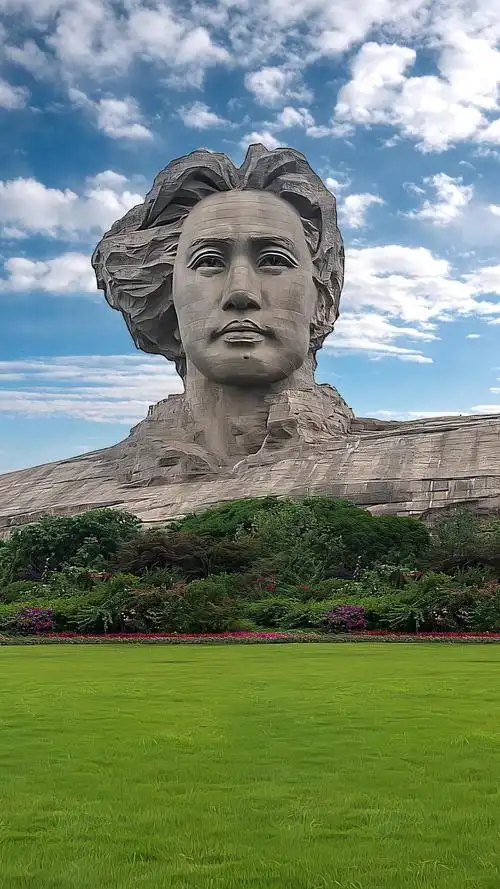
The undisputed centrepiece is the colossal Young Mao Zedong sculpture at the island's northern tip. Rising 32 metres high and stretching 83 metres long — roughly the height of a ten-storey building and the wingspan of a Boeing 747 — it ranks among the world's largest figurative monuments, echoing the ancient Colossus of Rhodes in its scale and rivaling Rio's Christ the Redeemer in stature. Carved from durable granite, the figure strides eastward with windswept hair and a billowing coat, conjuring the idealism of the May Fourth Movement of 1919. Behind it, the Wéntian Platform extends toward the river, offering one of central China's most cinematic vantage points.
Beyond the giant statue, the island unfolds as a linear open-air museum. A massive stone stele is inscribed with Mao's full poem "Qinyuanchun · Changsha," allowing visitors to read the verses in the very landscape that inspired them. Wandering south, you encounter the weathered Jiangshen Temple, once a riverside shrine where boatmen prayed for safe passage, and the elegant Wangjiang Pavilion, whose upturned eaves recall the lakeside pavilions of Suzhou. Together, these sites trace a layered history of folk faith, classical literature, and political awakening unique to Hunan province.
Access is straightforward but requires advance planning. The island lies within a state-rated five-A scenic zone that is free to enter, yet all visitors must register ahead — locals via the official WeChat account, foreign guests in person at the visitor centre with a passport. Metro Line 2 stops directly at Orange Isle Station, depositing you at the gates within minutes. Because the island stretches over five kilometres, the ¥40 sightseeing tram is strongly recommended; it loops the entire route with hop-on-hop-off flexibility, saving both legs and sun exposure.
Timing matters here. With little shade across the broad central lawns, midday summer sun can be punishing, so aim for early morning or the golden hour before sunset, when the Xiangjiang turns bronze and Dongting-bound freight barges drift past like floating silhouettes. Return after dark and you'll find the Mao sculpture dramatically uplit, its reflection shimmering across the black water — a scene that feels closer to floodlit Versailles than a provincial park. Bring your own water and snacks, as on-island dining is limited and pricey, but the experience itself — a fusion of pastoral beauty, revolutionary mythology, and one of China's most stirring urban riverscapes — is genuinely unforgettable.
Long before Mao ever set foot here, Orange Isle was already legendary. The island earned its name during the Tang and Song dynasties for the celebrated southern oranges ripening in its groves, and by the Ming era it ranked among the most celebrated sandbars of the Xiang River. Think of it as China's answer to Paris's Île de la Cité — a slender ribbon of land that became a cultural compass for the city around it. Its modern fame, however, was sealed in the early twentieth century, when a young Mao Zedong stood on these banks composing his immortal 1925 poem "Changsha," meditating on the fate of a nation still reeling from the 1911 Republican Revolution.
The undisputed centrepiece is the colossal Young Mao Zedong sculpture at the island's northern tip. Rising 32 metres high and stretching 83 metres long — roughly the height of a ten-storey building and the wingspan of a Boeing 747 — it ranks among the world's largest figurative monuments, echoing the ancient Colossus of Rhodes in its scale and rivaling Rio's Christ the Redeemer in stature. Carved from durable granite, the figure strides eastward with windswept hair and a billowing coat, conjuring the idealism of the May Fourth Movement of 1919. Behind it, the Wéntian Platform extends toward the river, offering one of central China's most cinematic vantage points.
Beyond the giant statue, the island unfolds as a linear open-air museum. A massive stone stele is inscribed with Mao's full poem "Qinyuanchun · Changsha," allowing visitors to read the verses in the very landscape that inspired them. Wandering south, you encounter the weathered Jiangshen Temple, once a riverside shrine where boatmen prayed for safe passage, and the elegant Wangjiang Pavilion, whose upturned eaves recall the lakeside pavilions of Suzhou. Together, these sites trace a layered history of folk faith, classical literature, and political awakening unique to Hunan province.
Access is straightforward but requires advance planning. The island lies within a state-rated five-A scenic zone that is free to enter, yet all visitors must register ahead — locals via the official WeChat account, foreign guests in person at the visitor centre with a passport. Metro Line 2 stops directly at Orange Isle Station, depositing you at the gates within minutes. Because the island stretches over five kilometres, the ¥40 sightseeing tram is strongly recommended; it loops the entire route with hop-on-hop-off flexibility, saving both legs and sun exposure.
Timing matters here. With little shade across the broad central lawns, midday summer sun can be punishing, so aim for early morning or the golden hour before sunset, when the Xiangjiang turns bronze and Dongting-bound freight barges drift past like floating silhouettes. Return after dark and you'll find the Mao sculpture dramatically uplit, its reflection shimmering across the black water — a scene that feels closer to floodlit Versailles than a provincial park. Bring your own water and snacks, as on-island dining is limited and pricey, but the experience itself — a fusion of pastoral beauty, revolutionary mythology, and one of China's most stirring urban riverscapes — is genuinely unforgettable.