Mount Yuelu
⭐ 4.60
Yuelu Mountain Scenic Area, Yuelu District, Changsha City, Hunan Province, China
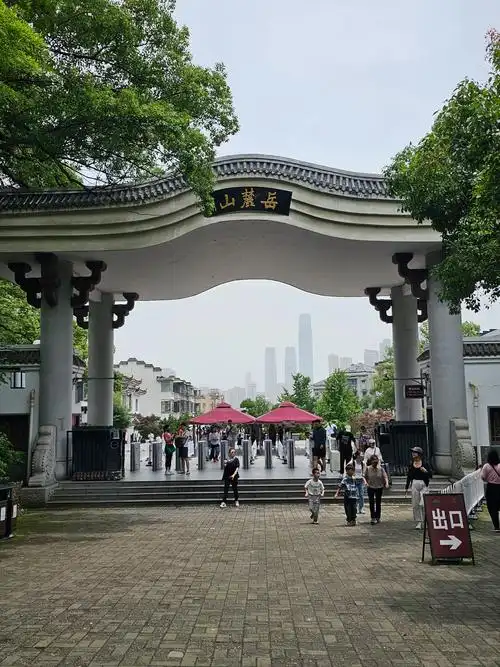 Yuelu Mountain's crown jewel is Yuelu Academy, founded in 976 CE—roughly contemporary with Europe's oldest universities at Bologna and Oxford. As one of China's "Four Great Academies" alongside the White Deer Grotto, Songyang, and Yingtian institutions, Yuelu has taught continuously for over a millennium, an extraordinary record matched by few seats of learning anywhere in the world. The mountain itself is older still: Buddhist monks established Lushan Temple here in the Western Jin dynasty, making it among Hunan's oldest religious sites. Walking these paths, visitors trace a thread of intellectual and spiritual life stretching back nearly 1,700 years.
What sets Yuelu apart is the remarkable coexistence of three great religious and philosophical traditions in a single landscape. Aiwan Pavilion—a delicate, upturned-eave structure nestled among maple and cypress—takes its name from the Tang poet Du Mu's famous autumn verse and ranks among China's "Four Famous Pavilions," comparable in cultural reverence to Kyoto's Kinkaku-ji or the celebrated pavilions of Suzhou's classical gardens. Higher up, Yunlu Palace crowns the summit as one of Taoism's twenty-three "Cave Heaven" blessed realms, its airy halls gazing out over the Xiang River. Together, Confucian academy, Buddhist temple, and Taoist sanctuary form a uniquely pluralist cultural tableau.
Yuelu Mountain is the spiritual stronghold of Huxiang culture—the fierce, scholarly tradition that has shaped Hunan for centuries. A famous couplet still hangs in the academy gateway: "Only Chu breeds talent, and here they gather in abundance." In 1167, the Neo-Confucian masters Zhu Xi and Zhang Shi met here for a legendary philosophical debate that helped define Chinese thought for the next eight centuries. The mountain also holds the tombs of revolutionary heroes Cai E and Huang Xing, pivotal figures in the 1911 Xinhai Revolution that ended imperial rule. Scholars, generals, and reformers all rest here, earning Yuelu the epithet "half the modern history of Hunan."
The mountain's natural setting rivals its cultural riches. In autumn, the slopes blaze crimson with maple—one of China's four premier maple-viewing destinations and a tradition Western travelers may recognize from New England's fall foliage or Japan's momiji season. Summer brings deep green shade and refreshing cool, an "oxygen bar" escape from the city below. From the summit viewing platform, the panorama unfolds spectacularly: the Xiang River curls like a ribbon around Orange Isle, with downtown Changsha spreading beyond. On clear days, the view stretches for miles.
The main scenic area is free but requires a real-name online reservation; only Yuelu Academy charges admission (¥40). Two metro stations serve visitors: Line 2 to Yingwanzhen Station near the East Gate, or Line 4 to Hunan University Station near the South Gate. For those who prefer not to climb, the park offers sightseeing buses (¥20 one-way), a cable car (¥30 up/¥25 down), and an alpine slide (around ¥35). Plan 3–4 hours for a full traverse: enter at the South Gate, visit the Academy, Aiwan Pavilion, and Lushan Temple, ascend to Yunlu Palace, and descend via the East Gate.
Spring and autumn offer the most pleasant weather, with autumn's maple season an unmissable highlight. In summer, plan visits for early morning or late afternoon to avoid heat and humidity—carry water, sunscreen, and insect repellent. Winter is uncrowded and atmospheric, ideal for those seeking quiet contemplation among bare branches and mist. A typical immersive itinerary threads through Yuelu Academy, Aiwan Pavilion, and Lushan Temple, climbs the forested ridge to Yunlu Palace, and ends with the sweeping summit view before descending via the East Gate—roughly 3 to 4 hours of moderate hiking.
Yuelu Mountain's crown jewel is Yuelu Academy, founded in 976 CE—roughly contemporary with Europe's oldest universities at Bologna and Oxford. As one of China's "Four Great Academies" alongside the White Deer Grotto, Songyang, and Yingtian institutions, Yuelu has taught continuously for over a millennium, an extraordinary record matched by few seats of learning anywhere in the world. The mountain itself is older still: Buddhist monks established Lushan Temple here in the Western Jin dynasty, making it among Hunan's oldest religious sites. Walking these paths, visitors trace a thread of intellectual and spiritual life stretching back nearly 1,700 years.
What sets Yuelu apart is the remarkable coexistence of three great religious and philosophical traditions in a single landscape. Aiwan Pavilion—a delicate, upturned-eave structure nestled among maple and cypress—takes its name from the Tang poet Du Mu's famous autumn verse and ranks among China's "Four Famous Pavilions," comparable in cultural reverence to Kyoto's Kinkaku-ji or the celebrated pavilions of Suzhou's classical gardens. Higher up, Yunlu Palace crowns the summit as one of Taoism's twenty-three "Cave Heaven" blessed realms, its airy halls gazing out over the Xiang River. Together, Confucian academy, Buddhist temple, and Taoist sanctuary form a uniquely pluralist cultural tableau.
Yuelu Mountain is the spiritual stronghold of Huxiang culture—the fierce, scholarly tradition that has shaped Hunan for centuries. A famous couplet still hangs in the academy gateway: "Only Chu breeds talent, and here they gather in abundance." In 1167, the Neo-Confucian masters Zhu Xi and Zhang Shi met here for a legendary philosophical debate that helped define Chinese thought for the next eight centuries. The mountain also holds the tombs of revolutionary heroes Cai E and Huang Xing, pivotal figures in the 1911 Xinhai Revolution that ended imperial rule. Scholars, generals, and reformers all rest here, earning Yuelu the epithet "half the modern history of Hunan."
The mountain's natural setting rivals its cultural riches. In autumn, the slopes blaze crimson with maple—one of China's four premier maple-viewing destinations and a tradition Western travelers may recognize from New England's fall foliage or Japan's momiji season. Summer brings deep green shade and refreshing cool, an "oxygen bar" escape from the city below. From the summit viewing platform, the panorama unfolds spectacularly: the Xiang River curls like a ribbon around Orange Isle, with downtown Changsha spreading beyond. On clear days, the view stretches for miles.
The main scenic area is free but requires a real-name online reservation; only Yuelu Academy charges admission (¥40). Two metro stations serve visitors: Line 2 to Yingwanzhen Station near the East Gate, or Line 4 to Hunan University Station near the South Gate. For those who prefer not to climb, the park offers sightseeing buses (¥20 one-way), a cable car (¥30 up/¥25 down), and an alpine slide (around ¥35). Plan 3–4 hours for a full traverse: enter at the South Gate, visit the Academy, Aiwan Pavilion, and Lushan Temple, ascend to Yunlu Palace, and descend via the East Gate.
Spring and autumn offer the most pleasant weather, with autumn's maple season an unmissable highlight. In summer, plan visits for early morning or late afternoon to avoid heat and humidity—carry water, sunscreen, and insect repellent. Winter is uncrowded and atmospheric, ideal for those seeking quiet contemplation among bare branches and mist. A typical immersive itinerary threads through Yuelu Academy, Aiwan Pavilion, and Lushan Temple, climbs the forested ridge to Yunlu Palace, and ends with the sweeping summit view before descending via the East Gate—roughly 3 to 4 hours of moderate hiking.