Boshan Lake
⭐ 3.80
Boshan Lake Scenic Area, Shihe District, Xinyang City, Henan Province, China
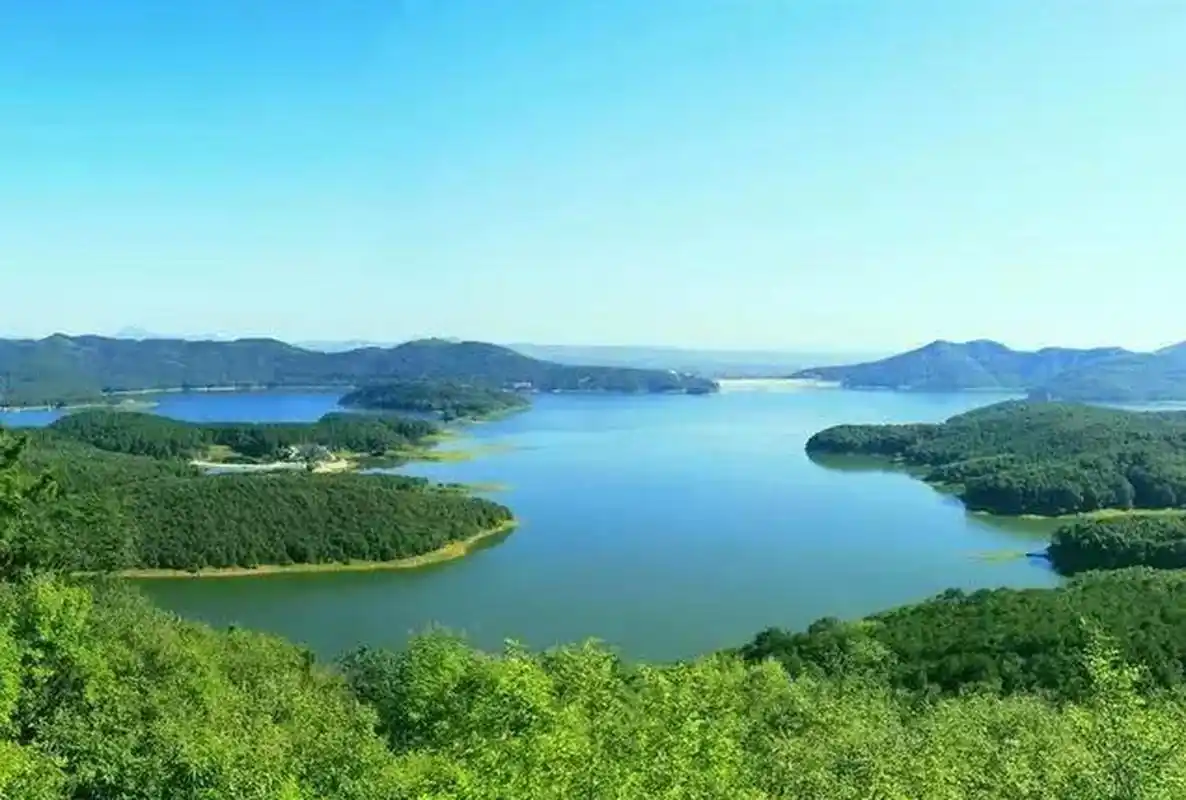 Boshan Lake was born in the early 1960s when engineers dammed a mountain basin to create the Boshan Reservoir, a project that echoes the era of America's TVA dam-building program and Europe's post-war hydroelectric expansion. Today the lake holds 620 million cubic meters of water, stretching across roughly 240 square kilometers of combined parkland. Its dam, viewed from a purpose-built observation platform, recalls the scale of Scotland's smaller hydroelectric lochs rather than vast continental reservoirs.
The surrounding peaks host a remarkable geological theater: Camel Peak, General's Wall, Whale Island, and Spirit Turtle Island rise like sculptural figures carved by millennia of weathering—comparable to the strange rock formations of the Isle of Skye or Norway's Trollfjord. Beneath these summits, a rare northern grove of moso bamboo thrives in the Cuixi (Green Bamboo) Valley, an unexpected touch of Jiangnan elegance transplanted to central China, while monkey troupes still roam the cliffs of Houer Cliff, evoking the wildlife encounters of the Cévennes or Carpathian forests.
History lingers here too: the Jiuzi Valley preserves remnants of ancient battlegrounds, paralleling the war-torn landscapes that dot the Rhine or Scottish Borders. Culturally, the lake gained wider fame when its misty shores stood in for celestial rivers in the beloved 1986 adaptation of *Journey to the West*, China's equivalent of a Tolkien-era fantasy epic—an association that continues to draw Chinese travelers and lends the scenery a mythic resonance absent from most Western lakes.
The core experience is unhurried. A wooden pleasure boat circles the principal landmarks in roughly an hour, passing General's Wall, Whale Island, and the playful "Divine Camels at Play." Motorized craft are prohibited to preserve water clarity, lending an atmosphere closer to Alpine canoeing than commercialized lake cruises. Ecological walking trails suit photographers and slow hikers, while summer brings kayaks and pedal boats. Facilities remain rustic rather than resort-style, appealing to visitors comfortable with a contemplative pace.
Practical matters favor self-driving visitors from Zhengzhou or Xinyang, both reachable in two to two and a half hours. Public transit requires transfers via Zhumadian or Queshan with limited schedules. Entry runs around 60 yuan in peak season and 40 yuan off-peak, with separate boat tickets. The best windows are spring (April–May) and autumn (September–October), when temperatures hover near 20°C; summers are cooler than the plains at roughly 24°C but require mosquito protection. On-site signage is predominantly Chinese, so downloading an offline map in advance is wise. Travelers drawn to quiet landscapes, sketching retreats, or family nature outings will find Boshan Lake a genuine antidote to China's busier tourist circuits.
Boshan Lake was born in the early 1960s when engineers dammed a mountain basin to create the Boshan Reservoir, a project that echoes the era of America's TVA dam-building program and Europe's post-war hydroelectric expansion. Today the lake holds 620 million cubic meters of water, stretching across roughly 240 square kilometers of combined parkland. Its dam, viewed from a purpose-built observation platform, recalls the scale of Scotland's smaller hydroelectric lochs rather than vast continental reservoirs.
The surrounding peaks host a remarkable geological theater: Camel Peak, General's Wall, Whale Island, and Spirit Turtle Island rise like sculptural figures carved by millennia of weathering—comparable to the strange rock formations of the Isle of Skye or Norway's Trollfjord. Beneath these summits, a rare northern grove of moso bamboo thrives in the Cuixi (Green Bamboo) Valley, an unexpected touch of Jiangnan elegance transplanted to central China, while monkey troupes still roam the cliffs of Houer Cliff, evoking the wildlife encounters of the Cévennes or Carpathian forests.
History lingers here too: the Jiuzi Valley preserves remnants of ancient battlegrounds, paralleling the war-torn landscapes that dot the Rhine or Scottish Borders. Culturally, the lake gained wider fame when its misty shores stood in for celestial rivers in the beloved 1986 adaptation of *Journey to the West*, China's equivalent of a Tolkien-era fantasy epic—an association that continues to draw Chinese travelers and lends the scenery a mythic resonance absent from most Western lakes.
The core experience is unhurried. A wooden pleasure boat circles the principal landmarks in roughly an hour, passing General's Wall, Whale Island, and the playful "Divine Camels at Play." Motorized craft are prohibited to preserve water clarity, lending an atmosphere closer to Alpine canoeing than commercialized lake cruises. Ecological walking trails suit photographers and slow hikers, while summer brings kayaks and pedal boats. Facilities remain rustic rather than resort-style, appealing to visitors comfortable with a contemplative pace.
Practical matters favor self-driving visitors from Zhengzhou or Xinyang, both reachable in two to two and a half hours. Public transit requires transfers via Zhumadian or Queshan with limited schedules. Entry runs around 60 yuan in peak season and 40 yuan off-peak, with separate boat tickets. The best windows are spring (April–May) and autumn (September–October), when temperatures hover near 20°C; summers are cooler than the plains at roughly 24°C but require mosquito protection. On-site signage is predominantly Chinese, so downloading an offline map in advance is wise. Travelers drawn to quiet landscapes, sketching retreats, or family nature outings will find Boshan Lake a genuine antidote to China's busier tourist circuits.