Changchun Cultural Square
⭐ 3.50
Cultural Square Street, Kuancheng District, Changchun City, Jilin Province, China
 The plaza's layered history mirrors the turbulent 20th century of Northeast China. Originally laid out in 1933 as "Imperial Palace Square" during the Japanese puppet state of Manchukuo, it was renamed Geological Palace Square in 1953 before its 1996 transformation into today's cultural gathering space. This evolution, from colonial ceremonial ground to democratic public realm, echoes the repurposing of Berlin's Tiergarten or Madrid's Retiro Park, where imperial landscapes were reimagined for citizens.
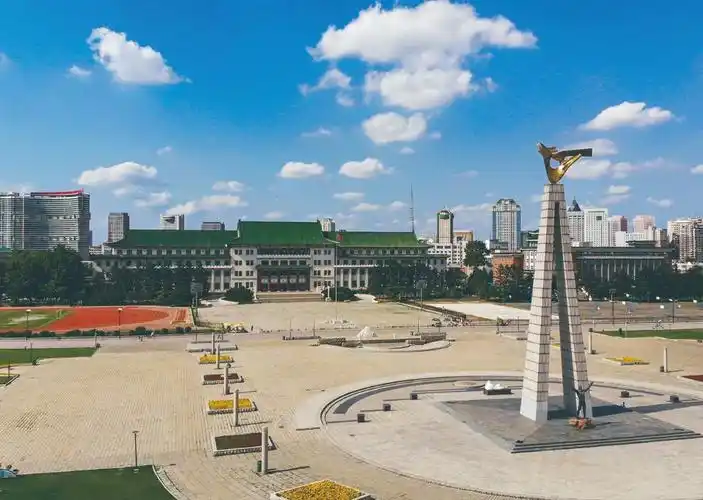
Architecturally, the plaza employs a strict north-south axial layout stretching 429 meters, comparable in scale to the grand perspectives of Versailles or Vatican City. At its heart rises the monumental "Sun Bird" sculpture group: a 37-meter centerpiece flanked by allegorical figures and four corner reliefs representing spring, summer, autumn, and winter. The axis terminates visually at the imposing Geological Palace, once planned as Manchukuo's imperial residence, creating a compelling dialogue between contemporary public art and somber historical architecture.
Culturally, the square pulses with northeastern Chinese life. Thousands of pigeons roost freely, residents fly kites, practice tai chi, and stroll beneath the trees. Throughout the year, it transforms into an open-air stage hosting international film festivals, sprawling book fairs, intangible heritage markets featuring Manchu and Mongolian crafts, and spectacular ice and snow sculpture exhibitions in winter. A summer fountain occasionally produces rainbows, while the open-air music pavilion hosts regular performances.
Practical visiting is straightforward. The plaza is entirely free and open 24 hours, with the main entrance accessible directly from Exit C of Cultural Plaza Station on Metro Line 2. Numerous buses, including routes 264, 283, and 288, also stop nearby. Visitors should note there are no rides or playgrounds; enjoyment comes from atmosphere, seasonal beauty, and people-watching rather than structured attractions.
For a richer experience, plan two to three hours and combine the plaza with adjacent heritage sites: the Geological Palace (now part of Jilin University), the colonial-era architectural ensemble along Xinmin Boulevard, and the well-preserved Puppet Emperor's Palace Museum, which together illuminate Changchun's complex pre-1949 history. Spring and autumn offer the most comfortable weather, while summer visitors should prepare for strong sun and winter visitors for Siberian-style cold, the latter season bringing the added magic of snow sculpture displays.
The plaza's layered history mirrors the turbulent 20th century of Northeast China. Originally laid out in 1933 as "Imperial Palace Square" during the Japanese puppet state of Manchukuo, it was renamed Geological Palace Square in 1953 before its 1996 transformation into today's cultural gathering space. This evolution, from colonial ceremonial ground to democratic public realm, echoes the repurposing of Berlin's Tiergarten or Madrid's Retiro Park, where imperial landscapes were reimagined for citizens.
Architecturally, the plaza employs a strict north-south axial layout stretching 429 meters, comparable in scale to the grand perspectives of Versailles or Vatican City. At its heart rises the monumental "Sun Bird" sculpture group: a 37-meter centerpiece flanked by allegorical figures and four corner reliefs representing spring, summer, autumn, and winter. The axis terminates visually at the imposing Geological Palace, once planned as Manchukuo's imperial residence, creating a compelling dialogue between contemporary public art and somber historical architecture.
Culturally, the square pulses with northeastern Chinese life. Thousands of pigeons roost freely, residents fly kites, practice tai chi, and stroll beneath the trees. Throughout the year, it transforms into an open-air stage hosting international film festivals, sprawling book fairs, intangible heritage markets featuring Manchu and Mongolian crafts, and spectacular ice and snow sculpture exhibitions in winter. A summer fountain occasionally produces rainbows, while the open-air music pavilion hosts regular performances.
Practical visiting is straightforward. The plaza is entirely free and open 24 hours, with the main entrance accessible directly from Exit C of Cultural Plaza Station on Metro Line 2. Numerous buses, including routes 264, 283, and 288, also stop nearby. Visitors should note there are no rides or playgrounds; enjoyment comes from atmosphere, seasonal beauty, and people-watching rather than structured attractions.
For a richer experience, plan two to three hours and combine the plaza with adjacent heritage sites: the Geological Palace (now part of Jilin University), the colonial-era architectural ensemble along Xinmin Boulevard, and the well-preserved Puppet Emperor's Palace Museum, which together illuminate Changchun's complex pre-1949 history. Spring and autumn offer the most comfortable weather, while summer visitors should prepare for strong sun and winter visitors for Siberian-style cold, the latter season bringing the added magic of snow sculpture displays.