Century Square
⭐ 0.00
Century Square, Kuancheng District, Changchun City, Jilin Province, China
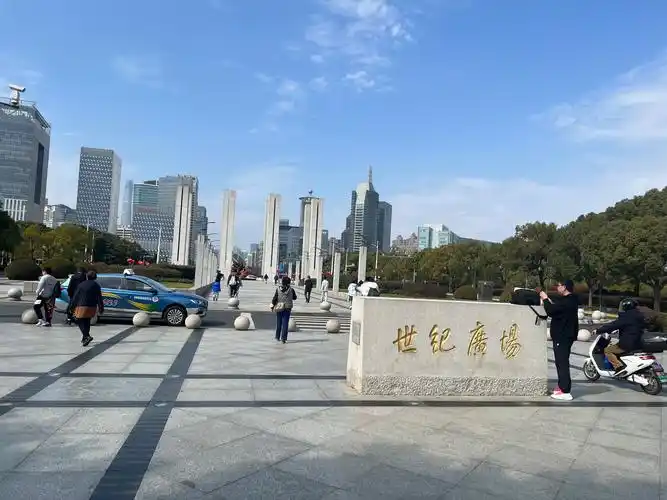 Century Square was conceived at the turn of the millennium as Changchun's flagship civic project, a gesture comparable to how Paris unveiled its Millennium Monument on the Champs-Élysées or Berlin rebuilt Potsdamer Platz after reunification. Built during the heady optimism of China's late-1990s urban boom, the plaza was designed to project a forward-looking identity for this northeastern industrial capital. Situated where Century Avenue, Jingyue Avenue, Weixing Road, and East Ring Road converged, its 320-metre roundabout anchored six arterial highways—making it both a symbolic and literal crossroads of a rapidly modernising city.
The square's architectural centrepiece was a sculptural ensemble combining two monumental works: "Voice of the Century" and "Wind of the Century." Rising from the roundabout's core, these abstract compositions employed sweeping metallic lines to evoke the dialogue between time and urban progress, blending high-modernist industrial aesthetics with a distinctly Chinese appetite for grandeur. In scale and ambition, the installation recalled the kinetic sculptures of Jean Tinguely or the civic monuments erected in Soviet-era plazas, though rendered in a sleeker, post-industrial vocabulary that resonated with contemporary Chinese urbanism.
Culturally, the plaza served as Changchun's democratic living room—a role reminiscent of Madrid's Puerta del Sol or Copenhagen's Superkilen Park. At dusk, residents gathered to practise ballroom dancing, fly kites, and cool off during humid Jilin summers. Students from nearby universities treated the open lawns as informal social hubs, while the adjacent Northeast Nationalities Folk Customs Museum and Changchun International Convention Centre lent the area a distinctly civic, exhibition-oriented atmosphere. For visitors, it offered an unfiltered glimpse into everyday northeastern Chinese urban life.
From a practical standpoint, Century Square is no longer accessible as a destination. Demolished in 2022, the site has been fully converted into a multi-level expressway interchange that opened to traffic in July 2024; the sculptures, lawns, and surrounding pedestrian zones have been entirely removed. Travellers searching online for the original landmark will find only the Light Rail Line 3 stop of the same name, which now serves a pure transport function with no sightseeing value whatsoever.
Despite the loss, the surrounding Nanguan District remains rich with rewarding alternatives. The Changchun World Sculpture Park, often compared to Oslo's Vigeland Installation for its ambitious scale, displays hundreds of works by international artists in landscaped grounds. The Puppet Manchukuo Imperial Palace offers a sobering counterpart to Beijing's Forbidden City, documenting the city's controversial role as wartime Japanese capital. For relaxation, South Lake Park provides boating and forested walking paths akin to a smaller version of Beijing's Summer Palace, while the Northeast Nationalities Folk Customs Museum continues to welcome visitors eager to explore Manchu and Korean heritage.
Century Square was conceived at the turn of the millennium as Changchun's flagship civic project, a gesture comparable to how Paris unveiled its Millennium Monument on the Champs-Élysées or Berlin rebuilt Potsdamer Platz after reunification. Built during the heady optimism of China's late-1990s urban boom, the plaza was designed to project a forward-looking identity for this northeastern industrial capital. Situated where Century Avenue, Jingyue Avenue, Weixing Road, and East Ring Road converged, its 320-metre roundabout anchored six arterial highways—making it both a symbolic and literal crossroads of a rapidly modernising city.
The square's architectural centrepiece was a sculptural ensemble combining two monumental works: "Voice of the Century" and "Wind of the Century." Rising from the roundabout's core, these abstract compositions employed sweeping metallic lines to evoke the dialogue between time and urban progress, blending high-modernist industrial aesthetics with a distinctly Chinese appetite for grandeur. In scale and ambition, the installation recalled the kinetic sculptures of Jean Tinguely or the civic monuments erected in Soviet-era plazas, though rendered in a sleeker, post-industrial vocabulary that resonated with contemporary Chinese urbanism.
Culturally, the plaza served as Changchun's democratic living room—a role reminiscent of Madrid's Puerta del Sol or Copenhagen's Superkilen Park. At dusk, residents gathered to practise ballroom dancing, fly kites, and cool off during humid Jilin summers. Students from nearby universities treated the open lawns as informal social hubs, while the adjacent Northeast Nationalities Folk Customs Museum and Changchun International Convention Centre lent the area a distinctly civic, exhibition-oriented atmosphere. For visitors, it offered an unfiltered glimpse into everyday northeastern Chinese urban life.
From a practical standpoint, Century Square is no longer accessible as a destination. Demolished in 2022, the site has been fully converted into a multi-level expressway interchange that opened to traffic in July 2024; the sculptures, lawns, and surrounding pedestrian zones have been entirely removed. Travellers searching online for the original landmark will find only the Light Rail Line 3 stop of the same name, which now serves a pure transport function with no sightseeing value whatsoever.
Despite the loss, the surrounding Nanguan District remains rich with rewarding alternatives. The Changchun World Sculpture Park, often compared to Oslo's Vigeland Installation for its ambitious scale, displays hundreds of works by international artists in landscaped grounds. The Puppet Manchukuo Imperial Palace offers a sobering counterpart to Beijing's Forbidden City, documenting the city's controversial role as wartime Japanese capital. For relaxation, South Lake Park provides boating and forested walking paths akin to a smaller version of Beijing's Summer Palace, while the Northeast Nationalities Folk Customs Museum continues to welcome visitors eager to explore Manchu and Korean heritage.