Jingyue Lake
⭐ 4.30
Jingyue District, Changchun City, Jilin Province, China
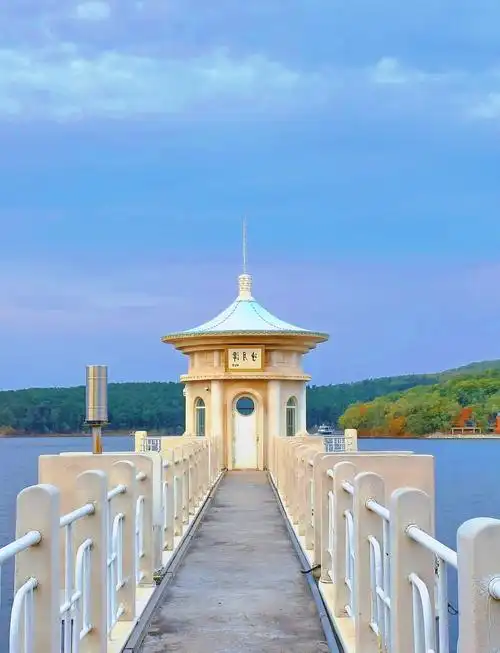 Jingyuetan's origins lie in the turbulent 1930s, when engineers dammed the Yitong River during the Manchukuo era—the Japanese puppet state that made Changchun, then called Hsinking, its capital from 1932 to 1945. The resulting crescent-shaped lake gave the site its poetic name, meaning "Pure Moon Pond." Over the following decades, ambitious reforestation transformed the area into one of Asia's largest artificial forests. Today, the 96-square-kilometer park functions as Changchun's ecological shield and "urban lung," its dense canopy purifying city air and offering a green counterpoint to the industrial legacy of northeast China.
The landscape marries water and woodland in classic Chinese style—imagine a Lake Como shoreline threaded through a Scandinavian pine forest. A 17-kilometer lakeside road and 20 kilometers of wooden boardwalk weave past Goddess Square, the main dam, a forest bathing field, and a wetland park, easily explored by rental bike or sightseeing tram. Summer brings lotus blooms and weeping willows; autumn ignites the maples and birches in crimson and gold; winter blankets the park in snow, when the lake hosts skiing, snowmobiling, and celebrated cross-country skiing festivals.
The Vasa Museum celebrates Changchun's ties with Sweden's famed Vasaloppet, the world's oldest cross-country ski race—giving the museum its Nordic-flavored name and connecting this Chinese park to a European sporting tradition dating to 1922. Tucked deeper in the woods, North Putuo Temple offers contemplative contrast, named after one of China's four sacred Buddhist mountains. Visitors can also ride cable cars above the forest canopy, meet reindeer at the woodland paddock, or drift across the moonlit lake on bamboo rafts during the popular "Dragon Wanders the Pure Moon" evening cruise.
Reaching the park is refreshingly simple: take Metro Line 3 directly to Jingyuetan Station. The entrance fee runs about 30 RMB (roughly 4 USD), with an additional 20 RMB for an all-day hop-on-hop-off sightseeing bus that loops the western lakeside road—a smart choice given the park's sheer size. Note that private cars and bicycles are prohibited inside; park at the main gate's multi-story garage or the west gate lot, then transfer to the shuttle. Gates open from 5:00 to 20:00, though indoor venues close around 17:30, and last boat tickets sell out by 17:10.
With summer highs around 22°C, Jingyuetan offers a cool reprieve comparable to escaping to the Bavarian Alps from a sweltering lowland city. Pack mosquito repellent and sunscreen, and plan your visit for early morning or late afternoon to avoid midday glare. Foreign visitors can purchase tickets with a passport. Strict fire regulations prohibit open flames, and the absence of vehicle traffic makes the park exceptionally safe for children. Whether you come for a quiet forest walk, a family bike ride, or a winter ski adventure, Jingyuetan delivers one of northeast China's most rewarding and accessible nature experiences.
Jingyuetan's origins lie in the turbulent 1930s, when engineers dammed the Yitong River during the Manchukuo era—the Japanese puppet state that made Changchun, then called Hsinking, its capital from 1932 to 1945. The resulting crescent-shaped lake gave the site its poetic name, meaning "Pure Moon Pond." Over the following decades, ambitious reforestation transformed the area into one of Asia's largest artificial forests. Today, the 96-square-kilometer park functions as Changchun's ecological shield and "urban lung," its dense canopy purifying city air and offering a green counterpoint to the industrial legacy of northeast China.
The landscape marries water and woodland in classic Chinese style—imagine a Lake Como shoreline threaded through a Scandinavian pine forest. A 17-kilometer lakeside road and 20 kilometers of wooden boardwalk weave past Goddess Square, the main dam, a forest bathing field, and a wetland park, easily explored by rental bike or sightseeing tram. Summer brings lotus blooms and weeping willows; autumn ignites the maples and birches in crimson and gold; winter blankets the park in snow, when the lake hosts skiing, snowmobiling, and celebrated cross-country skiing festivals.
The Vasa Museum celebrates Changchun's ties with Sweden's famed Vasaloppet, the world's oldest cross-country ski race—giving the museum its Nordic-flavored name and connecting this Chinese park to a European sporting tradition dating to 1922. Tucked deeper in the woods, North Putuo Temple offers contemplative contrast, named after one of China's four sacred Buddhist mountains. Visitors can also ride cable cars above the forest canopy, meet reindeer at the woodland paddock, or drift across the moonlit lake on bamboo rafts during the popular "Dragon Wanders the Pure Moon" evening cruise.
Reaching the park is refreshingly simple: take Metro Line 3 directly to Jingyuetan Station. The entrance fee runs about 30 RMB (roughly 4 USD), with an additional 20 RMB for an all-day hop-on-hop-off sightseeing bus that loops the western lakeside road—a smart choice given the park's sheer size. Note that private cars and bicycles are prohibited inside; park at the main gate's multi-story garage or the west gate lot, then transfer to the shuttle. Gates open from 5:00 to 20:00, though indoor venues close around 17:30, and last boat tickets sell out by 17:10.
With summer highs around 22°C, Jingyuetan offers a cool reprieve comparable to escaping to the Bavarian Alps from a sweltering lowland city. Pack mosquito repellent and sunscreen, and plan your visit for early morning or late afternoon to avoid midday glare. Foreign visitors can purchase tickets with a passport. Strict fire regulations prohibit open flames, and the absence of vehicle traffic makes the park exceptionally safe for children. Whether you come for a quiet forest walk, a family bike ride, or a winter ski adventure, Jingyuetan delivers one of northeast China's most rewarding and accessible nature experiences.