Museum of the Imperial Palace of Manchukuo
⭐ 4.60
Kuancheng District, Changchun, Jilin Province, China
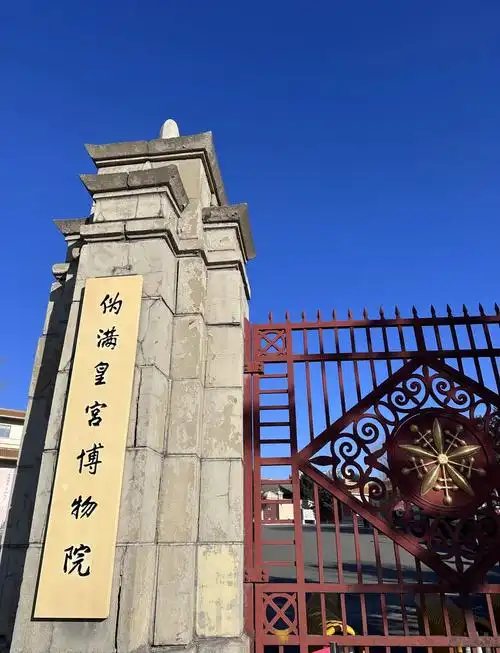 Puyi famously ascended the Qing throne in 1908 at the age of three, abdicated in 1912, and later became a useful pawn in Tokyo's imperial ambitions. When Japanese forces engineered the 1931 Mukden Incident and annexed Manchuria the following year, the former emperor was installed as "Chief Executive" of Manchukuo, a puppet state often compared to Vichy France under Marshal Pétain. Like the French collaborationist regime, Manchukuo presented a veneer of sovereignty while the real power rested with the Japanese Kwantung Army. This palace, originally a salt revenue office, was seized and lavishly rebuilt to serve as the throne room of Asia's most tragic political theater, an unbroken chain of command reaching from Tokyo that culminated in Japan's 1945 defeat and Soviet capture of Puyi.
The architectural ensemble reveals the contradictions of the regime itself. Qinmin Lou (the "Diligence-for-the-People Hall") is a two-story European-style brick edifice in which Puyi held his bizarre coronation in 1934, a ceremony deliberately styled to evoke images of European absolutism while serving colonial masters. Jixi Lou, his private residence, mixes Chinese tiled roofs with Western interior layouts, and the cavernous Tongde Hall fuses Chinese imperial motifs with Japanese shoin detailing, though Puyi never slept there, suspecting hidden microphones. The result is a built environment as ideologically schizophrenic as the puppet state it served, an Asian cousin to the eclectic colonial architecture found along Shanghai's Bund or in former European concessions from Hanoi to Tianjin.
Beyond the palace interiors, the on-site Northeast Occupation History Museum presents a comprehensive, often emotionally devastating narrative of Japanese aggression, from the staged 1931 Mukden Incident through the establishment of puppet regimes, the horrors of Unit 731's biological warfare experiments, forced labor, and "comfort women," to final liberation in 1945. A separate chronological exhibition follows Puyi's strange odyssey from imperial prince in the Forbidden City, to puppet in Changchun, to war criminal in Soviet and Chinese custody, and ultimately to ordinary gardener in Communist Beijing. The presentation is museum-quality, with bilingual panels and multimedia stations, treating difficult subject matter with the kind of rigor one finds at Berlin's Topography of Terror or Jerusalem's Yad Vashem.
Practical logistics are straightforward. The museum sits just north of Changchun Railway Station, a short taxi ride or two-stop metro hop from the city center. Admission is around 70 RMB (roughly $10) in high season, with reduced winter hours and Monday closures, except during Chinese public holidays. English audio guides are available for a small deposit, and guided tours can be booked through the official WeChat mini-program up to three days ahead, which is strongly recommended in July and August when domestic tourism peaks. Allow a full three to four hours to take in the palace complex and both major exhibitions.
This is not a cheerful site, and it should not be. Yet for travelers tracing the broader history of WWII across the Pacific theater, the Puppet Emperor's Palace offers something rare: an unaltered physical stage where collaboration, colonialism, and individual complicity played out in concrete form. Standing in the very rooms where decisions were made that affected millions of lives transforms textbook history into tangible memory. Visitors leave with a far clearer understanding of how fascism operated outside Europe, why the war in Asia lasted years after Germany's defeat, and why communities across northeast China continue to insist on remembrance. Pair a visit here with a stop at the nearby Eight Martyrs' Memorial or a day trip to Jilin's wartime sites for an unusually complete picture of this still-unfolding chapter.
Puyi famously ascended the Qing throne in 1908 at the age of three, abdicated in 1912, and later became a useful pawn in Tokyo's imperial ambitions. When Japanese forces engineered the 1931 Mukden Incident and annexed Manchuria the following year, the former emperor was installed as "Chief Executive" of Manchukuo, a puppet state often compared to Vichy France under Marshal Pétain. Like the French collaborationist regime, Manchukuo presented a veneer of sovereignty while the real power rested with the Japanese Kwantung Army. This palace, originally a salt revenue office, was seized and lavishly rebuilt to serve as the throne room of Asia's most tragic political theater, an unbroken chain of command reaching from Tokyo that culminated in Japan's 1945 defeat and Soviet capture of Puyi.
The architectural ensemble reveals the contradictions of the regime itself. Qinmin Lou (the "Diligence-for-the-People Hall") is a two-story European-style brick edifice in which Puyi held his bizarre coronation in 1934, a ceremony deliberately styled to evoke images of European absolutism while serving colonial masters. Jixi Lou, his private residence, mixes Chinese tiled roofs with Western interior layouts, and the cavernous Tongde Hall fuses Chinese imperial motifs with Japanese shoin detailing, though Puyi never slept there, suspecting hidden microphones. The result is a built environment as ideologically schizophrenic as the puppet state it served, an Asian cousin to the eclectic colonial architecture found along Shanghai's Bund or in former European concessions from Hanoi to Tianjin.
Beyond the palace interiors, the on-site Northeast Occupation History Museum presents a comprehensive, often emotionally devastating narrative of Japanese aggression, from the staged 1931 Mukden Incident through the establishment of puppet regimes, the horrors of Unit 731's biological warfare experiments, forced labor, and "comfort women," to final liberation in 1945. A separate chronological exhibition follows Puyi's strange odyssey from imperial prince in the Forbidden City, to puppet in Changchun, to war criminal in Soviet and Chinese custody, and ultimately to ordinary gardener in Communist Beijing. The presentation is museum-quality, with bilingual panels and multimedia stations, treating difficult subject matter with the kind of rigor one finds at Berlin's Topography of Terror or Jerusalem's Yad Vashem.
Practical logistics are straightforward. The museum sits just north of Changchun Railway Station, a short taxi ride or two-stop metro hop from the city center. Admission is around 70 RMB (roughly $10) in high season, with reduced winter hours and Monday closures, except during Chinese public holidays. English audio guides are available for a small deposit, and guided tours can be booked through the official WeChat mini-program up to three days ahead, which is strongly recommended in July and August when domestic tourism peaks. Allow a full three to four hours to take in the palace complex and both major exhibitions.
This is not a cheerful site, and it should not be. Yet for travelers tracing the broader history of WWII across the Pacific theater, the Puppet Emperor's Palace offers something rare: an unaltered physical stage where collaboration, colonialism, and individual complicity played out in concrete form. Standing in the very rooms where decisions were made that affected millions of lives transforms textbook history into tangible memory. Visitors leave with a far clearer understanding of how fascism operated outside Europe, why the war in Asia lasted years after Germany's defeat, and why communities across northeast China continue to insist on remembrance. Pair a visit here with a stop at the nearby Eight Martyrs' Memorial or a day trip to Jilin's wartime sites for an unusually complete picture of this still-unfolding chapter.