Mount Maoshan
⭐ 4.60
Zhenjiang, Jiangsu, China
 Maoshan's Taoist roots reach back to the Han Dynasty, when the legendary Ma brothers are said to have cultivated elixirs of immortality here, laying the foundation of the Shangqing school—China's equivalent of a monastic order that shaped spiritual life much like Benedictine communities did in medieval Europe. Imperial patronage through successive dynasties transformed the mountain into the Taoist heartland of southern China, and its "Eighth Grotto-Heaven" title places it in the same elite company as the sacred peaks of the Taoist pantheon. The mountain's modest elevation belies its cultural weight, reminiscent of how tiny Montserrat rises above the Catalan plain as a beacon of devotion.
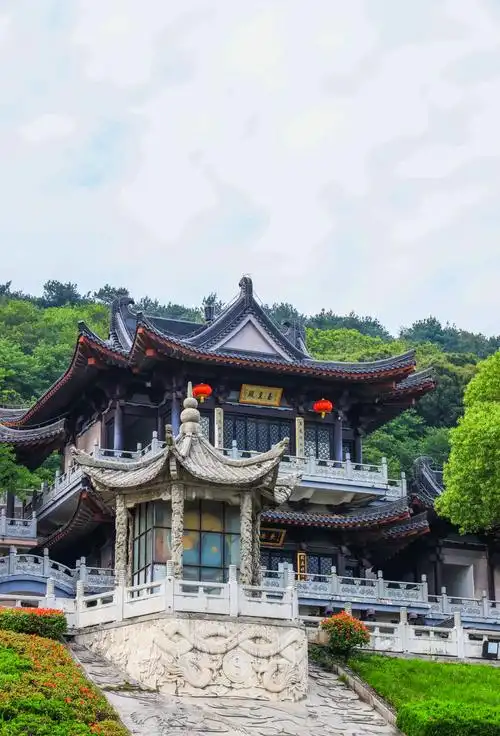
Perched atop the main peak, the Jiuxiao Wanshu Palace functions as Maoshan's spiritual epicentre, much as Sacré-Cœur crowns Montmartre in Paris. Its terraces cascade skyward in classical Taoist symmetry, with the main hall enshrining the Three Ma Immortals. Pilgrims light incense at "Heaven's First Incense" while sweeping panoramas of forested ridges unfold below. The ubiquitous fu (fortune) character invites visitors to trace its strokes, an interactive gesture akin to touching the mezuzah at a Jewish shrine.
The Yuanfu Wanning Palace draws admirers for its Guinness-certified, 33-metre outdoor bronze statue of Laozi—taller than Athens' Statue of Liberty from toe to torch. Beyond the colossal figure, the complex blends temple architecture with Jiangnan garden elegance, housing shrines to wealth and love alongside the contemplative Tai Chi Pool. Photographers and wish-makers alike find this the mountain's most photogenic corner.
Nature takes centre stage at Huayang Cave, the mountain's "Eighth Grotto-Heaven" body, where year-round cool temperatures and dripping stalactites create a subterranean cathedral akin to Italy's famous Frasassi Caves. Nearby, the delightful Xike Spring bubbles at the sound of clapping—an interactive marvel that charms families as much as any wishing well in Salzburg.
Maoshan also anchors the legacy of the New Fourth Army's wartime resistance. The Sunan Anti-Japanese Victory Monument and accompanying Memorial Hall stand with the solemnity of Normandy's war cemeteries, while a curious acoustic phenomenon at the monument causes firecrackers to echo as military bugles. This blend of remembrance and wonder makes the site a moving stop for visitors interested in twentieth-century history.
Practical guidance: drive directly to the Maoshan Scenic Area Visitor Centre. Peak-season tickets cost around 100 RMB, off-peak roughly 80 RMB, with a 35 RMB shuttle pass strongly recommended. The classic loop—shuttle uphill to Jiuxiao Wanshu Palace, then descend through Yuanfu Wanning Palace, Huayang Cave, Chongxi Wanshou Palace, and the war monuments—takes three to four hours. Pack mosquito repellent and a light jacket in summer; gates close at 16:30. Those with extra time should pair Maoshan with a stay at the Oriental Salt Lake City, just fifteen minutes away, for an immersive two-day getaway.
Maoshan's Taoist roots reach back to the Han Dynasty, when the legendary Ma brothers are said to have cultivated elixirs of immortality here, laying the foundation of the Shangqing school—China's equivalent of a monastic order that shaped spiritual life much like Benedictine communities did in medieval Europe. Imperial patronage through successive dynasties transformed the mountain into the Taoist heartland of southern China, and its "Eighth Grotto-Heaven" title places it in the same elite company as the sacred peaks of the Taoist pantheon. The mountain's modest elevation belies its cultural weight, reminiscent of how tiny Montserrat rises above the Catalan plain as a beacon of devotion.
Perched atop the main peak, the Jiuxiao Wanshu Palace functions as Maoshan's spiritual epicentre, much as Sacré-Cœur crowns Montmartre in Paris. Its terraces cascade skyward in classical Taoist symmetry, with the main hall enshrining the Three Ma Immortals. Pilgrims light incense at "Heaven's First Incense" while sweeping panoramas of forested ridges unfold below. The ubiquitous fu (fortune) character invites visitors to trace its strokes, an interactive gesture akin to touching the mezuzah at a Jewish shrine.
The Yuanfu Wanning Palace draws admirers for its Guinness-certified, 33-metre outdoor bronze statue of Laozi—taller than Athens' Statue of Liberty from toe to torch. Beyond the colossal figure, the complex blends temple architecture with Jiangnan garden elegance, housing shrines to wealth and love alongside the contemplative Tai Chi Pool. Photographers and wish-makers alike find this the mountain's most photogenic corner.
Nature takes centre stage at Huayang Cave, the mountain's "Eighth Grotto-Heaven" body, where year-round cool temperatures and dripping stalactites create a subterranean cathedral akin to Italy's famous Frasassi Caves. Nearby, the delightful Xike Spring bubbles at the sound of clapping—an interactive marvel that charms families as much as any wishing well in Salzburg.
Maoshan also anchors the legacy of the New Fourth Army's wartime resistance. The Sunan Anti-Japanese Victory Monument and accompanying Memorial Hall stand with the solemnity of Normandy's war cemeteries, while a curious acoustic phenomenon at the monument causes firecrackers to echo as military bugles. This blend of remembrance and wonder makes the site a moving stop for visitors interested in twentieth-century history.
Practical guidance: drive directly to the Maoshan Scenic Area Visitor Centre. Peak-season tickets cost around 100 RMB, off-peak roughly 80 RMB, with a 35 RMB shuttle pass strongly recommended. The classic loop—shuttle uphill to Jiuxiao Wanshu Palace, then descend through Yuanfu Wanning Palace, Huayang Cave, Chongxi Wanshou Palace, and the war monuments—takes three to four hours. Pack mosquito repellent and a light jacket in summer; gates close at 16:30. Those with extra time should pair Maoshan with a stay at the Oriental Salt Lake City, just fifteen minutes away, for an immersive two-day getaway.