Xijindu Ancient Street
⭐ 4.50
Xijindu Ancient Street, Jingkou District, Zhenjiang City, Jiangsu Province, China
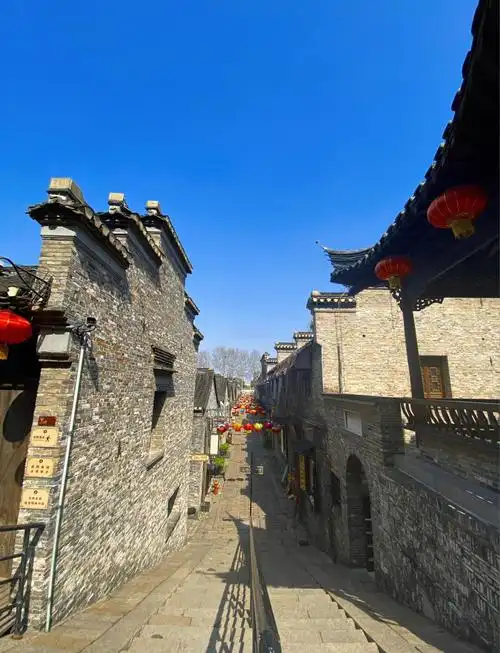 This is one of the oldest ferry crossings on the Yangtze, dating back to the Three Kingdoms period (220–280 AD) when it was known as "Suanshan Ferry." By the Tang and Song dynasties, it had become a vital artery for the Grand Canal's grain shipments—comparable in importance to the Danube trade routes that fed medieval European empires. When the Yangtze's course shifted northward in the late 19th century, the port lost its function but froze its history in place, earning a UNESCO Asia-Pacific Heritage Conservation Award in 2002.
The street's most arresting feature is the "Thousand Years in One Glance" glass walkway, where five distinct road surfaces—complete with ancient cart ruts—stack beneath your feet like a geological cross-section of civilization. Think of it as China's answer to Rome's strata beneath the Forum, but extending across imperial dynasties rather than merely centuries. Midway stands the Zhaoguan Stone Pagoda, a rare 14th-century Buddhist structure of the "pass-through" type, where pedestrians walk beneath the tower in a gesture of safe passage—one of very few still standing anywhere.
The western end reveals a completely different chapter: the 1889 British Consulate, today home to the Zhenjiang Museum, whose 30,000+ artifacts span the Western Zhou to the Republican era. Built during the colonial twilight of the Qing Dynasty, it stands as a silent witness to the Unequal Treaties era—the same historical ferment that produced Shanghai's Bund. The neighboring Rescue Society Museum commemorates a Qing-dynasty lifeboat service founded in 1736, predating Britain's Royal National Lifeboat Institution by nearly ninety years.
No visit is complete without sampling Zhenjiang's "Three Oddities": pot-lid-shaped noodles (guogaimian), crystal-clear pork jelly, and the city's famed black vinegar—flavors that have sustained Yangtze boatmen for centuries. The street blends these time-honored dishes with contemporary teahouses and design-forward coffee shops, creating a culinary map of Jiangnan province similar to how Lyon combines bouchons with modern bistros.
Plan your visit for late afternoon to evening (roughly 17:00–21:00), when the setting sun gilds the flagstones before lanterns transform the lane into a warm, glowing corridor. From the summit of Yuntai Pavilion, sweeping views encompass both the ancient rooftops and the broad Yangtze beyond—a panorama worthy of comparison with the river vistas at Budapest or Prague. Wear flat, comfortable shoes: the street's famous "Fifty-Three Slopes" include long flights of steps that punish heels mercilessly.
Xijin Dugu offers something rare in modern China: a place where you physically walk through history rather than view it behind glass. The street rewards both casual strollers and serious history enthusiasts with its layered authenticity, while its evening atmosphere—lanterns, river breezes, and the distant hum of the city—delivers a quintessentially Jiangnan experience that feels both deeply Chinese and warmly accessible to international travelers.
This is one of the oldest ferry crossings on the Yangtze, dating back to the Three Kingdoms period (220–280 AD) when it was known as "Suanshan Ferry." By the Tang and Song dynasties, it had become a vital artery for the Grand Canal's grain shipments—comparable in importance to the Danube trade routes that fed medieval European empires. When the Yangtze's course shifted northward in the late 19th century, the port lost its function but froze its history in place, earning a UNESCO Asia-Pacific Heritage Conservation Award in 2002.
The street's most arresting feature is the "Thousand Years in One Glance" glass walkway, where five distinct road surfaces—complete with ancient cart ruts—stack beneath your feet like a geological cross-section of civilization. Think of it as China's answer to Rome's strata beneath the Forum, but extending across imperial dynasties rather than merely centuries. Midway stands the Zhaoguan Stone Pagoda, a rare 14th-century Buddhist structure of the "pass-through" type, where pedestrians walk beneath the tower in a gesture of safe passage—one of very few still standing anywhere.
The western end reveals a completely different chapter: the 1889 British Consulate, today home to the Zhenjiang Museum, whose 30,000+ artifacts span the Western Zhou to the Republican era. Built during the colonial twilight of the Qing Dynasty, it stands as a silent witness to the Unequal Treaties era—the same historical ferment that produced Shanghai's Bund. The neighboring Rescue Society Museum commemorates a Qing-dynasty lifeboat service founded in 1736, predating Britain's Royal National Lifeboat Institution by nearly ninety years.
No visit is complete without sampling Zhenjiang's "Three Oddities": pot-lid-shaped noodles (guogaimian), crystal-clear pork jelly, and the city's famed black vinegar—flavors that have sustained Yangtze boatmen for centuries. The street blends these time-honored dishes with contemporary teahouses and design-forward coffee shops, creating a culinary map of Jiangnan province similar to how Lyon combines bouchons with modern bistros.
Plan your visit for late afternoon to evening (roughly 17:00–21:00), when the setting sun gilds the flagstones before lanterns transform the lane into a warm, glowing corridor. From the summit of Yuntai Pavilion, sweeping views encompass both the ancient rooftops and the broad Yangtze beyond—a panorama worthy of comparison with the river vistas at Budapest or Prague. Wear flat, comfortable shoes: the street's famous "Fifty-Three Slopes" include long flights of steps that punish heels mercilessly.
Xijin Dugu offers something rare in modern China: a place where you physically walk through history rather than view it behind glass. The street rewards both casual strollers and serious history enthusiasts with its layered authenticity, while its evening atmosphere—lanterns, river breezes, and the distant hum of the city—delivers a quintessentially Jiangnan experience that feels both deeply Chinese and warmly accessible to international travelers.