Jiao Mountain
⭐ 4.70
Jiaoshan Scenic Area, Jingkou District, Zhenjiang City, Jiangsu Province, China
 Jiaoshan takes its name from the Eastern Han scholar Jiao Guang, who refused imperial summons three times in the second century AD—much like the Roman Stoics who withdrew from public life to preserve their principles. The mountain has welcomed travelers for more than a millennium, its slopes bearing the imprint of dynasties from Han to Qing. In 1703, the Kangxi Emperor himself bestowed the temple's name "Dinghui" during one of his celebrated southern tours, leaving a permanent imperial mark on this island sanctuary that continues to draw pilgrims today.
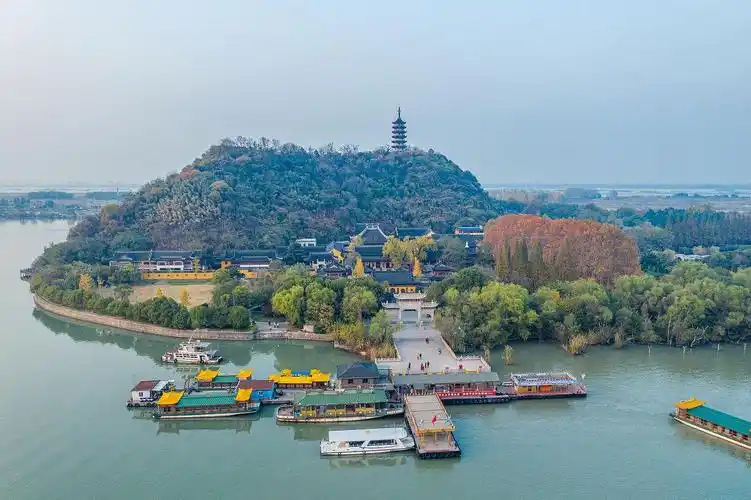
The temple complex presents a fascinating architectural inversion: where Jinshan nearby displays the typical "temple crowning the mountain" silhouette familiar from Mont-Saint-Michel, Jiaoshan reverses the formula into "mountain embracing temple." Yellow-walled halls and emerald tiles retreat into groves of ancient cypress and pine, with the main hall constructed entirely without nails—a marvel of joinery comparable to the timber ceilings of medieval European cathedrals. Walking the hushed courtyards, visitors experience the contemplative atmosphere that has drawn Buddhist practitioners for eighteen centuries.
For lovers of calligraphy, Jiaoshan is a pilgrimage site. The island's protected stele forest preserves over 500 carved stones spanning the Southern Dynasties through the Ming and Qing periods. Its crown jewel, the Yi He Ming (Burial of a Crane Inscription), is attributed to Wang Xizhi—revered as China's Shakespeare of the brush—and is honored as the founding masterpiece of large-character calligraphy. Scholars compare its influence to a typographic revolution in form: a watershed moment that shaped how generations of artists structured ink on stone and paper.
A more sobering chapter awaits at the island's northern tip, where dark bunker-like cannon emplacements survive from the First Opium War (1840-42). Here Zhenjiang's defenders perished resisting British forces in one of the conflict's most bitter engagements. Even Friedrich Engels, then a young journalist in Manchester, wrote admiringly of their resistance—the only Opium War battle to receive such notice from European observers. Standing amid these weathered fortifications while the Yangtze rushes past, visitors feel the weight of nineteenth-century imperial collision and the courage of those who held the line.
Reaching Jiaoshan requires a short ferry ride from Zhenjiang's western pier—the crossing itself sets the contemplative tone for the visit. The combined ticket covers ferry and island entry: 65 yuan in peak season (April-October), 50 yuan in winter. Allow at least half a day to climb the gentle slopes at a leisurely pace, visit the Xijiang Lou pavilion for panoramic river views, ascend the multi-storied Wanfo Pagoda, and stroll among thousand-year-old ginkgo trees in the elegant bonsai garden. Comfortable shoes are recommended.
While many Yangtze cities boast ancient temples and river views, Jiaoshan uniquely fuses all of Zhenjiang's treasures into one accessible island: deep Buddhist heritage, world-class calligraphy, and stirring modern history. Few places allow travelers to read Tang-era inscriptions in the morning, contemplate Opium War sacrifices by noon, and watch the sun set over the same waters that inspired Song-dynasty poets—all without leaving a single square mile. For travelers seeking China's cultural depth away from megacity crowds, Jiaoshan is genuinely unforgettable.
Jiaoshan takes its name from the Eastern Han scholar Jiao Guang, who refused imperial summons three times in the second century AD—much like the Roman Stoics who withdrew from public life to preserve their principles. The mountain has welcomed travelers for more than a millennium, its slopes bearing the imprint of dynasties from Han to Qing. In 1703, the Kangxi Emperor himself bestowed the temple's name "Dinghui" during one of his celebrated southern tours, leaving a permanent imperial mark on this island sanctuary that continues to draw pilgrims today.
The temple complex presents a fascinating architectural inversion: where Jinshan nearby displays the typical "temple crowning the mountain" silhouette familiar from Mont-Saint-Michel, Jiaoshan reverses the formula into "mountain embracing temple." Yellow-walled halls and emerald tiles retreat into groves of ancient cypress and pine, with the main hall constructed entirely without nails—a marvel of joinery comparable to the timber ceilings of medieval European cathedrals. Walking the hushed courtyards, visitors experience the contemplative atmosphere that has drawn Buddhist practitioners for eighteen centuries.
For lovers of calligraphy, Jiaoshan is a pilgrimage site. The island's protected stele forest preserves over 500 carved stones spanning the Southern Dynasties through the Ming and Qing periods. Its crown jewel, the Yi He Ming (Burial of a Crane Inscription), is attributed to Wang Xizhi—revered as China's Shakespeare of the brush—and is honored as the founding masterpiece of large-character calligraphy. Scholars compare its influence to a typographic revolution in form: a watershed moment that shaped how generations of artists structured ink on stone and paper.
A more sobering chapter awaits at the island's northern tip, where dark bunker-like cannon emplacements survive from the First Opium War (1840-42). Here Zhenjiang's defenders perished resisting British forces in one of the conflict's most bitter engagements. Even Friedrich Engels, then a young journalist in Manchester, wrote admiringly of their resistance—the only Opium War battle to receive such notice from European observers. Standing amid these weathered fortifications while the Yangtze rushes past, visitors feel the weight of nineteenth-century imperial collision and the courage of those who held the line.
Reaching Jiaoshan requires a short ferry ride from Zhenjiang's western pier—the crossing itself sets the contemplative tone for the visit. The combined ticket covers ferry and island entry: 65 yuan in peak season (April-October), 50 yuan in winter. Allow at least half a day to climb the gentle slopes at a leisurely pace, visit the Xijiang Lou pavilion for panoramic river views, ascend the multi-storied Wanfo Pagoda, and stroll among thousand-year-old ginkgo trees in the elegant bonsai garden. Comfortable shoes are recommended.
While many Yangtze cities boast ancient temples and river views, Jiaoshan uniquely fuses all of Zhenjiang's treasures into one accessible island: deep Buddhist heritage, world-class calligraphy, and stirring modern history. Few places allow travelers to read Tang-era inscriptions in the morning, contemplate Opium War sacrifices by noon, and watch the sun set over the same waters that inspired Song-dynasty poets—all without leaving a single square mile. For travelers seeking China's cultural depth away from megacity crowds, Jiaoshan is genuinely unforgettable.