Beigu Mountain
⭐ 4.60
Beigu Mountain Scenic Area, Jingkou District, Zhenjiang City, Jiangsu Province, China
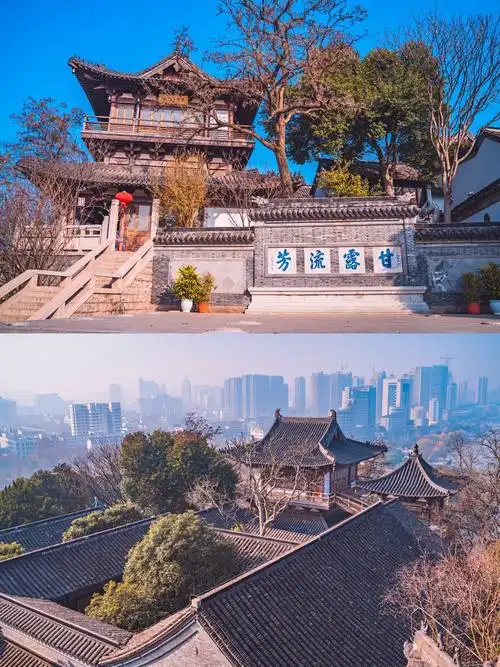 Beigu Mountain takes its name from the ancient phrase meaning "a fortress shaped by heaven itself," and for more than 1,800 years this modest limestone crag has shaped the fate of empires. While the Mongol khans, Roman legions, and Norman knights were reshaping medieval Europe, Beigu was already a frontline in the Three Kingdoms struggle (220–280 AD) between the kingdoms of Wu, Shu, and Wei. It was on these cliffs that Sun Quan built his iron-cask fortress, and where the legendary political marriage between his general Zhou Yu's strategy and Liu Bei's bride took place at Ganlu Temple—an episode later immortalized in Luo Guanzhong's 14th-century masterpiece, Romance of the Three Kingdoms, the Chinese equivalent of Europe's Arthurian cycle. The Southern Liang emperor Wu later inscribed the mountain as "The Finest Landscape Under Heaven," a verdict that has stuck for fifteen centuries.
Architecture here is layered like a compressed historical palimpsest. Ganlu Temple does not merely sit at the foot of the mountain—it cascades up its spine in the distinctive "temple-crowns-the-peak" configuration unique to Chinese Buddhist mountain sites, echoing the dramatic hilltop monasteries of Meteora in Greece or the clifftop sanctuaries of Montserrat in Spain. The Northern Song–era iron pagoda, painstakingly repaired during the Ming dynasty, is the only ancient cast-iron pagoda still standing in Jiangsu Province—a rare metalwork survivor that rivals Europe's wrought-iron weathervane traditions of the same period. The nearby Duojing (Many Sceneries) Pavilion ranks alongside Yueyang Tower and Huanghe Tower as one of the Three Great Towers of the Yangtze, a literary honor it shares with the river-cathedrals of European capitals.
Culturally, Beigu occupies a place roughly equivalent to a fusion of Runnymede (where history was sealed) and Stratford-upon-Avon (where that history became verse). It is the spiritual heartland of Three Kingdoms heritage, peppered with the tombs of Wu generals Lu Su and Taishi Ci, and was visited twice by the Southern Song warrior-poet Xin Qiji, whose celebrated lyric "South of the Town—Where Can I Find the Heroic Heart of Old?" was composed while gazing down at the same长江 waters tourists admire today. Generations of scholar-officials followed, carving poems into cliff faces until the mountainside itself became a weathered anthology. For Western readers who know Homer, Virgil, or the Song of Roland, Beigu offers the thrill of standing on terrain that inspired equally epic verse.
A visit begins conveniently from Zhenjiang Railway Station, a 15-minute taxi ride or short bus hop (routes 4, 8, or 25 to the Ganlu Temple stop). Entry costs roughly ¥36–40 (about US$5–6), with ID or passport required for tickets on-site or via WeChat. The site opens 08:00–17:00 (last entry 16:30) and rewards a leisurely two-to-three-hour circuit. The recommended route threads north gate in, down the ancient Eastern Wu Path, past the iron pagoda, through Ganlu Temple, up to Duojing Tower, along to the riverside Jiangji Pavilion, and out the north gate—a path that mimics the strategic sweep generals once used to survey the Yangtze. Free disposable shoe covers are required before ascending the wooden-floored towers to protect Ming-era planks, and non-slip footwear is wise after rain.
To truly grasp Beigu's appeal, time your visit for early morning or late afternoon, when the light slants amber across the长江 and the cliff winds carry the cool scent of river water—a sensory experience that has moved Chinese poets for a millennium and that photographs, however good, struggle to capture. Pair the climb with the lantern-lit alleys of nearby Xijin Duxiu Old Street (a ten-minute walk) or with sister peaks Jinshan and Jiaoshan, whose legendary White Snake and Han-dynasty inscriptions round out the trilogy Zhenjiang locals call the "Three Mountains of Jingkou." In an age of megacities, Beigu Mountain remains a remarkable survival: a place where a short walk carries you through bronze-age diplomacy, Tang dynasty Buddhism, Song poetry, and Ming engineering—all framed by a river that has flowed since long before Marco Polo or Ibn Battuta first heard its name.
Beigu Mountain takes its name from the ancient phrase meaning "a fortress shaped by heaven itself," and for more than 1,800 years this modest limestone crag has shaped the fate of empires. While the Mongol khans, Roman legions, and Norman knights were reshaping medieval Europe, Beigu was already a frontline in the Three Kingdoms struggle (220–280 AD) between the kingdoms of Wu, Shu, and Wei. It was on these cliffs that Sun Quan built his iron-cask fortress, and where the legendary political marriage between his general Zhou Yu's strategy and Liu Bei's bride took place at Ganlu Temple—an episode later immortalized in Luo Guanzhong's 14th-century masterpiece, Romance of the Three Kingdoms, the Chinese equivalent of Europe's Arthurian cycle. The Southern Liang emperor Wu later inscribed the mountain as "The Finest Landscape Under Heaven," a verdict that has stuck for fifteen centuries.
Architecture here is layered like a compressed historical palimpsest. Ganlu Temple does not merely sit at the foot of the mountain—it cascades up its spine in the distinctive "temple-crowns-the-peak" configuration unique to Chinese Buddhist mountain sites, echoing the dramatic hilltop monasteries of Meteora in Greece or the clifftop sanctuaries of Montserrat in Spain. The Northern Song–era iron pagoda, painstakingly repaired during the Ming dynasty, is the only ancient cast-iron pagoda still standing in Jiangsu Province—a rare metalwork survivor that rivals Europe's wrought-iron weathervane traditions of the same period. The nearby Duojing (Many Sceneries) Pavilion ranks alongside Yueyang Tower and Huanghe Tower as one of the Three Great Towers of the Yangtze, a literary honor it shares with the river-cathedrals of European capitals.
Culturally, Beigu occupies a place roughly equivalent to a fusion of Runnymede (where history was sealed) and Stratford-upon-Avon (where that history became verse). It is the spiritual heartland of Three Kingdoms heritage, peppered with the tombs of Wu generals Lu Su and Taishi Ci, and was visited twice by the Southern Song warrior-poet Xin Qiji, whose celebrated lyric "South of the Town—Where Can I Find the Heroic Heart of Old?" was composed while gazing down at the same长江 waters tourists admire today. Generations of scholar-officials followed, carving poems into cliff faces until the mountainside itself became a weathered anthology. For Western readers who know Homer, Virgil, or the Song of Roland, Beigu offers the thrill of standing on terrain that inspired equally epic verse.
A visit begins conveniently from Zhenjiang Railway Station, a 15-minute taxi ride or short bus hop (routes 4, 8, or 25 to the Ganlu Temple stop). Entry costs roughly ¥36–40 (about US$5–6), with ID or passport required for tickets on-site or via WeChat. The site opens 08:00–17:00 (last entry 16:30) and rewards a leisurely two-to-three-hour circuit. The recommended route threads north gate in, down the ancient Eastern Wu Path, past the iron pagoda, through Ganlu Temple, up to Duojing Tower, along to the riverside Jiangji Pavilion, and out the north gate—a path that mimics the strategic sweep generals once used to survey the Yangtze. Free disposable shoe covers are required before ascending the wooden-floored towers to protect Ming-era planks, and non-slip footwear is wise after rain.
To truly grasp Beigu's appeal, time your visit for early morning or late afternoon, when the light slants amber across the长江 and the cliff winds carry the cool scent of river water—a sensory experience that has moved Chinese poets for a millennium and that photographs, however good, struggle to capture. Pair the climb with the lantern-lit alleys of nearby Xijin Duxiu Old Street (a ten-minute walk) or with sister peaks Jinshan and Jiaoshan, whose legendary White Snake and Han-dynasty inscriptions round out the trilogy Zhenjiang locals call the "Three Mountains of Jingkou." In an age of megacities, Beigu Mountain remains a remarkable survival: a place where a short walk carries you through bronze-age diplomacy, Tang dynasty Buddhism, Song poetry, and Ming engineering—all framed by a river that has flowed since long before Marco Polo or Ibn Battuta first heard its name.