Jinshan Temple
⭐ 3.20
Qingyun County, Dezhou City, Shandong Province, China
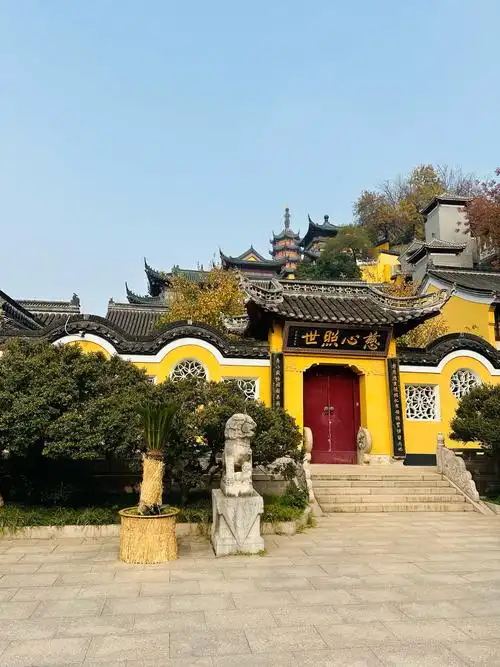 The original Jinshan Temple is believed to date back to the Sui Dynasty, reaching its golden age during the Zhenguan reign of Emperor Taizong of Tang (627–649 CE). Legend holds that the young Xuanzang (602–664 CE), whose 17-year journey to India inspired the classic novel "Journey to the West," began his monastic training on this very ground. Though mainstream historians debate the claim, the story lends the site an irresistible mystique. The temple was destroyed during the Ming Dynasty's wars and lay forgotten for centuries before its 2004 restoration. Nearby, the Fenshuiwang ancient ruins—a provincial heritage site—testify to the area's deep historical roots.
Architecturally, Jinshan follows a strict central axis reminiscent of Tang-era planning, comparable in spatial logic to Japan's Todai-ji or the great monasteries of medieval Europe. Visitors pass through the Mountain Gate, Heavenly Kings Hall, Mahavira Hall, Sutra Library, Ten-Thousand Buddha Hall, and a sweeping Nine-Dragon Screen wall. The 8.6-meter indoor bronze Shakyamuni, cast in 2008, stands as the tallest of its category nationwide, its serene face gazing down on worshippers much like the great Buddhas of Bamiyan once did. Flying eaves, intricate dougong bracket sets, and richly painted beams evoke the grandeur of 7th-century Chang'an.
Beyond its religious function, the temple offers a richly layered cultural experience. A multimedia "Underground Palace" attraction, an adjacent faux-ancient commercial street, and vegetarian buffet dining complement the spiritual core. Folk tales such as "Closing the Mountain Gate on a Donkey" bring local color to the visit, while the Sutra Library houses an impressive collection of ancient Buddhist texts. Photography is prohibited inside the halls out of respect for the sacred space.
Admission to the temple proper is free, with the Underground Palace requiring a small additional ticket of around 20 RMB. Opening hours run from 8:00 AM to 6:00 PM, and most visitors spend two to three hours exploring the grounds in a clockwise direction along the central axis. English-speaking guides are available by advance reservation, and complimentary parking is offered on site. Visitors are asked to dress modestly and maintain silence within the halls.
The temple is best visited in spring or autumn, when Shandong's climate is most comfortable. It lies roughly two hours from Jinan Yaoqiang International Airport and is accessible by intercity bus or car from Dezhou East Railway Station. Jinshan is ideal for devotees of Buddhist culture, photographers of classical architecture, and travelers seeking peaceful reflection, though those craving dramatic mountain scenery or amusement-park thrills may wish to look elsewhere.
The original Jinshan Temple is believed to date back to the Sui Dynasty, reaching its golden age during the Zhenguan reign of Emperor Taizong of Tang (627–649 CE). Legend holds that the young Xuanzang (602–664 CE), whose 17-year journey to India inspired the classic novel "Journey to the West," began his monastic training on this very ground. Though mainstream historians debate the claim, the story lends the site an irresistible mystique. The temple was destroyed during the Ming Dynasty's wars and lay forgotten for centuries before its 2004 restoration. Nearby, the Fenshuiwang ancient ruins—a provincial heritage site—testify to the area's deep historical roots.
Architecturally, Jinshan follows a strict central axis reminiscent of Tang-era planning, comparable in spatial logic to Japan's Todai-ji or the great monasteries of medieval Europe. Visitors pass through the Mountain Gate, Heavenly Kings Hall, Mahavira Hall, Sutra Library, Ten-Thousand Buddha Hall, and a sweeping Nine-Dragon Screen wall. The 8.6-meter indoor bronze Shakyamuni, cast in 2008, stands as the tallest of its category nationwide, its serene face gazing down on worshippers much like the great Buddhas of Bamiyan once did. Flying eaves, intricate dougong bracket sets, and richly painted beams evoke the grandeur of 7th-century Chang'an.
Beyond its religious function, the temple offers a richly layered cultural experience. A multimedia "Underground Palace" attraction, an adjacent faux-ancient commercial street, and vegetarian buffet dining complement the spiritual core. Folk tales such as "Closing the Mountain Gate on a Donkey" bring local color to the visit, while the Sutra Library houses an impressive collection of ancient Buddhist texts. Photography is prohibited inside the halls out of respect for the sacred space.
Admission to the temple proper is free, with the Underground Palace requiring a small additional ticket of around 20 RMB. Opening hours run from 8:00 AM to 6:00 PM, and most visitors spend two to three hours exploring the grounds in a clockwise direction along the central axis. English-speaking guides are available by advance reservation, and complimentary parking is offered on site. Visitors are asked to dress modestly and maintain silence within the halls.
The temple is best visited in spring or autumn, when Shandong's climate is most comfortable. It lies roughly two hours from Jinan Yaoqiang International Airport and is accessible by intercity bus or car from Dezhou East Railway Station. Jinshan is ideal for devotees of Buddhist culture, photographers of classical architecture, and travelers seeking peaceful reflection, though those craving dramatic mountain scenery or amusement-park thrills may wish to look elsewhere.