Zhongshan Park
⭐ 4.20
No. 3, Zhongshan Park Road, Hebei District, Tianjin, China
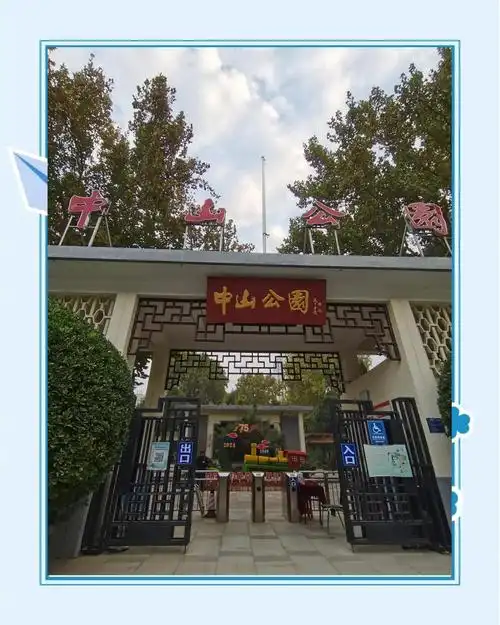 Tianjin Zhongshan Park occupies a remarkable place in Chinese urban history. Established in 1905 as the "Quanye Assembly Hall" and opened to the public in 1907, it was the first park in modern China designed, financed, and operated entirely by Chinese citizens—predating many similar civic green spaces across Asia. Just as London's Victoria Embankment Gardens and New York's Central Park reflected a 19th-century belief that public parks improved civic life, this Tianjin garden asserted national pride during an era when foreign concessions dominated the city's waterfront. Renamed in 1929 to honor Sun Yat-sen, the revolutionary founder of the Republic of China, the park preserves the very spot where he addressed crowds in 1912.
The park's roughly 20,000 square meters retain their century-old layout, offering a delightful East-meets-West composition. Western-style arched gateways and colonnaded corridors—comparable in spirit to the arcade walks of Hyde Park or the Petit Palais in Paris—blend seamlessly with traditional Chinese pavilions, stele galleries, and weathered scholar's rocks from Lake Tai. Centuries-old pear and cypress trees create a canopy of dappled shade, while the striking red-brick gatehouse evokes the rusticated charm of a Tuscan villa. The result is an intimate landscape that feels simultaneously European and Chinese, a visual signature of Tianjin's Republican-era cosmopolitanism.
More than a scenic retreat, Zhongshan Park functions as an open-air memorial to China's revolutionary spirit. Visitors will find the bronze statue of Sun Yat-sen and the base bearing his famous speech text, alongside the Martyrs' Monument commemorating seventeen young revolutionaries killed in 1912, the Wei Shiyi Ladies' Memorial, and the Two Daughters of Nanpi Zhang stele calligraphed by the noted scholar Hua Shikui. Designated a Tianjin Municipal Cultural Relic Protection Unit, a National AAAA-class scenic site, and a patriotic education base, the park's stele grove offers a sobering walk through the sacrifices that shaped modern China, similar in gravity to Paris's Père Lachaise or London's Westminster Abbey memorials.
Entry to Zhongshan Park is completely free, making it one of the most accessible cultural stops in the city. Summer hours run from 6:00 a.m. to 10:00 p.m. (last entry at 9:00 p.m.), with slightly shorter schedules in cooler months. On Mondays, certain exhibition halls close for maintenance. The most convenient access is via Metro Line 3 to Zhongshan Road Station, or by bus numbers 1, 12, 609, 619, or 641. Free wheelchairs and first-aid kits are available at the main gate, and clean public restrooms line the main pathways.
Plan to spend 1.5 to 2 hours wandering the grounds. The golden hours are before 8:30 a.m. or after 4:00 p.m., when soft light rakes across the red walls and ancient tree trunks, perfect for atmospheric photography without the crowds of morning exercisers. Begin at the red-brick gatehouse, drift through the heritage tree grove, pause at the Sino-Western architectural ensemble, and conclude at the stele display before mingling with locals at the activity lawn. Just outside the park, the 19th-century Wanghailou Catholic Church and the bustling Ancient Culture Street await, rounding out a rewarding half-day immersion into Tianjin's layered past.
Tianjin Zhongshan Park occupies a remarkable place in Chinese urban history. Established in 1905 as the "Quanye Assembly Hall" and opened to the public in 1907, it was the first park in modern China designed, financed, and operated entirely by Chinese citizens—predating many similar civic green spaces across Asia. Just as London's Victoria Embankment Gardens and New York's Central Park reflected a 19th-century belief that public parks improved civic life, this Tianjin garden asserted national pride during an era when foreign concessions dominated the city's waterfront. Renamed in 1929 to honor Sun Yat-sen, the revolutionary founder of the Republic of China, the park preserves the very spot where he addressed crowds in 1912.
The park's roughly 20,000 square meters retain their century-old layout, offering a delightful East-meets-West composition. Western-style arched gateways and colonnaded corridors—comparable in spirit to the arcade walks of Hyde Park or the Petit Palais in Paris—blend seamlessly with traditional Chinese pavilions, stele galleries, and weathered scholar's rocks from Lake Tai. Centuries-old pear and cypress trees create a canopy of dappled shade, while the striking red-brick gatehouse evokes the rusticated charm of a Tuscan villa. The result is an intimate landscape that feels simultaneously European and Chinese, a visual signature of Tianjin's Republican-era cosmopolitanism.
More than a scenic retreat, Zhongshan Park functions as an open-air memorial to China's revolutionary spirit. Visitors will find the bronze statue of Sun Yat-sen and the base bearing his famous speech text, alongside the Martyrs' Monument commemorating seventeen young revolutionaries killed in 1912, the Wei Shiyi Ladies' Memorial, and the Two Daughters of Nanpi Zhang stele calligraphed by the noted scholar Hua Shikui. Designated a Tianjin Municipal Cultural Relic Protection Unit, a National AAAA-class scenic site, and a patriotic education base, the park's stele grove offers a sobering walk through the sacrifices that shaped modern China, similar in gravity to Paris's Père Lachaise or London's Westminster Abbey memorials.
Entry to Zhongshan Park is completely free, making it one of the most accessible cultural stops in the city. Summer hours run from 6:00 a.m. to 10:00 p.m. (last entry at 9:00 p.m.), with slightly shorter schedules in cooler months. On Mondays, certain exhibition halls close for maintenance. The most convenient access is via Metro Line 3 to Zhongshan Road Station, or by bus numbers 1, 12, 609, 619, or 641. Free wheelchairs and first-aid kits are available at the main gate, and clean public restrooms line the main pathways.
Plan to spend 1.5 to 2 hours wandering the grounds. The golden hours are before 8:30 a.m. or after 4:00 p.m., when soft light rakes across the red walls and ancient tree trunks, perfect for atmospheric photography without the crowds of morning exercisers. Begin at the red-brick gatehouse, drift through the heritage tree grove, pause at the Sino-Western architectural ensemble, and conclude at the stele display before mingling with locals at the activity lawn. Just outside the park, the 19th-century Wanghailou Catholic Church and the bustling Ancient Culture Street await, rounding out a rewarding half-day immersion into Tianjin's layered past.