Shuidonggou
⭐ 4.60
Yinchuan City, Ningxia, China
 Shuidonggou is to Chinese prehistory what the caves of Lascaux are to European art—a foundational site where the deep human story was first brought to light. In 1923, French geologist Emile Licent (Sang Zhihua) unearthed stone tools, bone implements, and fossils here, launching China's study of the Old Stone Age. Evidence shows Homo sapiens hunted and gathered along the Yellow River floodplain 30,000 to 40,000 years ago. A purpose-built museum employs 270-degree panoramas and holographic projection to recreate those prehistoric scenes, while the adjacent "Original Homeland" lets visitors try their hand at fire-drilling and flint-knapping. Nearby stands the restored Zhang San Inn, where Licent and his Chinese counterparts once lodged and forged cross-border scientific friendships.
The Camouflage Soldier Caves (Cangbing Dong) constitute the best-preserved three-dimensional military defense system in China, a subterranean labyrinth of armories, council chambers, prison cells, and lethal trapdoors carved into the loess. Comparable to France's Maginot Line or Vietnam's Cu Chi Tunnels, these Ming-era fortifications reveal how frontier garrisons survived behind enemy lines. Linked to the Red Mountain Fortress section of the Ming Great Wall, the site straddles the Ningxia-Inner Mongolia border. From the viewing platform, visitors can literally stand one foot in each province, gazing north toward the Mu Us Desert and south to the wetlands below.
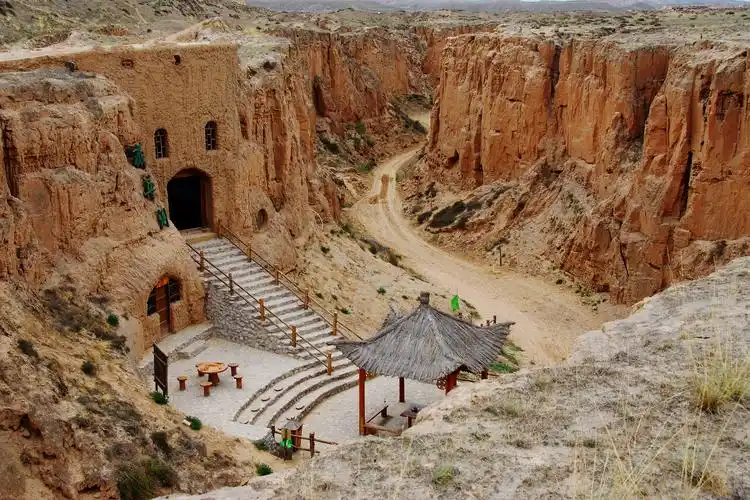
Landscape is equally compelling. The Reed Valley, Red Mountain Lake, and the so-called Grand Canyon display classic yardang formations—wind-eroded ridges of reddish clay often compared to Turkey's Cappadocia or Death Valley's badlands. A boat cruise through Red Mountain Lake frames the crumbling Great Wall beside sculpted desert cliffs, a tableau marrying martial grit with lyrical beauty. For spectacle, the open-air show "Song of the Northern Frontier" unleashes scores of mounted Mongolian riders performing equestrian stunts against the wall, an adrenaline-charged homage to centuries of steppe warfare.
Plan five to seven hours for the full circuit. Purchase the all-inclusive ticket covering transport, cave entry, and the show for best value. The site opens 08:00–18:00; enter via the South Gate and exit the East Gate to follow the one-way loop and save energy. From Yinchuan Hedong Airport, the drive is only 11 km. Inside the caves, follow your guide closely—the branching tunnels are easy to lose your way in. Pack a sun hat, sunglasses, and high-SPF sunscreen for the arid Ningxia summer, and bring a light jacket for the chilly cave interiors.
Shuidonggou rewards travelers seeking layers: the paleontological gravitas of Cro-Magnon-era Europe, the masonry ingenuity of Rome's Hadrian's Wall, the silent drama of lunar-like desert terrain, and a living frontier culture where Han Chinese, Mongol, and Hui Muslim worlds have long intersected. Few places compress so much of China's prehistory, martial past, and wild geography into a single half-day excursion. It is, quite simply, an essential stop in any Yinchuan itinerary.
Shuidonggou is to Chinese prehistory what the caves of Lascaux are to European art—a foundational site where the deep human story was first brought to light. In 1923, French geologist Emile Licent (Sang Zhihua) unearthed stone tools, bone implements, and fossils here, launching China's study of the Old Stone Age. Evidence shows Homo sapiens hunted and gathered along the Yellow River floodplain 30,000 to 40,000 years ago. A purpose-built museum employs 270-degree panoramas and holographic projection to recreate those prehistoric scenes, while the adjacent "Original Homeland" lets visitors try their hand at fire-drilling and flint-knapping. Nearby stands the restored Zhang San Inn, where Licent and his Chinese counterparts once lodged and forged cross-border scientific friendships.
The Camouflage Soldier Caves (Cangbing Dong) constitute the best-preserved three-dimensional military defense system in China, a subterranean labyrinth of armories, council chambers, prison cells, and lethal trapdoors carved into the loess. Comparable to France's Maginot Line or Vietnam's Cu Chi Tunnels, these Ming-era fortifications reveal how frontier garrisons survived behind enemy lines. Linked to the Red Mountain Fortress section of the Ming Great Wall, the site straddles the Ningxia-Inner Mongolia border. From the viewing platform, visitors can literally stand one foot in each province, gazing north toward the Mu Us Desert and south to the wetlands below.
Landscape is equally compelling. The Reed Valley, Red Mountain Lake, and the so-called Grand Canyon display classic yardang formations—wind-eroded ridges of reddish clay often compared to Turkey's Cappadocia or Death Valley's badlands. A boat cruise through Red Mountain Lake frames the crumbling Great Wall beside sculpted desert cliffs, a tableau marrying martial grit with lyrical beauty. For spectacle, the open-air show "Song of the Northern Frontier" unleashes scores of mounted Mongolian riders performing equestrian stunts against the wall, an adrenaline-charged homage to centuries of steppe warfare.
Plan five to seven hours for the full circuit. Purchase the all-inclusive ticket covering transport, cave entry, and the show for best value. The site opens 08:00–18:00; enter via the South Gate and exit the East Gate to follow the one-way loop and save energy. From Yinchuan Hedong Airport, the drive is only 11 km. Inside the caves, follow your guide closely—the branching tunnels are easy to lose your way in. Pack a sun hat, sunglasses, and high-SPF sunscreen for the arid Ningxia summer, and bring a light jacket for the chilly cave interiors.
Shuidonggou rewards travelers seeking layers: the paleontological gravitas of Cro-Magnon-era Europe, the masonry ingenuity of Rome's Hadrian's Wall, the silent drama of lunar-like desert terrain, and a living frontier culture where Han Chinese, Mongol, and Hui Muslim worlds have long intersected. Few places compress so much of China's prehistory, martial past, and wild geography into a single half-day excursion. It is, quite simply, an essential stop in any Yinchuan itinerary.