Ningxia Museum
⭐ 4.60
Yinchuan City, Ningxia, China
 Ningxia sits at the geographic crossroads where Mongolian steppe meets Tibetan Plateau and Yellow River plains—a meeting point shaping trade for millennia. The province's recorded history stretches back roughly 30,000 years to the Shuidonggou Paleolithic site, one of China's most important early human fossil localities. Successive waves of nomadic peoples—Xiongnu, Sogdian merchants, Tanguts—transformed the region into a Silk Road artery as vital as medieval Venice's trade routes. By the 11th century, the Tangut Western Xia (1038–1227) had built an empire whose written script, Buddhist art, and legal codes rivaled Song China's sophistication, comparable in scale to the contemporary Holy Roman Empire. Their disappearance under Genghis Khan's armies makes their material legacy exceptionally precious.
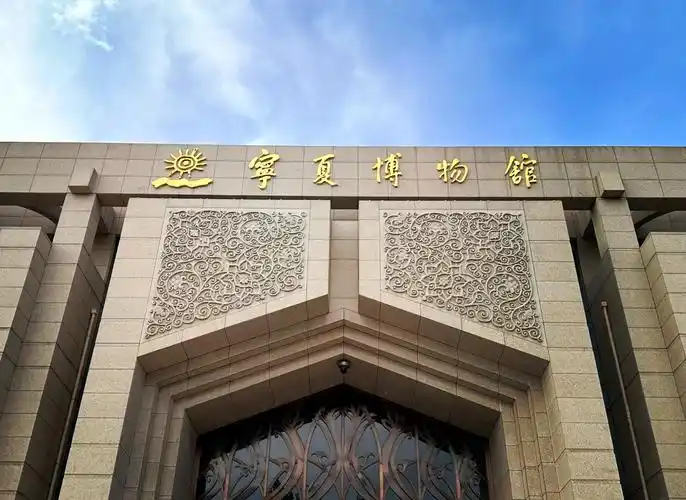
Opened in 2008 and winner of China's prestigious Luban Prize for construction, the museum building draws its bold, monolithic form from the silhouette of the Helan Mountains and the flowing curves of the Yellow River. The four-story structure rises around a central atrium, with exterior reliefs subtly embedding motifs drawn from the museum's own collection—an architectural echo of how the institution interprets the land it celebrates. Standing at the eastern edge of Yinchuan's People's Square, it functions as both a civic anchor and a modern counterpart to the ancient frontier watchtowers. The result feels closer to a contemporary European cultural center—like Madrid's Reina Sofía—than a traditional Chinese museum.
Among the nearly 2,000 Grade-One relics, three "must-see" treasures anchor the museum's reputation. The Western Xia Gilt Bronze Bull, weighing 188 kilograms, demonstrates the lost-wax casting techniques of Tangut craftsmen at an engineering level comparable to Italian Renaissance masterworks. The Tang Dynasty Whirling Dancer Stone Tomb Gate captures a Sogdian musician mid-pirouette—frozen evidence of Central Asian performance traditions flowing eastward along the Silk Road. Perhaps most precious is the Lishi Zhiwen Pedestal, the only known Western Xia stone carving bearing both Tangut and Chinese artisan names, offering scholars a rare direct link between makers and dynasty.
Four permanent galleries organize the collection thematically. "Sky of Enduring Color," the chronological spine, sweeps from Shuidonggou flint tools through Bronze Age nomadic cultures, Han frontier garrisons, Tang Silk Road cosmopolitanism, Western Xia imperial glory, and Yuan-Qing administration—a sweep as comprehensive as the British Museum's world galleries but regionally focused. "Carved in Stone" dedicates itself to Helan Mountain petroglyphs, with hunting scenes and sun worship dating back 3,000 years—often likened to a prehistoric Lascaux of nomadic consciousness. "Red Flags Unfurled" documents Ningxia's revolutionary 20th-century history, while "The Yellow River Enriches Ningxia" celebrates Hui Islamic traditions, embroidery, and intangible cultural heritage.
Admission is free but advance booking is mandatory: reserve 1–3 days ahead through the official WeChat account using a passport or ID number to receive an entry QR code. Opening hours are Tuesday through Sunday, 9:00–17:00, extended to 18:00 in summer; closed Mondays. Allow 2.5–3 hours for a thorough visit. Free guided tours and electronic audio guides are available—inquire at the information desk immediately upon arrival. The recommended route follows rock art → general history → folk customs, building knowledge progressively. Flash photography, tripods, food, and loud conversations are prohibited; backpacks must be checked at the entrance. Free luggage storage, wheelchair access, and drinking water are provided throughout.
For travelers interested in Silk Road history, religious syncretism, or cultures erased by conquest, this museum fills a gap that few Western guidebooks address. Pair it with a day trip to the Western Xia Imperial Tombs, some 30 kilometers west of Yinchuan—a sprawling necropolis where nine Tangut emperors and 250 subsidiary tombs rest beneath the Helan foothills. Visiting the museum first provides crucial context: you will recognize tomb guardian sculptures, understand stelae inscriptions, and grasp the ambitions of an empire that issued its own currency and translated Buddhist sutras from Tibetan before vanishing. Together, the two sites form one of China's most underrated historical pairings.
Ningxia sits at the geographic crossroads where Mongolian steppe meets Tibetan Plateau and Yellow River plains—a meeting point shaping trade for millennia. The province's recorded history stretches back roughly 30,000 years to the Shuidonggou Paleolithic site, one of China's most important early human fossil localities. Successive waves of nomadic peoples—Xiongnu, Sogdian merchants, Tanguts—transformed the region into a Silk Road artery as vital as medieval Venice's trade routes. By the 11th century, the Tangut Western Xia (1038–1227) had built an empire whose written script, Buddhist art, and legal codes rivaled Song China's sophistication, comparable in scale to the contemporary Holy Roman Empire. Their disappearance under Genghis Khan's armies makes their material legacy exceptionally precious.
Opened in 2008 and winner of China's prestigious Luban Prize for construction, the museum building draws its bold, monolithic form from the silhouette of the Helan Mountains and the flowing curves of the Yellow River. The four-story structure rises around a central atrium, with exterior reliefs subtly embedding motifs drawn from the museum's own collection—an architectural echo of how the institution interprets the land it celebrates. Standing at the eastern edge of Yinchuan's People's Square, it functions as both a civic anchor and a modern counterpart to the ancient frontier watchtowers. The result feels closer to a contemporary European cultural center—like Madrid's Reina Sofía—than a traditional Chinese museum.
Among the nearly 2,000 Grade-One relics, three "must-see" treasures anchor the museum's reputation. The Western Xia Gilt Bronze Bull, weighing 188 kilograms, demonstrates the lost-wax casting techniques of Tangut craftsmen at an engineering level comparable to Italian Renaissance masterworks. The Tang Dynasty Whirling Dancer Stone Tomb Gate captures a Sogdian musician mid-pirouette—frozen evidence of Central Asian performance traditions flowing eastward along the Silk Road. Perhaps most precious is the Lishi Zhiwen Pedestal, the only known Western Xia stone carving bearing both Tangut and Chinese artisan names, offering scholars a rare direct link between makers and dynasty.
Four permanent galleries organize the collection thematically. "Sky of Enduring Color," the chronological spine, sweeps from Shuidonggou flint tools through Bronze Age nomadic cultures, Han frontier garrisons, Tang Silk Road cosmopolitanism, Western Xia imperial glory, and Yuan-Qing administration—a sweep as comprehensive as the British Museum's world galleries but regionally focused. "Carved in Stone" dedicates itself to Helan Mountain petroglyphs, with hunting scenes and sun worship dating back 3,000 years—often likened to a prehistoric Lascaux of nomadic consciousness. "Red Flags Unfurled" documents Ningxia's revolutionary 20th-century history, while "The Yellow River Enriches Ningxia" celebrates Hui Islamic traditions, embroidery, and intangible cultural heritage.
Admission is free but advance booking is mandatory: reserve 1–3 days ahead through the official WeChat account using a passport or ID number to receive an entry QR code. Opening hours are Tuesday through Sunday, 9:00–17:00, extended to 18:00 in summer; closed Mondays. Allow 2.5–3 hours for a thorough visit. Free guided tours and electronic audio guides are available—inquire at the information desk immediately upon arrival. The recommended route follows rock art → general history → folk customs, building knowledge progressively. Flash photography, tripods, food, and loud conversations are prohibited; backpacks must be checked at the entrance. Free luggage storage, wheelchair access, and drinking water are provided throughout.
For travelers interested in Silk Road history, religious syncretism, or cultures erased by conquest, this museum fills a gap that few Western guidebooks address. Pair it with a day trip to the Western Xia Imperial Tombs, some 30 kilometers west of Yinchuan—a sprawling necropolis where nine Tangut emperors and 250 subsidiary tombs rest beneath the Helan foothills. Visiting the museum first provides crucial context: you will recognize tomb guardian sculptures, understand stelae inscriptions, and grasp the ambitions of an empire that issued its own currency and translated Buddhist sutras from Tibetan before vanishing. Together, the two sites form one of China's most underrated historical pairings.