Chengtian Pagoda
⭐ 3.00
Chengtian Pagoda, Xingqing District, Yinchuan City, Ningxia Hui Autonomous Region, China
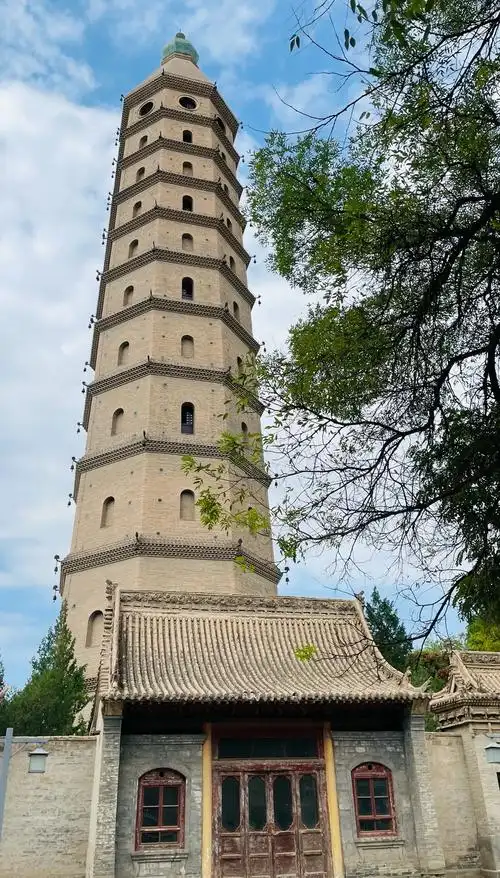 Constructed in 1050 CE during the reign of Western Xia emperor Li Yuanhao, the pagoda predates the Norman conquests of England by only three decades and predates the founding of the Mongol Empire by more than a century. The Western Xia, or Tangut, kingdom ruled much of what is now northwestern China and Inner Mongolia, building a sophisticated Buddhist civilization with its own script and distinctive art style before being utterly destroyed by Genghis Khan in 1227. The pagoda thus stands as a rare physical survivor of a lost empire, much as certain Romanesque towers across Europe preserve glimpses of vanished medieval worlds.
Standing at 64.5 meters, the tower rivals many European bell towers in scale—a brick-built contemporary of Pisa's famous leaning campanile, though far better balanced. Its octagonal plan supports eleven tiered eaves, each corner hung with iron bells that chime musically in the desert breeze. Inside, a wooden spiral staircase winds upward through alternating window placements on odd and even floors, a clever design that balances natural lighting with structural strength. At the summit, a circular window frames panoramic vistas over Yinchuan and toward the Yellow River.
The surrounding Chengtian Temple was originally a royal monastery, distinguished by an unusual eastward-facing gate that breaks with the Chinese architectural tradition of southward orientation—a small but telling detail that reflects the Western Xia's eclectic religious culture, which freely blended Buddhism with indigenous Tangut beliefs and influences from Tibet and Central Asia. Today the temple compound forms a traditional four-courtyard layout containing halls such as the Five Buddhas Hall and the Reclining Buddha Hall. Centuries-old scholar trees shade the courtyards, creating an atmosphere redolent of imperial times.
Visitors should budget roughly 1 to 1.5 hours. Entrance to the temple grounds costs around 10 yuan, with an additional 20 to 35 yuan to climb the pagoda. Opening hours typically run 8:30 to 17:30 in summer and 9:00 to 17:00 in winter, though the site may close on Mondays and occasionally restricts entry during peak periods—checking the official notice before visiting is wise. The pagoda is located at 76 Jinning South Street in the Xingqing District.
Practical advice: the interior staircase is narrow and steep, so visitors with mobility concerns, young children, or weak knees should consider their limits before climbing. Sturdy flat shoes with good grip are essential. Late afternoon offers softer photographic light and the most atmospheric bell sounds. Public buses 17, 25, 32, 33, and 501 stop at West Pagoda North, and given the limited parking in the old town's narrow lanes, public transport is strongly recommended over driving.
This is a must-see for anyone curious about the Silk Road's lesser-known kingdoms. Where most travelers flock to China's great pagodas at Xi'an or Datong, the Chengtian Temple Pagoda offers a quieter, more contemplative encounter with a forgotten dynasty—standing as a stoic sentinel over Yinchuan and a vivid reminder that medieval China was far more diverse, multilingual, and culturally rich than commonly imagined.
Constructed in 1050 CE during the reign of Western Xia emperor Li Yuanhao, the pagoda predates the Norman conquests of England by only three decades and predates the founding of the Mongol Empire by more than a century. The Western Xia, or Tangut, kingdom ruled much of what is now northwestern China and Inner Mongolia, building a sophisticated Buddhist civilization with its own script and distinctive art style before being utterly destroyed by Genghis Khan in 1227. The pagoda thus stands as a rare physical survivor of a lost empire, much as certain Romanesque towers across Europe preserve glimpses of vanished medieval worlds.
Standing at 64.5 meters, the tower rivals many European bell towers in scale—a brick-built contemporary of Pisa's famous leaning campanile, though far better balanced. Its octagonal plan supports eleven tiered eaves, each corner hung with iron bells that chime musically in the desert breeze. Inside, a wooden spiral staircase winds upward through alternating window placements on odd and even floors, a clever design that balances natural lighting with structural strength. At the summit, a circular window frames panoramic vistas over Yinchuan and toward the Yellow River.
The surrounding Chengtian Temple was originally a royal monastery, distinguished by an unusual eastward-facing gate that breaks with the Chinese architectural tradition of southward orientation—a small but telling detail that reflects the Western Xia's eclectic religious culture, which freely blended Buddhism with indigenous Tangut beliefs and influences from Tibet and Central Asia. Today the temple compound forms a traditional four-courtyard layout containing halls such as the Five Buddhas Hall and the Reclining Buddha Hall. Centuries-old scholar trees shade the courtyards, creating an atmosphere redolent of imperial times.
Visitors should budget roughly 1 to 1.5 hours. Entrance to the temple grounds costs around 10 yuan, with an additional 20 to 35 yuan to climb the pagoda. Opening hours typically run 8:30 to 17:30 in summer and 9:00 to 17:00 in winter, though the site may close on Mondays and occasionally restricts entry during peak periods—checking the official notice before visiting is wise. The pagoda is located at 76 Jinning South Street in the Xingqing District.
Practical advice: the interior staircase is narrow and steep, so visitors with mobility concerns, young children, or weak knees should consider their limits before climbing. Sturdy flat shoes with good grip are essential. Late afternoon offers softer photographic light and the most atmospheric bell sounds. Public buses 17, 25, 32, 33, and 501 stop at West Pagoda North, and given the limited parking in the old town's narrow lanes, public transport is strongly recommended over driving.
This is a must-see for anyone curious about the Silk Road's lesser-known kingdoms. Where most travelers flock to China's great pagodas at Xi'an or Datong, the Chengtian Temple Pagoda offers a quieter, more contemplative encounter with a forgotten dynasty—standing as a stoic sentinel over Yinchuan and a vivid reminder that medieval China was far more diverse, multilingual, and culturally rich than commonly imagined.