Western Xia Imperial Tombs
⭐ 3.60
Yinchuan City, Ningxia, China
 The Western Xia Dynasty was founded in 1038 by the Tangut chieftain Li Yuanhao, who established his capital at Xingqing, modern-day Yinchuan. For nearly two centuries, this often-overlooked kingdom stood as a peer to the Song and Liao dynasties, controlling the vital Hexi Corridor of the Silk Road. Comparable in geopolitical importance to the contemporaneous Angevin or Holy Roman empires, Western Xia commanded a sophisticated Buddhist culture and its own written script. Construction of the imperial necropolis began in the 11th century and continued across multiple reigns until the dynasty's brutal destruction by the Mongols in 1227, after which the surface structures were obliterated, leaving only the haunting earthen mounds that survive today.
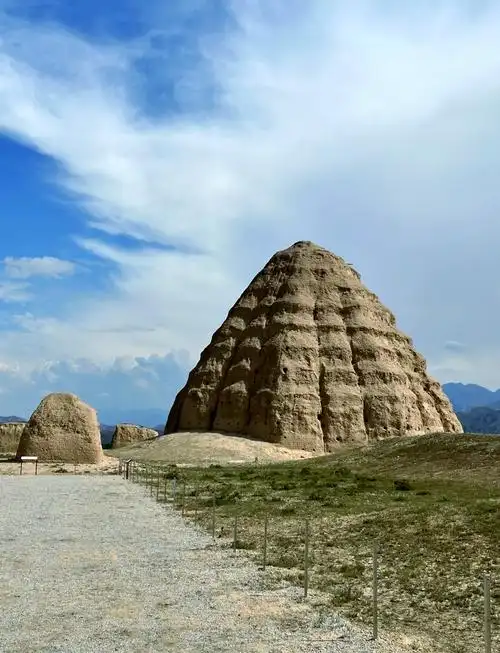
The nine imperial mausoleums are arranged along a 10-kilometer north-south axis on the slopes of the Helan Mountains, following the symmetrical axial planning of Tang and Song imperial tombs while incorporating distinctly Tangut ritual elements. Each mausoleum features an octagonal, seven-tiered dense-eave rammed-earth tower standing more than 20 meters tall—the largest such structures surviving in China. The burial chambers once yielded extraordinary artifacts including gilt-bronze oxen, stone horses, and Tangut-script steles, many of which are now displayed in the on-site museum and remain vital to scholars deciphering this lost civilization.
As the most significant material remnant of Western Xia civilization, the tombs serve as an irreplaceable archive for studying a dynasty that flourished for nearly two centuries yet remains largely unknown outside specialist circles. The 2025 UNESCO inscription acknowledges both the site's unique architectural fusion and its importance to global heritage studies. Visitors can engage with Tangut material culture, Buddhist art, and one of history's most enigmatic scripts, offering perspectives unavailable at more mainstream Chinese heritage sites like the Ming Tombs or the Qin Shi Huang Mausoleum.
The site lies in Yinchuan's Xixia District, approximately 30 to 40 kilometers west of the city center. Opening hours run from 8:00 a.m. to 5:00 p.m., extended to 6:00 p.m. in peak season. Admission is around 85 to 95 RMB per person and includes a sightseeing shuttle and a 3D film. Foreign visitors must present their original passport and are strongly advised to book English-speaking guides or multilingual audio devices in advance through official channels, as the site's deeper significance is difficult to appreciate independently.
For an optimal visit, begin at the Western Xia Museum to grasp Tangut history and script, then take the shuttle to Tomb No. 3, believed to be Li Yuanhao's Tai Mausoleum and the most impressive of the nine. Continue to Tombs No. 1 and No. 2, allowing roughly 3.5 to 4 hours for the full circuit. The unpaved gravel paths demand sun protection and plenty of water in summer. Pairing the tombs with the nearby Helan Mountain Rock Carvings creates a rewarding cultural journey spanning ancient petroglyphs through a vanished empire—far removed from the crowds of Beijing or Xi'an.
The Western Xia Dynasty was founded in 1038 by the Tangut chieftain Li Yuanhao, who established his capital at Xingqing, modern-day Yinchuan. For nearly two centuries, this often-overlooked kingdom stood as a peer to the Song and Liao dynasties, controlling the vital Hexi Corridor of the Silk Road. Comparable in geopolitical importance to the contemporaneous Angevin or Holy Roman empires, Western Xia commanded a sophisticated Buddhist culture and its own written script. Construction of the imperial necropolis began in the 11th century and continued across multiple reigns until the dynasty's brutal destruction by the Mongols in 1227, after which the surface structures were obliterated, leaving only the haunting earthen mounds that survive today.
The nine imperial mausoleums are arranged along a 10-kilometer north-south axis on the slopes of the Helan Mountains, following the symmetrical axial planning of Tang and Song imperial tombs while incorporating distinctly Tangut ritual elements. Each mausoleum features an octagonal, seven-tiered dense-eave rammed-earth tower standing more than 20 meters tall—the largest such structures surviving in China. The burial chambers once yielded extraordinary artifacts including gilt-bronze oxen, stone horses, and Tangut-script steles, many of which are now displayed in the on-site museum and remain vital to scholars deciphering this lost civilization.
As the most significant material remnant of Western Xia civilization, the tombs serve as an irreplaceable archive for studying a dynasty that flourished for nearly two centuries yet remains largely unknown outside specialist circles. The 2025 UNESCO inscription acknowledges both the site's unique architectural fusion and its importance to global heritage studies. Visitors can engage with Tangut material culture, Buddhist art, and one of history's most enigmatic scripts, offering perspectives unavailable at more mainstream Chinese heritage sites like the Ming Tombs or the Qin Shi Huang Mausoleum.
The site lies in Yinchuan's Xixia District, approximately 30 to 40 kilometers west of the city center. Opening hours run from 8:00 a.m. to 5:00 p.m., extended to 6:00 p.m. in peak season. Admission is around 85 to 95 RMB per person and includes a sightseeing shuttle and a 3D film. Foreign visitors must present their original passport and are strongly advised to book English-speaking guides or multilingual audio devices in advance through official channels, as the site's deeper significance is difficult to appreciate independently.
For an optimal visit, begin at the Western Xia Museum to grasp Tangut history and script, then take the shuttle to Tomb No. 3, believed to be Li Yuanhao's Tai Mausoleum and the most impressive of the nine. Continue to Tombs No. 1 and No. 2, allowing roughly 3.5 to 4 hours for the full circuit. The unpaved gravel paths demand sun protection and plenty of water in summer. Pairing the tombs with the nearby Helan Mountain Rock Carvings creates a rewarding cultural journey spanning ancient petroglyphs through a vanished empire—far removed from the crowds of Beijing or Xi'an.