Huangjueping Graffiti Street
⭐ 4.00
Huangjueping Street, Jiulongpo District, Chongqing, China
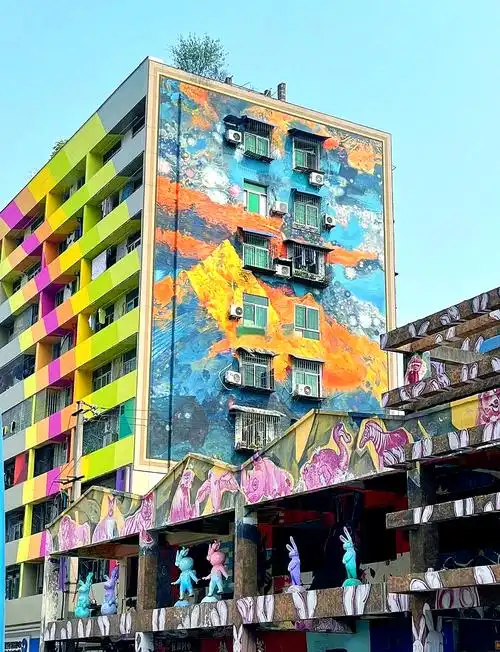 Huangjueping Graffiti Street emerged in 2007 when the Jiulongpo District government partnered with Sichuan Fine Arts Institute to reimagine a tired industrial neighborhood. Following a major upgrade completed in 2021, it stands among China's earliest large-scale public art initiatives co-created by authorities and an art academy. The project echoes international precedents like Berlin's East Side Gallery, where a remnant of the Cold War divide became a global street-art destination, and New York's 1970s subway graffiti movement that transformed urban vandalism into recognized contemporary art. Like Bilbao's Guggenheim sparking regional renewal, Huangjueping demonstrates how creative intervention can revitalize forgotten corners of a city.
The street redefines architectural surfaces as collective artwork. Across 37 buildings, approximately 50,000 square meters of facades—including walls, utility poles, and even bus shelters—display paintings by Sichuan Fine Arts Institute faculty, students, and invited international artists. Among the works are recreations of pieces by celebrated Chinese realist Luo Zhongli alongside original student creations and distinctly Chongqing motifs: stepped alleyways, Yangtze riverboats, the city's iconic cable cars crossing the skyline. The street organizes itself into three color-coded zones—red for classic viewing, yellow for emerging creativity, and blue for visitor interaction—creating a structured yet spontaneous visual journey.
What distinguishes Huangjueping is its refusal to separate art from daily life. Unlike a conventional museum where visitors observe from a distance, here murals share walls with apartment windows, noodle shops, and vegetable markets. Residents live, eat, and bargain beneath towering painted figures. This philosophy mirrors the ethos of European street-art festivals in cities like Lisbon or Berlin, yet retains a uniquely Chongqing character rooted in the area's industrial heritage. The street has become a magnet for photographers, creative entrepreneurs, and scholars studying China's evolving urban culture, offering a living laboratory of how contemporary art can breathe new energy into aging neighborhoods.
The street is completely free and open 24 hours a day, with most visitors spending one to two hours exploring. The most convenient access is via Metro Line 18 to Sichuan Fine Arts Institute Station, Exit 4, followed by a six-minute walk. Alternatively, take Line 2 to Yangjiaping, then transfer to bus 223, 233, or 244 to Huangjueping Main Street. For photographers seeking gentler light and fewer crowds, weekday mornings or early evenings are ideal. The flat, open hours mean you can experience the street bathed in golden-hour glow or illuminated dramatically against the night sky.
A visit to Huangjueping rewards travelers who crave authentic local texture alongside contemporary creativity. Combine the graffiti street with the nearby Transportation Teahouse, a century-old establishment serving traditional covered-bowl tea in an atmosphere reminiscent of old Sichuan opera houses, the 501 Art Base with its industrial loft galleries, and Tank Loft Contemporary Art Center housed in converted military warehouses. Comfortable shoes are essential—Chongqing's hilly terrain demands them—and sun protection matters since shade is limited. Affordable local specialties like pig's trotter soup, silken tofu served over rice, and dry-pot dishes make excellent fuel for this atmospheric half-day cultural ramble through one of Asia's most distinctive urban art destinations.
Huangjueping Graffiti Street emerged in 2007 when the Jiulongpo District government partnered with Sichuan Fine Arts Institute to reimagine a tired industrial neighborhood. Following a major upgrade completed in 2021, it stands among China's earliest large-scale public art initiatives co-created by authorities and an art academy. The project echoes international precedents like Berlin's East Side Gallery, where a remnant of the Cold War divide became a global street-art destination, and New York's 1970s subway graffiti movement that transformed urban vandalism into recognized contemporary art. Like Bilbao's Guggenheim sparking regional renewal, Huangjueping demonstrates how creative intervention can revitalize forgotten corners of a city.
The street redefines architectural surfaces as collective artwork. Across 37 buildings, approximately 50,000 square meters of facades—including walls, utility poles, and even bus shelters—display paintings by Sichuan Fine Arts Institute faculty, students, and invited international artists. Among the works are recreations of pieces by celebrated Chinese realist Luo Zhongli alongside original student creations and distinctly Chongqing motifs: stepped alleyways, Yangtze riverboats, the city's iconic cable cars crossing the skyline. The street organizes itself into three color-coded zones—red for classic viewing, yellow for emerging creativity, and blue for visitor interaction—creating a structured yet spontaneous visual journey.
What distinguishes Huangjueping is its refusal to separate art from daily life. Unlike a conventional museum where visitors observe from a distance, here murals share walls with apartment windows, noodle shops, and vegetable markets. Residents live, eat, and bargain beneath towering painted figures. This philosophy mirrors the ethos of European street-art festivals in cities like Lisbon or Berlin, yet retains a uniquely Chongqing character rooted in the area's industrial heritage. The street has become a magnet for photographers, creative entrepreneurs, and scholars studying China's evolving urban culture, offering a living laboratory of how contemporary art can breathe new energy into aging neighborhoods.
The street is completely free and open 24 hours a day, with most visitors spending one to two hours exploring. The most convenient access is via Metro Line 18 to Sichuan Fine Arts Institute Station, Exit 4, followed by a six-minute walk. Alternatively, take Line 2 to Yangjiaping, then transfer to bus 223, 233, or 244 to Huangjueping Main Street. For photographers seeking gentler light and fewer crowds, weekday mornings or early evenings are ideal. The flat, open hours mean you can experience the street bathed in golden-hour glow or illuminated dramatically against the night sky.
A visit to Huangjueping rewards travelers who crave authentic local texture alongside contemporary creativity. Combine the graffiti street with the nearby Transportation Teahouse, a century-old establishment serving traditional covered-bowl tea in an atmosphere reminiscent of old Sichuan opera houses, the 501 Art Base with its industrial loft galleries, and Tank Loft Contemporary Art Center housed in converted military warehouses. Comfortable shoes are essential—Chongqing's hilly terrain demands them—and sun protection matters since shade is limited. Affordable local specialties like pig's trotter soup, silken tofu served over rice, and dry-pot dishes make excellent fuel for this atmospheric half-day cultural ramble through one of Asia's most distinctive urban art destinations.