General Bai's Residence
⭐ 4.50
Shapingba District, Chongqing, China
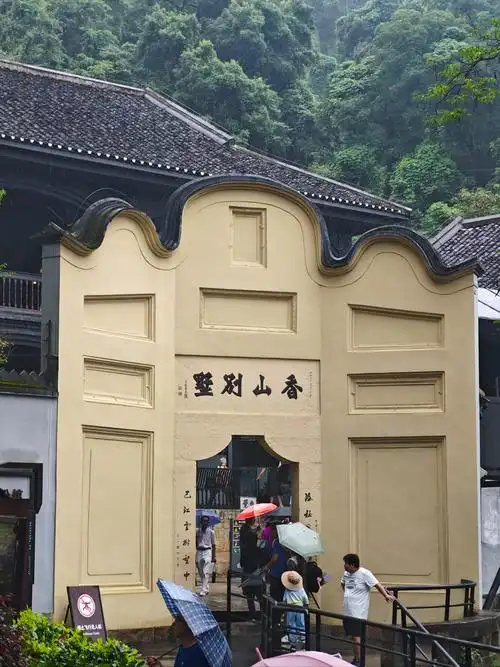 White Residence traces its grim chapters to the twilight of China's civil war, a period when ideological battlefields stretched from Shanghai's streets to Manchuria's mountains. Built in the 1920s as the private retreat of Sichuan warlord Bai Ju—who styled himself a modern-day hermit—the villa was purchased in 1939 by Dai Li, head of the Nationalist secret police, and converted into a covert detention center. Like Berlin's Stasi archives or Moscow's Lubyanka, it became a tool of state terror. Here, the Nationalists held political prisoners considered dangerous to their rule, among them General Yang Hucheng, the once-powerful Xi'an Incident negotiator, and Jiang Zhuyun (immortalized as "Sister Jiang"), whose steadfast defiance became legend.
The complex clings to the wooded hillside of Gele Mountain, its weathered buildings cascading down the slope in a deliberately disorienting layout. Visitors pass through iron-barred gates into a labyrinth of cramped cells, a damp underground dungeon, and an interrogation chamber where the original brick walls still bear scorch marks. The atmosphere recalls the chilling austerity of Eastern European political museums or the cold cells of Robben Island. A sculpted tableau of bound martyrs dominates the central courtyard, while a poignant bronze statue honors Little Carrot Song Zhenzhong, China's youngest revolutionary martyr, eternally clutching his toys in innocence.
Designated a Major National Historical Site and a national AAAA-level scenic area, White Residence anchors the Red Crag spirit—a creed of unwavering resistance born in these very prison blocks. The November 27, 1949 massacre, carried out just weeks before Communist forces liberated Chongqing, claimed the lives of dozens of revolutionaries who refused to betray their comrades. The site has become a pilgrimage destination for those seeking to understand the human cost of modern China's founding. Annual ceremonies draw veterans, students, and ordinary citizens paying respects to figures like Chen Ran, whose defiant calligraphic phrase "My People's China" remains a rallying symbol.
Admission is free, but advance booking through the official "Red Crag Online" WeChat mini-program is mandatory—simply show your passport or ID at the gate. The site opens daily from 9:00 AM to 5:00 PM (last entry 4:30 PM) and closes on Mondays except during national holidays. Allow roughly 90 minutes here, or two to three hours if you plan to walk the short trail to the companion site Zhazidong. To reach the entrance, take Metro Line 1 to Lieshimu Station, then either board bus 210 or enjoy a 15-minute uphill walk through shaded forest paths.
A guided interpreter or rented audio device is highly recommended—English commentary is limited but enriches the experience considerably. Visitors should dress modestly and maintain a respectful silence; photography is restricted in several interior chambers. Summer visitors should bring insect repellent, as the forested setting attracts mosquitoes. Beyond the somber main exhibits, the surrounding Gele Mountain Martyrs' Cemetery offers panoramic views over Chongqing and a contemplative space to absorb the day's weight. For travelers interested in twentieth-century political history, White Residence delivers an experience as moving as Dachau's memorial halls or Argentina's ESMA—essential, unforgettable, and profoundly human.
White Residence traces its grim chapters to the twilight of China's civil war, a period when ideological battlefields stretched from Shanghai's streets to Manchuria's mountains. Built in the 1920s as the private retreat of Sichuan warlord Bai Ju—who styled himself a modern-day hermit—the villa was purchased in 1939 by Dai Li, head of the Nationalist secret police, and converted into a covert detention center. Like Berlin's Stasi archives or Moscow's Lubyanka, it became a tool of state terror. Here, the Nationalists held political prisoners considered dangerous to their rule, among them General Yang Hucheng, the once-powerful Xi'an Incident negotiator, and Jiang Zhuyun (immortalized as "Sister Jiang"), whose steadfast defiance became legend.
The complex clings to the wooded hillside of Gele Mountain, its weathered buildings cascading down the slope in a deliberately disorienting layout. Visitors pass through iron-barred gates into a labyrinth of cramped cells, a damp underground dungeon, and an interrogation chamber where the original brick walls still bear scorch marks. The atmosphere recalls the chilling austerity of Eastern European political museums or the cold cells of Robben Island. A sculpted tableau of bound martyrs dominates the central courtyard, while a poignant bronze statue honors Little Carrot Song Zhenzhong, China's youngest revolutionary martyr, eternally clutching his toys in innocence.
Designated a Major National Historical Site and a national AAAA-level scenic area, White Residence anchors the Red Crag spirit—a creed of unwavering resistance born in these very prison blocks. The November 27, 1949 massacre, carried out just weeks before Communist forces liberated Chongqing, claimed the lives of dozens of revolutionaries who refused to betray their comrades. The site has become a pilgrimage destination for those seeking to understand the human cost of modern China's founding. Annual ceremonies draw veterans, students, and ordinary citizens paying respects to figures like Chen Ran, whose defiant calligraphic phrase "My People's China" remains a rallying symbol.
Admission is free, but advance booking through the official "Red Crag Online" WeChat mini-program is mandatory—simply show your passport or ID at the gate. The site opens daily from 9:00 AM to 5:00 PM (last entry 4:30 PM) and closes on Mondays except during national holidays. Allow roughly 90 minutes here, or two to three hours if you plan to walk the short trail to the companion site Zhazidong. To reach the entrance, take Metro Line 1 to Lieshimu Station, then either board bus 210 or enjoy a 15-minute uphill walk through shaded forest paths.
A guided interpreter or rented audio device is highly recommended—English commentary is limited but enriches the experience considerably. Visitors should dress modestly and maintain a respectful silence; photography is restricted in several interior chambers. Summer visitors should bring insect repellent, as the forested setting attracts mosquitoes. Beyond the somber main exhibits, the surrounding Gele Mountain Martyrs' Cemetery offers panoramic views over Chongqing and a contemplative space to absorb the day's weight. For travelers interested in twentieth-century political history, White Residence delivers an experience as moving as Dachau's memorial halls or Argentina's ESMA—essential, unforgettable, and profoundly human.