China Three Gorges Museum
⭐ 4.60
No. 236, Renmin Road, Yuzhong District, Chongqing, China
 The China Three Gorges Museum was conceived as far more than a regional showcase — it emerged directly from one of the largest cultural rescue operations in modern history, the archaeological salvage undertaken before the flooding of the Three Gorges Dam. Comparable in ambition to the UNESCO-led heritage campaigns around Egypt's Abu Simbel or the post-war rebuilding of European cathedrals, this project salvaged tens of thousands of relics from the rising Yangtze. The museum also documents Chongqing's role as China's wartime capital from 1937 to 1945, when the city endured relentless Japanese bombing raids — an ordeal often compared to the London Blitz in scale and civilian endurance.
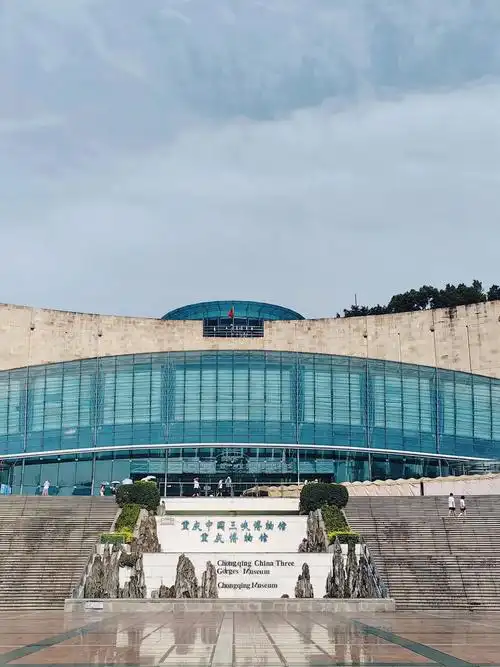
The museum's striking contemporary form, designed around a "Three Gorges Arc" concept, features a sweeping curved glass façade that bends toward the river. This bold modernist gesture creates a deliberate dialogue with the neighboring Great Hall of the People, whose Roman-revival columns and traditional Chinese roof evoke the socialist-classical architecture of the 1950s — not unlike Moscow's Seven Sisters or Berlin's Stalin-era landmarks. The interplay between the two buildings captures Chongqing itself: a city balancing ancient roots with rapid modernization, traditional Chinese aesthetics with a global architectural vocabulary.
Within its spacious, light-filled galleries, the museum curates over 280,000 artifacts, including ten designated "treasures of the house." Highlights include Wushan Man fossils — hominid remains that push back the timeline of human settlement in East Asia — and exquisite Ba-state bronzes that illuminate a Bronze Age kingdom as mysterious to outsiders as Minoan Crete. Han dynasty relics, particularly the carved stone reliefs and lively "storyteller" figurines, are often compared in spirit to the funerary art of ancient Rome: a shared fascination with depicting daily life, mythology, and the afterlife in stone.
The four permanent exhibitions each offer a distinct lens. On the ground floor, the recently refreshed Magnificent Three Gorges (2024) employs naked-eye 3D, AI interactions, and a wraparound cinema to plunge visitors into the geological drama of the gorges and the monumental engineering of the dam. Upstairs, War of Resistance Years uses a dramatic half-scenographic painting to recreate the 1939 bombing of Chongqing, while Path of the City traces the city's transformation from ancient Ba capital to modern megacity. The third-floor Ba-Shu Han Sculpture Art gallery displays stone gate towers and pictorial stones that rank among China's finest Han-era carvings.
The museum sits at 236 Renmin Road in Yuzhong District and welcomes visitors Tuesday through Sunday from 9:00 a.m. to 5:00 p.m., with last entry at 4:00 p.m.; it closes on Mondays except during public holidays. Admission is free for all visitors. Chinese citizens need ID or advance online booking, while foreign tourists can simply present their passport at the entrance — no reservation required. Plan for two to three hours to cover the four halls plus the immersive film. Audio guides and English-language guided tours are strongly recommended to unpack the deeper cultural narratives.
Begin on the ground floor with Magnificent Three Gorges for maximum visual impact, then ascend chronologically through the war and city halls before reaching the serene Han sculptures. Alternatively, start on the top floor and work downward to dodge crowds. Outside, the Great Hall of the People and Renmin Square invite a stroll, and the museum pairs naturally with nearby Jiefangbei Pedestrian Street and the cliff-hugging Hongyadong complex — a half-day cultural loop that reveals why Chongqing, often compared to San Francisco for its dramatic hillside setting, has always been a city shaped by its relationship with the Yangtze.
The China Three Gorges Museum was conceived as far more than a regional showcase — it emerged directly from one of the largest cultural rescue operations in modern history, the archaeological salvage undertaken before the flooding of the Three Gorges Dam. Comparable in ambition to the UNESCO-led heritage campaigns around Egypt's Abu Simbel or the post-war rebuilding of European cathedrals, this project salvaged tens of thousands of relics from the rising Yangtze. The museum also documents Chongqing's role as China's wartime capital from 1937 to 1945, when the city endured relentless Japanese bombing raids — an ordeal often compared to the London Blitz in scale and civilian endurance.
The museum's striking contemporary form, designed around a "Three Gorges Arc" concept, features a sweeping curved glass façade that bends toward the river. This bold modernist gesture creates a deliberate dialogue with the neighboring Great Hall of the People, whose Roman-revival columns and traditional Chinese roof evoke the socialist-classical architecture of the 1950s — not unlike Moscow's Seven Sisters or Berlin's Stalin-era landmarks. The interplay between the two buildings captures Chongqing itself: a city balancing ancient roots with rapid modernization, traditional Chinese aesthetics with a global architectural vocabulary.
Within its spacious, light-filled galleries, the museum curates over 280,000 artifacts, including ten designated "treasures of the house." Highlights include Wushan Man fossils — hominid remains that push back the timeline of human settlement in East Asia — and exquisite Ba-state bronzes that illuminate a Bronze Age kingdom as mysterious to outsiders as Minoan Crete. Han dynasty relics, particularly the carved stone reliefs and lively "storyteller" figurines, are often compared in spirit to the funerary art of ancient Rome: a shared fascination with depicting daily life, mythology, and the afterlife in stone.
The four permanent exhibitions each offer a distinct lens. On the ground floor, the recently refreshed Magnificent Three Gorges (2024) employs naked-eye 3D, AI interactions, and a wraparound cinema to plunge visitors into the geological drama of the gorges and the monumental engineering of the dam. Upstairs, War of Resistance Years uses a dramatic half-scenographic painting to recreate the 1939 bombing of Chongqing, while Path of the City traces the city's transformation from ancient Ba capital to modern megacity. The third-floor Ba-Shu Han Sculpture Art gallery displays stone gate towers and pictorial stones that rank among China's finest Han-era carvings.
The museum sits at 236 Renmin Road in Yuzhong District and welcomes visitors Tuesday through Sunday from 9:00 a.m. to 5:00 p.m., with last entry at 4:00 p.m.; it closes on Mondays except during public holidays. Admission is free for all visitors. Chinese citizens need ID or advance online booking, while foreign tourists can simply present their passport at the entrance — no reservation required. Plan for two to three hours to cover the four halls plus the immersive film. Audio guides and English-language guided tours are strongly recommended to unpack the deeper cultural narratives.
Begin on the ground floor with Magnificent Three Gorges for maximum visual impact, then ascend chronologically through the war and city halls before reaching the serene Han sculptures. Alternatively, start on the top floor and work downward to dodge crowds. Outside, the Great Hall of the People and Renmin Square invite a stroll, and the museum pairs naturally with nearby Jiefangbei Pedestrian Street and the cliff-hugging Hongyadong complex — a half-day cultural loop that reveals why Chongqing, often compared to San Francisco for its dramatic hillside setting, has always been a city shaped by its relationship with the Yangtze.