Chongqing Hongyadong Folk Customs Scenic Area

⭐ 4.20

No. 88, Jiabin Road, Yuzhong District, Chongqing, China
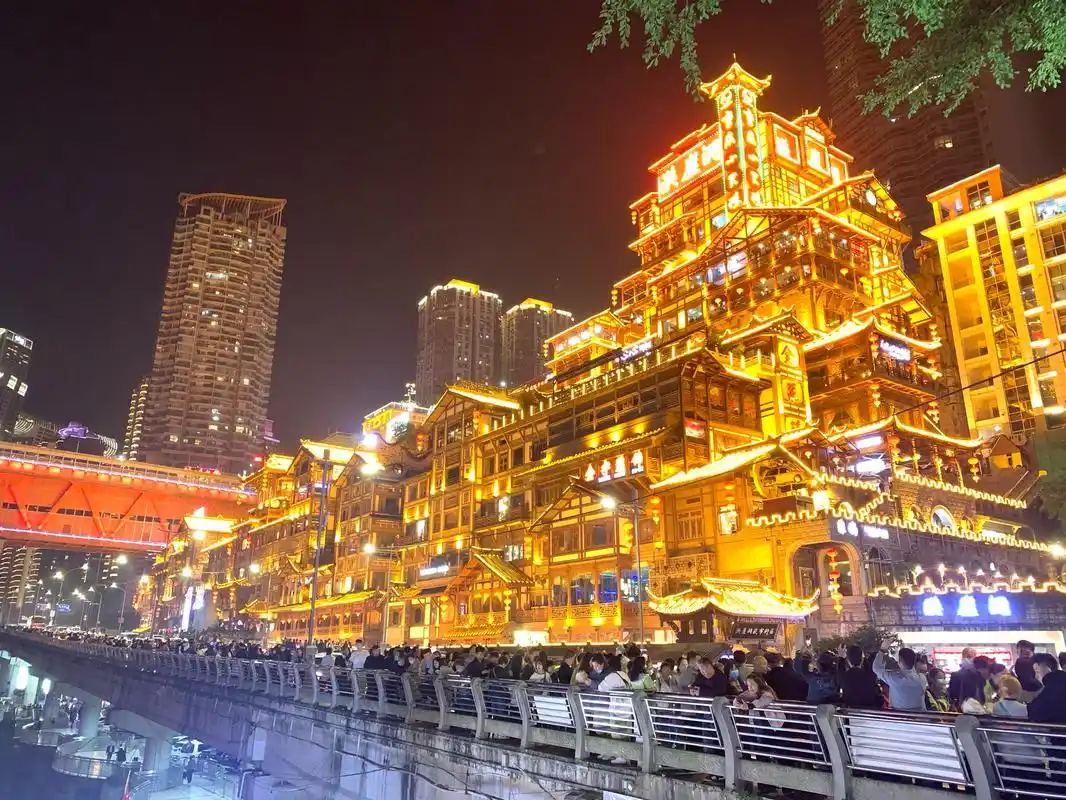
Chongqing Hongyadong Folk Customs Scenic Area
**Historical Context** Long before glass skyscrapers defined Chongqing, this stretch along the Jialing River served as a thriving commercial port for the Ba and Yu kingdoms—regional powers documented in Chinese chronicles as early as the eleventh century BCE. Traditional stilt dwellings, known as diaojiaolou, were erected directly over the water and up the cliff faces, allowing residents to adapt to the city's vertiginous terrain. Think of the multi-tiered fishing villages that once lined Norway's fjords, or the stacked whitewashed houses of Greece's Cycladic islands. Hongyadong's modern reconstruction revives this vernacular heritage using contemporary engineering, blending ancient building memory with twenty-first-century scale to honor Chongqing's identity as one of China's great river-trade capitals. **Architecture** The complex rises seventy-nine meters against the cliff face in eleven tiers of cantilevered stilt-house design, crowned with upturned eaves and intricate bracket sets reminiscent of Ming and Qing dynasty temples. Whereas Lisbon's Alfama district cascades down a single hill toward the Tagus, or Dubrovnik's Old Town steps toward the Adriatic, Hongyadong achieves something different: a fully three-dimensional urban matrix. Visitors entering at street level on the eleventh floor can look down seven stories to the riverside road below, while those entering at the base find themselves beneath the entire suspended city above. This architectural inversion embodies Chongqing's nickname as the "8D city," where GPS maps often fail and streets exist on multiple planes simultaneously. **Cultural Significance** Beyond its photogenic appeal, Hongyadong functions as a living cultural showcase. The interior houses the "Reunion 1980s" themed street, where neon signage, vintage storefronts, and period décor recreate the texture of late-twentieth-century Chongqing street life. Traditional teahouses and Sichuan opera performances, including the famous bianlian face-changing art, occupy dedicated stages throughout the complex. A bustling commercial layer runs alongside these cultural elements, featuring regional specialties like fiery Chongqing hotpot, savory small noodles, and refreshing bingfen ice jelly, alongside crafts and souvenirs. Visitors seeking more authentic fare at lower prices should wander into the surrounding alleyways or head to the nearby Jiefangbei pedestrian district. **Night Viewing Experience** The illuminated complex is Hongyadong's defining spectacle. From approximately 7:30 PM onward, amber-toned lights gradually illuminate the tiered wooden façades, contrasting dramatically against the steel-and-glass skyline rising on the opposite riverbank. The Qiansimen Bridge, a modern cable-stayed span reminiscent of Copenhagen's harbor crossings, glows in synchronized lighting across the water, while river cruise boats pass beneath, their reflections shimmering on the Jialing. Optimal viewing runs from 7:30 to 9:30 PM, with the "blue hour"—the brief period after sunset when the sky deepens to indigo—offering the most cinematic photography conditions. The eleventh-floor city balcony provides panoramic perspectives, while the riverbank near the Grand Theatre yields the iconic full-frame shot. **Practical Visit Information** Hongyadong is open daily from roughly 9:00 AM to 11:00 PM with free admission and no advance reservation required. The most efficient route is via Metro Line 1 or Line 6 to Xiaoshizi Station, Exit 9, followed by a ten-to-fifteen-minute walk; alternatively, Linjiangmen Station offers direct access to the eleventh-floor entrance. Visitors are strongly advised to begin at the top and descend—the entire route flows downhill and requires roughly 1.5 to 2 hours. Arrive by early evening to witness the sunset transition, then stay through the full lighting display. Avoid so-called "fast-track" touts and costumed mascot photo offers, which frequently lead to surprise fees; all elevators and viewing platforms are freely accessible. **Why Visit and Final Tips** Hongyadong encapsulates Chongqing's singular character in a single, walkable site: a layered vertical city where ancient building traditions meet futuristic urban ambition, framed by one of the world's great river confluences. Few landmarks globally offer such an immediate sensory collision of river, mountain, light, and history. Travelers should wear flat, non-slip shoes—the cliffside paths and stone steps become treacherous when wet—carry a compact umbrella for sudden summer storms, and bring a light jacket for breezy riverside evenings. Weekends and July through August see overwhelming crowds; visiting after 9:30 PM provides a calmer, equally luminous experience for those willing to stay late.

Traveler reviews

Hongyadong is a famous scenic area in Chongqing, built along the river, with two directions for entry and exit. If entering from the front, be aware of traffic congestion, especially during holidays when it's unusually backed up. After entering the scenic area, the first floor features a food street with various small carts, as well as some shops offering vacuum-packed souvenirs that can be mailed for free once you reach a certain spending threshold. Going inside, you can take the elevator up, where there are restaurants and some merchandise sales. Walking further up, hon...
⭐ 4 · Avery Stone Expand
Encountering the Dreamlike Lights of the Mountain City - Hongyadong Travel Notes: As dusk just brushed the skyline of Chongqing, I hurried toward Hongyadong with my navigation - having long heard that the nightscape here is the "real-life Spirited Away," I had to see it with my own eyes before I could rest. Just as I reached Jialin Road, my gaze was seized by the lights on the cliff. Eleven stories of stilted houses stacked along the mountain slope, warm yellow light spilling from wooden lattice windows, outlining the curves of upturned eaves and corners, as if all the vibrant life of old Chongqing were wrapped within the play of light and shadow. The river breeze carried moisture, mingled with the aroma of hotpot from the street. In the distance, the lights of Qiansimen Bridge suddenly lit up, a silver-blue ribbon spanning the Jialing River, contrasting cold with Hongyadong's warm glow, making the river surface sparkle like scattered diamonds. Following the crowd into Hongyadong, every floor held surprises. The observation deck on the 8th floor was packed with people holding up their phones, all tiptoeing to look down. A cruise ship on the river drew slowly past with a trail of orange lights, and the reflection of Hongyadong's lights shimmered in the water, possessing a truly fantastical, animated quality. Wandering to the folk street on the 4th floor, lanterns hung down from overhead, and in the glass cases of the handicraft shops, the koi on the Shu embroidery handkerchiefs seemed to swim out from the light. Biting into the brown sugar mochi, the exterior...
⭐ 4 · Indigo Vale Expand