Biyun Temple
⭐ 4.20
Biyun Temple, Zhongyuan District, Zhengzhou City, Henan Province, China
 **A Dynasty-Spanning Sanctuary**
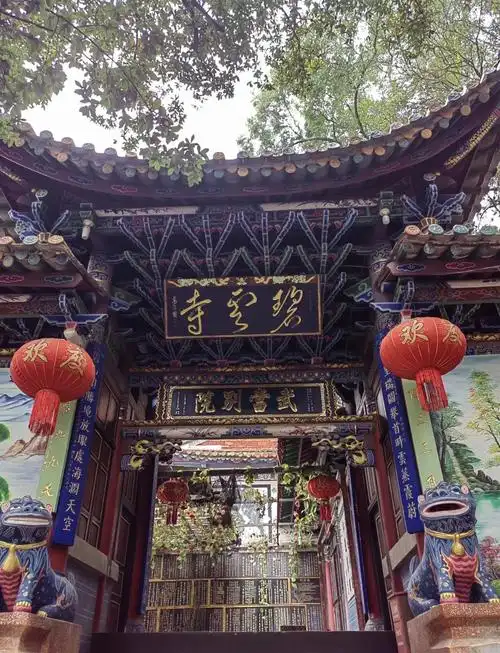
Azure Cloud Temple traces its origins to 1331, when descendants of the famed Khitan statesman Yelü Chucai established a private retreat during the Mongol-ruled Yuan Dynasty—an era contemporary with the late medieval period in Europe, when cathedrals like Cologne's were still rising. Like Europe's great monastic complexes that evolved across centuries, the temple was repeatedly rebuilt: a Ming Dynasty eunuch expanded it in the early 1500s, only for it to fall into ruin before Emperor Qianlong lavishly redeveloped it in 1746, the same year Mozart was composing symphonies in Salzburg. Qianlong incorporated Suzhou-style garden aesthetics, making the temple a centerpiece of the imperial "Three Hills Five Gardens" landscape, comparable to how French royalty shaped Versailles.
**Architectural Wonders**
The temple's undisputed masterpiece is the 34.7-meter Vajrasana Pagoda, China's largest surviving diamond-throne tower. Erected in 1747 and inspired by the Mahabodhi Temple at Bodh Gaya, India—where the Buddha attained enlightenment—its massive stone bulk is intricately carved with Buddhist sutras and deities, echoing the sculptural ambition of Gothic cathedrals or the rock-hewn churches of Lalibela. Equally remarkable is the Arhat Hall, housing 508 gilded wooden statues of enlightened disciples, each rendered with such expressive individuality that art historians compare them to the most accomplished works of the European Baroque. A Ming Dynasty bronze Maitreya and the coiled-dragon ceiling caisson of the main hall add further artistic distinction.
**A Place of Living Memory**
Beyond its Buddhist purpose, Azure Cloud Temple carries profound significance in modern Chinese history. Following the death of Sun Yat-sen in 1925, his symbolic cenotaph was temporarily housed here before transfer to the Sun Yat-sen Mausoleum in Nanjing, and a memorial hall was constructed to honor the revolutionary leader—a figure often likened to George Washington as the father of modern China. Today, pilgrims and patriots alike visit to pay respects, making the temple a rare fusion of sacred ground and secular memory. In the tranquil Water Spring Garden, the legendary "Three Generation Tree"—a 1,000-year-old ginkgo hosting other species on its trunk—embodies the layered continuity of Chinese civilization itself.
**Practical Information for Visitors**
Azure Cloud Temple sits within Xiangshan Park in Beijing's Haidian District, accessible via the Xiangshan station on the Western Suburban Metro Line, a 15-minute walk from the exit, or bus 563 to the park's east gate. Admission requires purchasing both a park entry ticket (around RMB 10) and a separate temple ticket (RMB 5-10). The temple closes on Mondays for maintenance, so plan accordingly. Advance online reservation through official Xiangshan Park channels is strongly recommended, and bring your passport for entry. Visitors should dress modestly, maintain silence within Buddha halls, and respect the no-photography zones in active worship spaces.
**Why Azure Cloud Temple Deserves Your Time**
While Beijing's Forbidden City and Temple of Heaven draw the crowds, Azure Cloud Temple offers something rarer: an unhurried encounter with layered history, from Mongol-era foundations to imperial Qing artistry to 20th-century political memory, all wrapped in a serene mountain setting. Autumn is the incomparable season, when the temple's centuries-old ginkgo trees ignite in gold and crimson, framing ancient eaves and pagoda spires in postcard perfection. Allow two to three hours along the central axis—from the gate through the Maitreya Hall, Grand Hall, Bodhisattva Hall, Sun Yat-sen Memorial, and the Water Spring Court—wearing sturdy shoes for uneven stone paths. Combine your visit with the surrounding Xiangshan Park for a full day of imperial landscape exploration.
**A Dynasty-Spanning Sanctuary**
Azure Cloud Temple traces its origins to 1331, when descendants of the famed Khitan statesman Yelü Chucai established a private retreat during the Mongol-ruled Yuan Dynasty—an era contemporary with the late medieval period in Europe, when cathedrals like Cologne's were still rising. Like Europe's great monastic complexes that evolved across centuries, the temple was repeatedly rebuilt: a Ming Dynasty eunuch expanded it in the early 1500s, only for it to fall into ruin before Emperor Qianlong lavishly redeveloped it in 1746, the same year Mozart was composing symphonies in Salzburg. Qianlong incorporated Suzhou-style garden aesthetics, making the temple a centerpiece of the imperial "Three Hills Five Gardens" landscape, comparable to how French royalty shaped Versailles.
**Architectural Wonders**
The temple's undisputed masterpiece is the 34.7-meter Vajrasana Pagoda, China's largest surviving diamond-throne tower. Erected in 1747 and inspired by the Mahabodhi Temple at Bodh Gaya, India—where the Buddha attained enlightenment—its massive stone bulk is intricately carved with Buddhist sutras and deities, echoing the sculptural ambition of Gothic cathedrals or the rock-hewn churches of Lalibela. Equally remarkable is the Arhat Hall, housing 508 gilded wooden statues of enlightened disciples, each rendered with such expressive individuality that art historians compare them to the most accomplished works of the European Baroque. A Ming Dynasty bronze Maitreya and the coiled-dragon ceiling caisson of the main hall add further artistic distinction.
**A Place of Living Memory**
Beyond its Buddhist purpose, Azure Cloud Temple carries profound significance in modern Chinese history. Following the death of Sun Yat-sen in 1925, his symbolic cenotaph was temporarily housed here before transfer to the Sun Yat-sen Mausoleum in Nanjing, and a memorial hall was constructed to honor the revolutionary leader—a figure often likened to George Washington as the father of modern China. Today, pilgrims and patriots alike visit to pay respects, making the temple a rare fusion of sacred ground and secular memory. In the tranquil Water Spring Garden, the legendary "Three Generation Tree"—a 1,000-year-old ginkgo hosting other species on its trunk—embodies the layered continuity of Chinese civilization itself.
**Practical Information for Visitors**
Azure Cloud Temple sits within Xiangshan Park in Beijing's Haidian District, accessible via the Xiangshan station on the Western Suburban Metro Line, a 15-minute walk from the exit, or bus 563 to the park's east gate. Admission requires purchasing both a park entry ticket (around RMB 10) and a separate temple ticket (RMB 5-10). The temple closes on Mondays for maintenance, so plan accordingly. Advance online reservation through official Xiangshan Park channels is strongly recommended, and bring your passport for entry. Visitors should dress modestly, maintain silence within Buddha halls, and respect the no-photography zones in active worship spaces.
**Why Azure Cloud Temple Deserves Your Time**
While Beijing's Forbidden City and Temple of Heaven draw the crowds, Azure Cloud Temple offers something rarer: an unhurried encounter with layered history, from Mongol-era foundations to imperial Qing artistry to 20th-century political memory, all wrapped in a serene mountain setting. Autumn is the incomparable season, when the temple's centuries-old ginkgo trees ignite in gold and crimson, framing ancient eaves and pagoda spires in postcard perfection. Allow two to three hours along the central axis—from the gate through the Maitreya Hall, Grand Hall, Bodhisattva Hall, Sun Yat-sen Memorial, and the Water Spring Court—wearing sturdy shoes for uneven stone paths. Combine your visit with the surrounding Xiangshan Park for a full day of imperial landscape exploration.