Yellow River Scenic Area
⭐ 3.80
Yellow River Scenic Area, Huiji District, Zhengzhou City, Henan Province, China
 **A Cradle-of-Civilisation Setting**
The site sits where the Yellow River tumbles off the final ridge of the Loess Plateau and begins its long, silt-choked journey across the North China Plain—the same lowland cradle that, like the Nile Valley or Mesopotamia, gave rise to one of humanity's earliest organised societies. Legends of the Yan and Huang ancestors, Yu the Great's flood-taming exploits, and the mythic foundations of Chinese identity all converge here. In the modern era, Mao Zedong inspected the river from these very banks, and the weathered piers of the Beijing-Hankou Railway Bridge—the first permanent crossing of the Yellow River, completed in 1906—still stand as a reminder of China's late-Qing push into industrial modernity.
**The Monumental Yan-Huang Sculpture**
Dominating the southern skyline is the colossal Yan-Huang statue, hewn from pink granite and rising 106 metres (about as tall as the Statue of Liberty on her pedestal combined). Flanked by 117 figures of historical luminaries and fronted by a marble "Nurture" group symbolising the Mother River cradling her children, it functions as both a patriotic shrine and an open-air sculpture gallery. The composition echoes the allegorical ambition of European 19th-century monuments such as Vienna's Ringstrasse ensembles or Rome's Vittoriano, but on a far grander scale.
**The "Suspended River" and Landscapes**
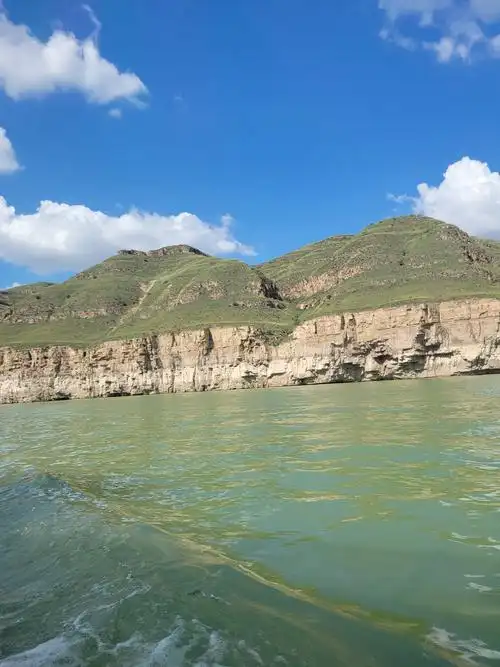
The park is the textbook vantage point for the famous "hanging river"—a stretch where decades of silt deposition have left the waterway flowing several metres above farmland and villages, protected only by levees. From the summit pavilion of Wulong Peak and the saddle of Camel Ridge, visitors can trace this surreal geography and watch the tawny current snake eastward. A lake called Xinghai adds a quieter counterpoint, and the cave-shaped Yellow River Geology Museum interprets river formation, flooding, and modern conservation efforts with clear English-friendly displays.
**Steles, Calligraphy, and Ancient Battlefields**
A forest of more than 4,000 stone steles, carved with classical and contemporary Chinese calligraphy, turns a hillside into an outdoor library of brushwork—comparable in spirit to Athens' ancient inscriptions or Florence's literary stones. Nearby stands a 10-metre, 150-tonne bronze of Yu the Great, the legendary flood controller. Remnants of the Han-Ba Er Wang Cheng battlefield, where Liu Bang and Xiang Yu fought for the empire in 204 BCE, scatter the surroundings, layering nearly three millennia of military memory onto an already mythic landscape.
**Practical Information**
The park lies roughly 20 kilometres north of central Zhengzhou, about 40 minutes by car via the Lianhuo Expressway (Huiji exit) or by tourist buses 16 and 18, and is also served by the Zhengzhou-Jiaozuo intercity rail at "Yellow River Scenic Area" station. Admission is around 48 yuan, free for children under 1.4 metres and seniors over 60; cable cars and inflatable boat rides cost extra. Opening hours run roughly 7:30–18:00 in summer and shorten in winter. Food options inside are limited, so bring water, snacks, and sun protection.
**Why It's Worth the Trip**
Few places on earth let a traveller stand on a single bluff and absorb the geological fury, mythological depth, and modern political symbolism of one of the world's great rivers at once. For Western visitors, it offers a vivid counterpoint to the Nile or the Danube—an unfiltered encounter with the landscape that shaped a quarter of humanity's history, paired with monuments engineered to overwhelm the eye and the imagination in equal measure.
**A Cradle-of-Civilisation Setting**
The site sits where the Yellow River tumbles off the final ridge of the Loess Plateau and begins its long, silt-choked journey across the North China Plain—the same lowland cradle that, like the Nile Valley or Mesopotamia, gave rise to one of humanity's earliest organised societies. Legends of the Yan and Huang ancestors, Yu the Great's flood-taming exploits, and the mythic foundations of Chinese identity all converge here. In the modern era, Mao Zedong inspected the river from these very banks, and the weathered piers of the Beijing-Hankou Railway Bridge—the first permanent crossing of the Yellow River, completed in 1906—still stand as a reminder of China's late-Qing push into industrial modernity.
**The Monumental Yan-Huang Sculpture**
Dominating the southern skyline is the colossal Yan-Huang statue, hewn from pink granite and rising 106 metres (about as tall as the Statue of Liberty on her pedestal combined). Flanked by 117 figures of historical luminaries and fronted by a marble "Nurture" group symbolising the Mother River cradling her children, it functions as both a patriotic shrine and an open-air sculpture gallery. The composition echoes the allegorical ambition of European 19th-century monuments such as Vienna's Ringstrasse ensembles or Rome's Vittoriano, but on a far grander scale.
**The "Suspended River" and Landscapes**
The park is the textbook vantage point for the famous "hanging river"—a stretch where decades of silt deposition have left the waterway flowing several metres above farmland and villages, protected only by levees. From the summit pavilion of Wulong Peak and the saddle of Camel Ridge, visitors can trace this surreal geography and watch the tawny current snake eastward. A lake called Xinghai adds a quieter counterpoint, and the cave-shaped Yellow River Geology Museum interprets river formation, flooding, and modern conservation efforts with clear English-friendly displays.
**Steles, Calligraphy, and Ancient Battlefields**
A forest of more than 4,000 stone steles, carved with classical and contemporary Chinese calligraphy, turns a hillside into an outdoor library of brushwork—comparable in spirit to Athens' ancient inscriptions or Florence's literary stones. Nearby stands a 10-metre, 150-tonne bronze of Yu the Great, the legendary flood controller. Remnants of the Han-Ba Er Wang Cheng battlefield, where Liu Bang and Xiang Yu fought for the empire in 204 BCE, scatter the surroundings, layering nearly three millennia of military memory onto an already mythic landscape.
**Practical Information**
The park lies roughly 20 kilometres north of central Zhengzhou, about 40 minutes by car via the Lianhuo Expressway (Huiji exit) or by tourist buses 16 and 18, and is also served by the Zhengzhou-Jiaozuo intercity rail at "Yellow River Scenic Area" station. Admission is around 48 yuan, free for children under 1.4 metres and seniors over 60; cable cars and inflatable boat rides cost extra. Opening hours run roughly 7:30–18:00 in summer and shorten in winter. Food options inside are limited, so bring water, snacks, and sun protection.
**Why It's Worth the Trip**
Few places on earth let a traveller stand on a single bluff and absorb the geological fury, mythological depth, and modern political symbolism of one of the world's great rivers at once. For Western visitors, it offers a vivid counterpoint to the Nile or the Danube—an unfiltered encounter with the landscape that shaped a quarter of humanity's history, paired with monuments engineered to overwhelm the eye and the imagination in equal measure.