Hometown of the Yellow Emperor
⭐ 4.50
Hometown of the Yellow Emperor, Zhengzhou City, Henan Province, China
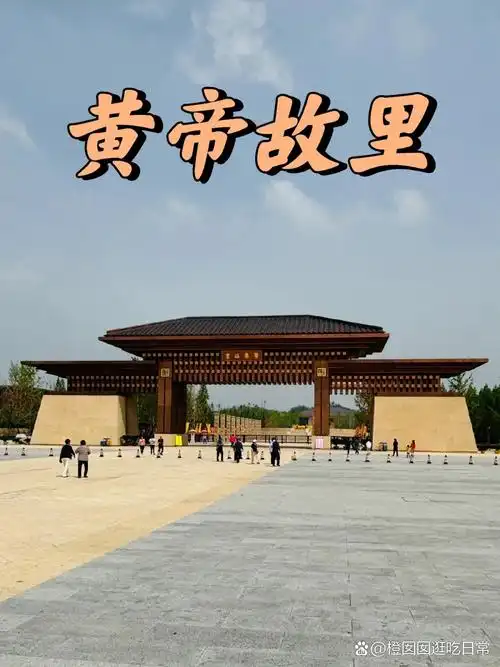 The Yellow Emperor, a semi-legendary culture-hero traditionally placed around 2600 BCE, occupies in Chinese consciousness a role roughly analogous to Romulus for Rome. Credited with inventing the compass, silk weaving, and early Chinese characters, he is venerated as the primordial ancestor of Han Chinese—indeed, "descendants of Yan and Huang" remains a common self-designation today. The shrine in Xinzheng, Henan, was first erected during the Han Dynasty and has been rebuilt many times, with current halls preserving Ming-Qing architectural conventions. For Western visitors, this is essentially China's equivalent of a national pantheon, where myth, history, and national identity converge.
The complex follows a "Heaven, Earth, and Humanity" axis running north to south. At its heart stands the Ancestral Hall, whose main chamber houses an imposing statue of the Yellow Emperor beneath the plaque "Founder of Human Civilization." Eight vivid murals narrate his legendary deeds, while flanking halls honor his consorts Leizu and Momu, credited with discovering silk. Southward, the Worship Square opens with a Ming-era restored bridge and a Sacred Flame platform symbolizing unbroken cultural transmission. The modern Memorial Hall uses earth-covered architecture reminiscent of Scandinavia's minimalist Neolithic-inspired museums, providing a striking contemporary counterpoint to the traditional halls.
The Chinese Surnames Plaza is arguably the most arresting feature. Its immense surname wall engraves over 3,000 family names—a living encyclopedia of Chinese genealogy and a pilgrimage point for overseas Chinese tracing ancestry. Adjacent rises the spectacular "First Ding of China," a nine-meter ceremonial bronze cauldron weighing twenty-four tonnes, ringed by eight smaller ding vessels. The ancient ding, a uniquely Chinese ritual object, served as both cooking vessel and symbol of sovereign authority, comparable in cultural weight to European crown jewels. Flanking the plaza, fifty-six carved totem pillars represent China's officially recognized ethnic groups—a striking testament to the nation's "pluralistic unity."
The site is open daily from 8:00 AM to 5:00 PM, and admission is free—visitors must present valid identification, with passports accepted for foreigners. Allow one to one-and-a-half hours for a complete walking tour. The most atmospheric time is weekday mornings between nine and eleven, when soft light filters through ancient jujube trees reputedly over a thousand years old and crowds are sparse. On the third day of the third lunar month, the site hosts a massive Worship Ceremony, offering extraordinary pageantry if your schedule allows. Note that on-site dining is limited, so bring water and snacks.
From central Zhengzhou, allow roughly forty minutes by taxi, or take an intercity train to Xinzheng Station and connect with Bus 101 to the Huangdi Guli stop. Comfortable walking shoes are essential, as are sun hats in summer. Pair your visit with the nearby Xinzheng Museum and Zheng-Han Ancient City ruins—the latter comprising the remains of two successive Bronze Age capitals—to deepen your understanding of early Chinese statehood. In a country where ancient landmarks often mean imperial tombs or Buddhist caves, this site offers something rarer: a chance to engage directly with the foundational myths of Chinese civilization.
The Yellow Emperor, a semi-legendary culture-hero traditionally placed around 2600 BCE, occupies in Chinese consciousness a role roughly analogous to Romulus for Rome. Credited with inventing the compass, silk weaving, and early Chinese characters, he is venerated as the primordial ancestor of Han Chinese—indeed, "descendants of Yan and Huang" remains a common self-designation today. The shrine in Xinzheng, Henan, was first erected during the Han Dynasty and has been rebuilt many times, with current halls preserving Ming-Qing architectural conventions. For Western visitors, this is essentially China's equivalent of a national pantheon, where myth, history, and national identity converge.
The complex follows a "Heaven, Earth, and Humanity" axis running north to south. At its heart stands the Ancestral Hall, whose main chamber houses an imposing statue of the Yellow Emperor beneath the plaque "Founder of Human Civilization." Eight vivid murals narrate his legendary deeds, while flanking halls honor his consorts Leizu and Momu, credited with discovering silk. Southward, the Worship Square opens with a Ming-era restored bridge and a Sacred Flame platform symbolizing unbroken cultural transmission. The modern Memorial Hall uses earth-covered architecture reminiscent of Scandinavia's minimalist Neolithic-inspired museums, providing a striking contemporary counterpoint to the traditional halls.
The Chinese Surnames Plaza is arguably the most arresting feature. Its immense surname wall engraves over 3,000 family names—a living encyclopedia of Chinese genealogy and a pilgrimage point for overseas Chinese tracing ancestry. Adjacent rises the spectacular "First Ding of China," a nine-meter ceremonial bronze cauldron weighing twenty-four tonnes, ringed by eight smaller ding vessels. The ancient ding, a uniquely Chinese ritual object, served as both cooking vessel and symbol of sovereign authority, comparable in cultural weight to European crown jewels. Flanking the plaza, fifty-six carved totem pillars represent China's officially recognized ethnic groups—a striking testament to the nation's "pluralistic unity."
The site is open daily from 8:00 AM to 5:00 PM, and admission is free—visitors must present valid identification, with passports accepted for foreigners. Allow one to one-and-a-half hours for a complete walking tour. The most atmospheric time is weekday mornings between nine and eleven, when soft light filters through ancient jujube trees reputedly over a thousand years old and crowds are sparse. On the third day of the third lunar month, the site hosts a massive Worship Ceremony, offering extraordinary pageantry if your schedule allows. Note that on-site dining is limited, so bring water and snacks.
From central Zhengzhou, allow roughly forty minutes by taxi, or take an intercity train to Xinzheng Station and connect with Bus 101 to the Huangdi Guli stop. Comfortable walking shoes are essential, as are sun hats in summer. Pair your visit with the nearby Xinzheng Museum and Zheng-Han Ancient City ruins—the latter comprising the remains of two successive Bronze Age capitals—to deepen your understanding of early Chinese statehood. In a country where ancient landmarks often mean imperial tombs or Buddhist caves, this site offers something rarer: a chance to engage directly with the foundational myths of Chinese civilization.