Erqi Tower
⭐ 3.50
Erqi Tower, Erqi District, Zhengzhou, Henan Province, China
 The February 7th Massacre of 1923 holds a place in Chinese history comparable to the Pullman Strike of 1894 or the Haymarket Affair in Chicago—moments when industrial workers stood against overwhelming military force and paid the ultimate price. When railway workers in Zhengzhou convened the first All-China Federation of Trade Unions, warlord Wu Peifu ordered troops to fire on the gathering. Martyrs like Lin Xiangqian and Shi Yang became icons of the early Chinese labor movement, their sacrifices echoing the struggles of union organizers in Britain, the United States, and across Europe during the same era. The tower, erected in 1971 on the very site of the bloodshed, was designated a national key cultural relic in 2006.
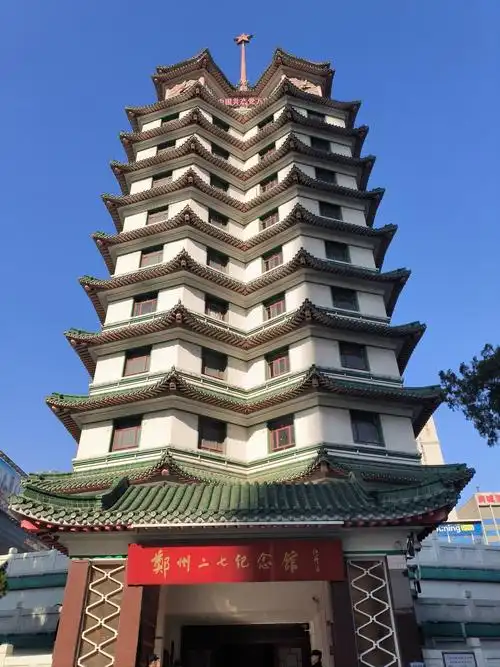
Architecturally, the tower breaks from conventional memorial design. Standing 63 meters tall across 14 stories, its floor plan consists of two interlocking pentagons—a configuration found nowhere else in China. This geometric choice symbolizes unity and resolve rather than mere aesthetics. Six clock faces crown the structure, while a melody familiar to every Chinese citizen plays each hour. For visitors familiar with European monuments like London's Big Ben or Vienna's Rathaus, the tower offers a similar civic presence but with a distinctly Chinese commemorative purpose, blending traditional silhouettes with modern monumentality.
Beyond its striking form, the tower functions as a national secondary museum and patriotic education center. Inside, exhibits of photographs, artifacts, and documentary footage trace the full arc of the 1923 strike and its place in the broader revolutionary narrative. Visitors interested in 20th-century labor history, socialist movements, or modern Chinese political development will find the displays illuminating, though signage is primarily in Chinese—translation apps are recommended for international guests.
Practical planning is straightforward. Entry is free with advance reservation using a passport or ID. The museum floors (roughly levels 1–10) can be explored in about an hour, while the observation deck rewards those who climb higher with sweeping views over the old city and surrounding commercial districts. Opening hours run Tuesday through Sunday, 9:00 to 17:00, with final entry at 16:30; the tower closes all day Monday. Free guided tours are offered during set times.
Time your visit for late afternoon to catch golden-hour light on the facade, then watch the city illuminate as dusk settles. The tower sits at the heart of Zhengzhou's busiest commercial district—just steps away, the pedestrianized Dehua Street serves up local specialties like hui noodles (a rich lamb broth with hand-pulled wheat noodles) and hu la tang, a peppery soup that's the city's morning staple. Photographers should kneel at the square's flower beds for a dramatic upward shot that frames the full tower against the night sky.
The February 7th Massacre of 1923 holds a place in Chinese history comparable to the Pullman Strike of 1894 or the Haymarket Affair in Chicago—moments when industrial workers stood against overwhelming military force and paid the ultimate price. When railway workers in Zhengzhou convened the first All-China Federation of Trade Unions, warlord Wu Peifu ordered troops to fire on the gathering. Martyrs like Lin Xiangqian and Shi Yang became icons of the early Chinese labor movement, their sacrifices echoing the struggles of union organizers in Britain, the United States, and across Europe during the same era. The tower, erected in 1971 on the very site of the bloodshed, was designated a national key cultural relic in 2006.
Architecturally, the tower breaks from conventional memorial design. Standing 63 meters tall across 14 stories, its floor plan consists of two interlocking pentagons—a configuration found nowhere else in China. This geometric choice symbolizes unity and resolve rather than mere aesthetics. Six clock faces crown the structure, while a melody familiar to every Chinese citizen plays each hour. For visitors familiar with European monuments like London's Big Ben or Vienna's Rathaus, the tower offers a similar civic presence but with a distinctly Chinese commemorative purpose, blending traditional silhouettes with modern monumentality.
Beyond its striking form, the tower functions as a national secondary museum and patriotic education center. Inside, exhibits of photographs, artifacts, and documentary footage trace the full arc of the 1923 strike and its place in the broader revolutionary narrative. Visitors interested in 20th-century labor history, socialist movements, or modern Chinese political development will find the displays illuminating, though signage is primarily in Chinese—translation apps are recommended for international guests.
Practical planning is straightforward. Entry is free with advance reservation using a passport or ID. The museum floors (roughly levels 1–10) can be explored in about an hour, while the observation deck rewards those who climb higher with sweeping views over the old city and surrounding commercial districts. Opening hours run Tuesday through Sunday, 9:00 to 17:00, with final entry at 16:30; the tower closes all day Monday. Free guided tours are offered during set times.
Time your visit for late afternoon to catch golden-hour light on the facade, then watch the city illuminate as dusk settles. The tower sits at the heart of Zhengzhou's busiest commercial district—just steps away, the pedestrianized Dehua Street serves up local specialties like hui noodles (a rich lamb broth with hand-pulled wheat noodles) and hu la tang, a peppery soup that's the city's morning staple. Photographers should kneel at the square's flower beds for a dramatic upward shot that frames the full tower against the night sky.