Handan Sports Center
⭐ 3.80
Handan Sports Center, Congtai District, Handan, Hebei, China
 Handan carries an unusually deep historical pedigree for a city of its size, having served as the capital of the Warring Kingdom of Zhao from 386 BCE until its fall to Qin in 228 BCE. It later flourished during the Han dynasty and gave Chinese language enduring idioms such as "邯郸梦" (the Handan dream) and "邯郸学步" (learning to walk in Handan). Where the new Sports Center now rises in Congtai District, ancient Zhao battlements and royal tombs lie just minutes away at the neighboring Zhaowangcheng Ruins Park, allowing travelers to trace a literal arc from Bronze Age chariot diplomacy to 21st-century stadium engineering in a single afternoon.
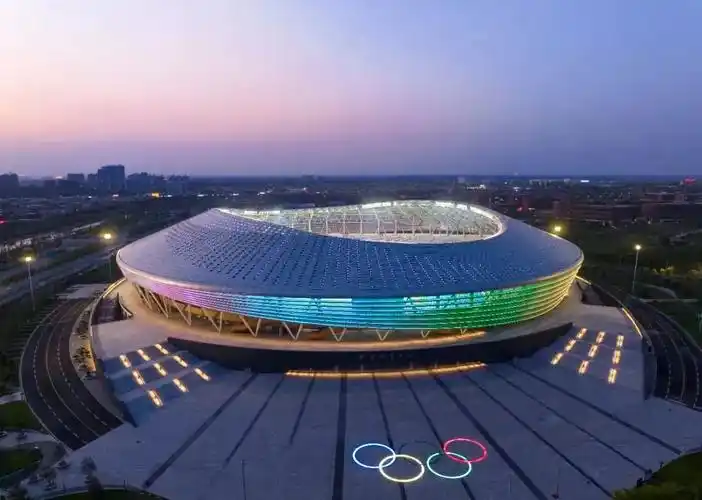
Architecturally, the venue reads as a confident statement in prefabricated construction—China's first large stadium built almost entirely from modular components, a method that compresses build times and reduces on-site waste while achieving bold spans. The 82,000-square-meter structure is crowned by an undulating canopy shaped like the interlocking double fish of the Tai Chi symbol, a flowing gesture that recalls Santiago Calatrava's organic silhouettes yet speaks in distinctly Chinese visual grammar. Inside, blue-and-white seats echo the same motion, while the "Wind-Tossed Tai Chi" lighting scheme transforms the bowl after dark into a luminous city beacon visible from across the surrounding university district.
For visitors, the cultural payoff is the encounter with Yongnian Tai Chi itself, an art whose gentle, circular movements have been practiced across the globe but whose homeland lies barely an hour from this stadium. Watching locals of all ages gather on the concourse for morning practice, or for evening square dancing and roller-skating on the outer plaza, places you inside a living folk tradition rather than a museum display. The center also serves as Handan's main stage for football league matches, national athletics meets, and touring concert productions, so event calendars occasionally transform the venue into something close in atmosphere to a smaller Olympiastadion in Berlin or a regional arena hosting Premier League fixtures.
Practical planning is straightforward but worth noting. The stadium opens daily on a segmented schedule set by the Handan Sports Bureau, with full free access each year on August 8—China's National Fitness Day—between 6:00 and 20:00; routine hours otherwise offer free early-morning jogging and low-cost track use on weekday evenings. During ticketed fixtures and concerts the bowl and surrounding roads close, so checking the official website or hotline before traveling is essential. Individual guided tours are not offered, but the exterior and concourse remain photogenic regardless of inside status, and a typical visit can be neatly built around a 15-minute photo walk of the cantilevered roof paired with one to two hours of running, walking, or simply people-watching on the terraces.
What ultimately makes the Handan Sports Center worth including on any cultural itinerary is this unlikely juxtaposition: a building engineered in prefabricated steel and high-tech composite meets the same district where Zhao princes once mustered cavalry and where peasant families later refined the meditative slow-motion form now known worldwide. Pair it with the ruins park beside it—locals call the landscaped area Lü'er Garden—and you get a satisfying day that braids modern Chinese ambition, ancient statecraft, and one of humanity's oldest continuous exercise traditions into a single, walkable experience.
Handan carries an unusually deep historical pedigree for a city of its size, having served as the capital of the Warring Kingdom of Zhao from 386 BCE until its fall to Qin in 228 BCE. It later flourished during the Han dynasty and gave Chinese language enduring idioms such as "邯郸梦" (the Handan dream) and "邯郸学步" (learning to walk in Handan). Where the new Sports Center now rises in Congtai District, ancient Zhao battlements and royal tombs lie just minutes away at the neighboring Zhaowangcheng Ruins Park, allowing travelers to trace a literal arc from Bronze Age chariot diplomacy to 21st-century stadium engineering in a single afternoon.
Architecturally, the venue reads as a confident statement in prefabricated construction—China's first large stadium built almost entirely from modular components, a method that compresses build times and reduces on-site waste while achieving bold spans. The 82,000-square-meter structure is crowned by an undulating canopy shaped like the interlocking double fish of the Tai Chi symbol, a flowing gesture that recalls Santiago Calatrava's organic silhouettes yet speaks in distinctly Chinese visual grammar. Inside, blue-and-white seats echo the same motion, while the "Wind-Tossed Tai Chi" lighting scheme transforms the bowl after dark into a luminous city beacon visible from across the surrounding university district.
For visitors, the cultural payoff is the encounter with Yongnian Tai Chi itself, an art whose gentle, circular movements have been practiced across the globe but whose homeland lies barely an hour from this stadium. Watching locals of all ages gather on the concourse for morning practice, or for evening square dancing and roller-skating on the outer plaza, places you inside a living folk tradition rather than a museum display. The center also serves as Handan's main stage for football league matches, national athletics meets, and touring concert productions, so event calendars occasionally transform the venue into something close in atmosphere to a smaller Olympiastadion in Berlin or a regional arena hosting Premier League fixtures.
Practical planning is straightforward but worth noting. The stadium opens daily on a segmented schedule set by the Handan Sports Bureau, with full free access each year on August 8—China's National Fitness Day—between 6:00 and 20:00; routine hours otherwise offer free early-morning jogging and low-cost track use on weekday evenings. During ticketed fixtures and concerts the bowl and surrounding roads close, so checking the official website or hotline before traveling is essential. Individual guided tours are not offered, but the exterior and concourse remain photogenic regardless of inside status, and a typical visit can be neatly built around a 15-minute photo walk of the cantilevered roof paired with one to two hours of running, walking, or simply people-watching on the terraces.
What ultimately makes the Handan Sports Center worth including on any cultural itinerary is this unlikely juxtaposition: a building engineered in prefabricated steel and high-tech composite meets the same district where Zhao princes once mustered cavalry and where peasant families later refined the meditative slow-motion form now known worldwide. Pair it with the ruins park beside it—locals call the landscaped area Lü'er Garden—and you get a satisfying day that braids modern Chinese ambition, ancient statecraft, and one of humanity's oldest continuous exercise traditions into a single, walkable experience.