Handan Food Street
⭐ 4.00
Handan Food Street, Congtai District, Handan City, Hebei Province, China
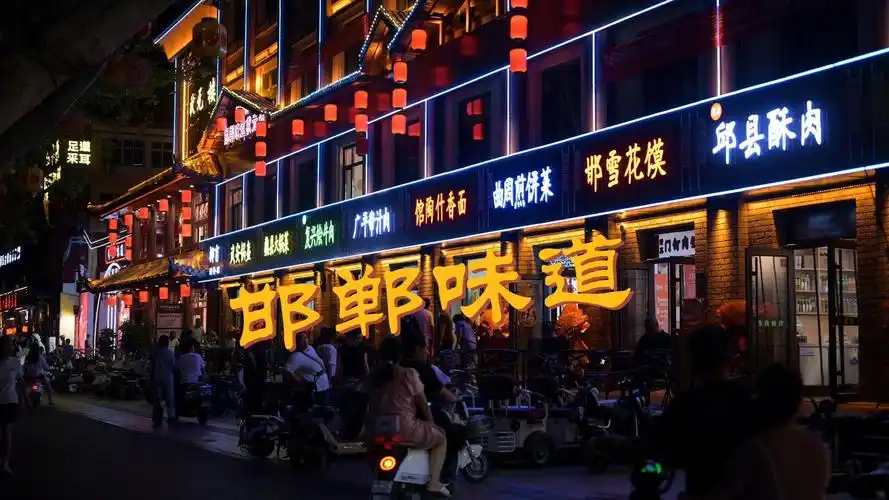 To step into Handan is to enter one of China's oldest continuously inhabited cities, predating Rome's founding by several centuries. As the royal seat of the State of Zhao from 386 to 228 BCE, Handan rivaled contemporary European powers such as the Greek city-states in political influence. The city gave birth to dozens of Chinese idioms still used daily, including the famous "learning to walk in Handan," a tale about losing one's own gait while imitating the capital's fashionable stride. Today this linguistic heritage lives on in lantern decorations, carved plaques, and themed performances scattered throughout the two districts.
"Handan Flavors," the newer of the two zones, opened in August 2025 at the corner of Guangming North Street and Exhibition Road. Its ground floor packs 24 storefronts and 26 food carts, each representing a different county of southern Hebei. Visitors can watch artisans hand-shape dumplings and press dough for stuffed flatbreads, then climb to a second-floor themed restaurant designed in traditional style with hanging idiom lanterns. The compact layout makes it a paradise for serious food hunters, who can sample more than fifty dishes in a single evening.
Handan Avenue Historical District, by contrast, stretches nearly two kilometers through the Congtai district and feels closer to wandering through an open-air museum of Chinese antiquity, much like strolling Rome's Appian Way or Athens' ancient agora. The southern section recreates late-imperial Ming and Qing streetscapes, while the northern zone evokes the martial atmosphere of the Warring States era. Along the way lie ten heritage sites, including the legend-shrouded Return Carriage Alley, the elegant Handan Academy, and the picturesque Learning to Walk Bridge spanning the ancient city's moat.
Both districts invest heavily in atmosphere. Evening brings illuminated archways, lion dances, classical Chinese music parades, and digital projection shows that transform the historic facades into glowing backdrops. The most photographed spot, Zhaodu Que Bridge, frames the ancient stonework against neon reflections, a striking juxtaposition that draws photographers and influencers alike. Multilingual audio guides, foreign card acceptance, and currency exchange services cater to international guests, while Chinese-style costume rental shops let visitors dress as scholars or nobles for the perfect souvenir photo.
Practical visits are refreshingly straightforward. Both zones are free to enter and served by buses 1, 3, 17, and 66, with taxi or rideshare recommended over driving. Parking is available at the Handan Flavors underground garage for 5 yuan per hour or at the nearby Xinshiji Shopping Center. Budget around 30 to 50 yuan for street snacks and 60 to 100 yuan for a sit-down meal. Note that Handan cuisine leans salty and relies heavily on wheat-based staples with generous portions of pork and lamb, so travelers with dietary restrictions should inform vendors in advance. Arriving after 5 p.m. guarantees the best lighting and liveliest crowds.
To step into Handan is to enter one of China's oldest continuously inhabited cities, predating Rome's founding by several centuries. As the royal seat of the State of Zhao from 386 to 228 BCE, Handan rivaled contemporary European powers such as the Greek city-states in political influence. The city gave birth to dozens of Chinese idioms still used daily, including the famous "learning to walk in Handan," a tale about losing one's own gait while imitating the capital's fashionable stride. Today this linguistic heritage lives on in lantern decorations, carved plaques, and themed performances scattered throughout the two districts.
"Handan Flavors," the newer of the two zones, opened in August 2025 at the corner of Guangming North Street and Exhibition Road. Its ground floor packs 24 storefronts and 26 food carts, each representing a different county of southern Hebei. Visitors can watch artisans hand-shape dumplings and press dough for stuffed flatbreads, then climb to a second-floor themed restaurant designed in traditional style with hanging idiom lanterns. The compact layout makes it a paradise for serious food hunters, who can sample more than fifty dishes in a single evening.
Handan Avenue Historical District, by contrast, stretches nearly two kilometers through the Congtai district and feels closer to wandering through an open-air museum of Chinese antiquity, much like strolling Rome's Appian Way or Athens' ancient agora. The southern section recreates late-imperial Ming and Qing streetscapes, while the northern zone evokes the martial atmosphere of the Warring States era. Along the way lie ten heritage sites, including the legend-shrouded Return Carriage Alley, the elegant Handan Academy, and the picturesque Learning to Walk Bridge spanning the ancient city's moat.
Both districts invest heavily in atmosphere. Evening brings illuminated archways, lion dances, classical Chinese music parades, and digital projection shows that transform the historic facades into glowing backdrops. The most photographed spot, Zhaodu Que Bridge, frames the ancient stonework against neon reflections, a striking juxtaposition that draws photographers and influencers alike. Multilingual audio guides, foreign card acceptance, and currency exchange services cater to international guests, while Chinese-style costume rental shops let visitors dress as scholars or nobles for the perfect souvenir photo.
Practical visits are refreshingly straightforward. Both zones are free to enter and served by buses 1, 3, 17, and 66, with taxi or rideshare recommended over driving. Parking is available at the Handan Flavors underground garage for 5 yuan per hour or at the nearby Xinshiji Shopping Center. Budget around 30 to 50 yuan for street snacks and 60 to 100 yuan for a sit-down meal. Note that Handan cuisine leans salty and relies heavily on wheat-based staples with generous portions of pork and lamb, so travelers with dietary restrictions should inform vendors in advance. Arriving after 5 p.m. guarantees the best lighting and liveliest crowds.