Taihang Mountain Grand Canyon
⭐ 4.20
Taihang Mountain Grand Canyon, Wu'an, Handan, Hebei, China
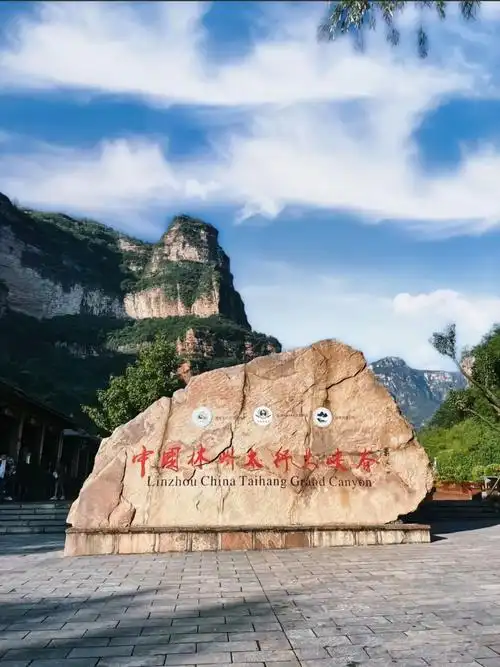 **A Mountain Frontier with a Martial Past.** The Wu'an Taihang range rises abruptly from the North China Plain, with elevations swinging from 800 to 1,736 meters—dramatic relief comparable to the foothills of the Pyrenees. For two millennia these defiles served as the fortified bulwark of the ancient Kingdom of Zhao during the Warring States period (475–221 BCE), making them China's equivalent of the Alpine passes guarded by Habsburg fortresses. Echoes of those campaigns linger in the network of ancient passes, beacon towers, and weathered military roads that still trace the ridgelines today.
**Jingniang Lake and the Legend of the Founding Emperor.** The centerpiece, Jingniang Lake, spans some 2,500 mu (about 165 hectares) of jade-green water ringed by rust-red cliffs. According to folklore, the future Song Dynasty founder Zhao Kuangyin—then a wandering knight-errant—escorted a young woman named Jingniang safely home through these mountains, a tale reminiscent of medieval European chivalric romances. Visitors can cruise the lake by boat, absorbing the same vertiginous scenery that has inspired poets for centuries.
**Taoist Heritage and Dramatic Canyons.** Ancient Wudang Mountain (1,437 m) ranks among northern China's principal Taoist sacred sites, with a lineage tied to the more famous Wudang in Hubei. Its cliff-side temples recall the mountaintop monasteries of Meteora, while the neighboring Qibugou gorge packs waterfalls, cable cars, and a small ski field into a compact valley—ideal for families seeking both hiking thrills and gentler rambles.
**East Taihang's Glass Walkway and Danxia Drama.** For pure adrenaline, the East Taihang area delivers a 1,000-meter cliff-hugging glass walkway that juts out over sheer drop-offs, offering unobstructed views of crimson pinnacles and rolling cloud seas. Comparable in scale to Spain's Caminito del Rey but suspended far higher, it has become a pilgrimage for landscape photographers and a bucket-list item for thrill-seekers. Nearby, the Geological Museum interprets the tectonic forces that sculpted these 2.5-billion-year-old strata.
**Planning Your Visit.** The optimal window runs May through October; summer brings cool escapes from the lowland heat, while autumn ignites the foliage in scarlet and gold. The seven sub-attractions are scattered over a wide area, so renting a car or hiring a driver is essential—public transport is thin on the ground. Expect to pay separately for each sub-site or buy a combo ticket; the glass walkway carries an additional fee and is unsuitable for those with severe vertigo. Sturdy hiking shoes, layered clothing, and rain gear for afternoon thunderstorms are non-negotiable.
**Why Go and What to Eat.** Few destinations combine imperial history, Taoist spirituality, and such concentrated geological theater within a few hours' drive of Beijing or Taiyuan. After long days on the trails, refuel with Wu'an braised noodles (*huimian*) and hearty clay-pot rice (*menfan*), local staples served in rustic village eateries for around ¥40 per person—a fitting, homespun conclusion to a journey through one of northern China's most underrated mountain landscapes.
**A Mountain Frontier with a Martial Past.** The Wu'an Taihang range rises abruptly from the North China Plain, with elevations swinging from 800 to 1,736 meters—dramatic relief comparable to the foothills of the Pyrenees. For two millennia these defiles served as the fortified bulwark of the ancient Kingdom of Zhao during the Warring States period (475–221 BCE), making them China's equivalent of the Alpine passes guarded by Habsburg fortresses. Echoes of those campaigns linger in the network of ancient passes, beacon towers, and weathered military roads that still trace the ridgelines today.
**Jingniang Lake and the Legend of the Founding Emperor.** The centerpiece, Jingniang Lake, spans some 2,500 mu (about 165 hectares) of jade-green water ringed by rust-red cliffs. According to folklore, the future Song Dynasty founder Zhao Kuangyin—then a wandering knight-errant—escorted a young woman named Jingniang safely home through these mountains, a tale reminiscent of medieval European chivalric romances. Visitors can cruise the lake by boat, absorbing the same vertiginous scenery that has inspired poets for centuries.
**Taoist Heritage and Dramatic Canyons.** Ancient Wudang Mountain (1,437 m) ranks among northern China's principal Taoist sacred sites, with a lineage tied to the more famous Wudang in Hubei. Its cliff-side temples recall the mountaintop monasteries of Meteora, while the neighboring Qibugou gorge packs waterfalls, cable cars, and a small ski field into a compact valley—ideal for families seeking both hiking thrills and gentler rambles.
**East Taihang's Glass Walkway and Danxia Drama.** For pure adrenaline, the East Taihang area delivers a 1,000-meter cliff-hugging glass walkway that juts out over sheer drop-offs, offering unobstructed views of crimson pinnacles and rolling cloud seas. Comparable in scale to Spain's Caminito del Rey but suspended far higher, it has become a pilgrimage for landscape photographers and a bucket-list item for thrill-seekers. Nearby, the Geological Museum interprets the tectonic forces that sculpted these 2.5-billion-year-old strata.
**Planning Your Visit.** The optimal window runs May through October; summer brings cool escapes from the lowland heat, while autumn ignites the foliage in scarlet and gold. The seven sub-attractions are scattered over a wide area, so renting a car or hiring a driver is essential—public transport is thin on the ground. Expect to pay separately for each sub-site or buy a combo ticket; the glass walkway carries an additional fee and is unsuitable for those with severe vertigo. Sturdy hiking shoes, layered clothing, and rain gear for afternoon thunderstorms are non-negotiable.
**Why Go and What to Eat.** Few destinations combine imperial history, Taoist spirituality, and such concentrated geological theater within a few hours' drive of Beijing or Taiyuan. After long days on the trails, refuel with Wu'an braised noodles (*huimian*) and hearty clay-pot rice (*menfan*), local staples served in rustic village eateries for around ¥40 per person—a fitting, homespun conclusion to a journey through one of northern China's most underrated mountain landscapes.