Zishan Scenic Area
⭐ 3.80
Zishan Scenic Area, Fengfeng Mining District, Handan City, Hebei Province, China
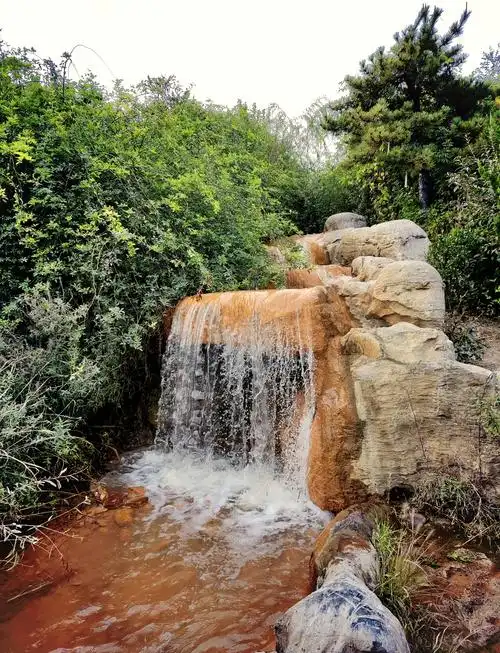 **A Mountain of Quartz and Quiet Woods**
Zishan belongs to the eastern foothills of the Taihang Range, the same uplifted spine that separates the North China Plain from the Shanxi highlands to the west. Its slopes are gentle enough for a relaxed climb, with grey stone steps threading through pine, locust, and apricot groves where summer oxygen levels run high enough that locals call it a natural "lung bath." For Western travelers used to the vertical drama of the Alps or the Dolomites, think instead of a wooded ridge more reminiscent of Germany's Black Forest foothills, modest in altitude but rich in quiet woodland atmosphere and sweeping countryside vistas.
**The General Who Shaped a Surname**
The mountain's older name, Mafu Shan, commemorates Zhao She (d. 260 BC), the brilliant Zhao state general who earned the title "Lord of Mafu" after halting Qin's expansion at the Battle of Yique. He is to Chinese military tradition what Epaminondas was to Theban Greece: a tactician whose reforms outlasted his era. His mausoleum and statue still occupy a forested terrace on the slopes, and genealogists worldwide recognize this site as a founding homeland of the Ma (马) and Mai surname families. A visit here resonates like standing at a Homeric-era hero shrine transported into leafy suburban China.
**Yuan Dynasty Learning and Sacred Architecture**
Higher on the ridge, fragments of the Yuan-era "Zishan School" recall a quiet flourishing of Neo-Confucian scholarship in the 13th and 14th centuries, when Handan served as a hub linking northern and southern intellectual traditions. Surviving religious structures, including a Jade Emperor Hall, reflect the vernacular temple style typical of northern Hebei: tiled roofs, painted beams, and courtyards arranged along the contours of the hill. These modest buildings reward visitors interested in the everyday spiritual landscape that flourished outside China's great capital cities.
**Sunset, Lake, and a Sea of Flowers**
The signature sight is "Zifeng Sunset," counted among the Ten Classical Scenes of Old Handan: from the hilltop Zifeng Pagoda, the quartz-flecked summit ignites into copper and violet as the sun sinks behind the Taihang ridgeline. Below, Ziyun Lake strings together covered walkways, wind-and-rain bridges, and a lakeshore circuit ideal for an evening stroll. Spring blankets the slopes in yellow rapeseed, summer brings rambling roses, and autumn explodes in pink muhly grass, turning the park into a magnet for photographers chasing the same soft, romantic light found in Provence lavender fields or Japan's flower parks.
**Practicalities for the Visitor**
Entry is free, including parking, and a single ascent takes roughly 45 minutes along the Y-shaped stairway, suitable for children and older travelers. Basic refreshment kiosks, restrooms, and a designated camping lawn sit near the lake; hot food and local specialties like donkey-burger flatbread (lürou huoshao) and Handan cold noodles await in the villages at the foot of the hill. Public buses are infrequent, so a taxi, ride-hail, or rented car is strongly advised. Spring and autumn offer the best weather and blossoms; summer is green but hot, while post-rain mist drifting through the pines is the park's most cinematic mood.
**Why Make the Trip**
Zishan offers something rare in fast-modernizing China: a mountain where geology, ancient battlefield memory, scholarly heritage, and pastoral scenery all converge within an easy drive of the city. It is the kind of unhurried, layered landscape that rewards travelers curious about the deeper currents of Chinese history beyond the Great Wall and the Forbidden City, an honest, breezy afternoon that leaves you knowing a little more about who the Han Chinese are, and where they came from.
**A Mountain of Quartz and Quiet Woods**
Zishan belongs to the eastern foothills of the Taihang Range, the same uplifted spine that separates the North China Plain from the Shanxi highlands to the west. Its slopes are gentle enough for a relaxed climb, with grey stone steps threading through pine, locust, and apricot groves where summer oxygen levels run high enough that locals call it a natural "lung bath." For Western travelers used to the vertical drama of the Alps or the Dolomites, think instead of a wooded ridge more reminiscent of Germany's Black Forest foothills, modest in altitude but rich in quiet woodland atmosphere and sweeping countryside vistas.
**The General Who Shaped a Surname**
The mountain's older name, Mafu Shan, commemorates Zhao She (d. 260 BC), the brilliant Zhao state general who earned the title "Lord of Mafu" after halting Qin's expansion at the Battle of Yique. He is to Chinese military tradition what Epaminondas was to Theban Greece: a tactician whose reforms outlasted his era. His mausoleum and statue still occupy a forested terrace on the slopes, and genealogists worldwide recognize this site as a founding homeland of the Ma (马) and Mai surname families. A visit here resonates like standing at a Homeric-era hero shrine transported into leafy suburban China.
**Yuan Dynasty Learning and Sacred Architecture**
Higher on the ridge, fragments of the Yuan-era "Zishan School" recall a quiet flourishing of Neo-Confucian scholarship in the 13th and 14th centuries, when Handan served as a hub linking northern and southern intellectual traditions. Surviving religious structures, including a Jade Emperor Hall, reflect the vernacular temple style typical of northern Hebei: tiled roofs, painted beams, and courtyards arranged along the contours of the hill. These modest buildings reward visitors interested in the everyday spiritual landscape that flourished outside China's great capital cities.
**Sunset, Lake, and a Sea of Flowers**
The signature sight is "Zifeng Sunset," counted among the Ten Classical Scenes of Old Handan: from the hilltop Zifeng Pagoda, the quartz-flecked summit ignites into copper and violet as the sun sinks behind the Taihang ridgeline. Below, Ziyun Lake strings together covered walkways, wind-and-rain bridges, and a lakeshore circuit ideal for an evening stroll. Spring blankets the slopes in yellow rapeseed, summer brings rambling roses, and autumn explodes in pink muhly grass, turning the park into a magnet for photographers chasing the same soft, romantic light found in Provence lavender fields or Japan's flower parks.
**Practicalities for the Visitor**
Entry is free, including parking, and a single ascent takes roughly 45 minutes along the Y-shaped stairway, suitable for children and older travelers. Basic refreshment kiosks, restrooms, and a designated camping lawn sit near the lake; hot food and local specialties like donkey-burger flatbread (lürou huoshao) and Handan cold noodles await in the villages at the foot of the hill. Public buses are infrequent, so a taxi, ride-hail, or rented car is strongly advised. Spring and autumn offer the best weather and blossoms; summer is green but hot, while post-rain mist drifting through the pines is the park's most cinematic mood.
**Why Make the Trip**
Zishan offers something rare in fast-modernizing China: a mountain where geology, ancient battlefield memory, scholarly heritage, and pastoral scenery all converge within an easy drive of the city. It is the kind of unhurried, layered landscape that rewards travelers curious about the deeper currents of Chinese history beyond the Great Wall and the Forbidden City, an honest, breezy afternoon that leaves you knowing a little more about who the Han Chinese are, and where they came from.