Handan Museum
⭐ 4.60
No. 218, Renmin Road, Congtai District, Handan City, Hebei Province, China
 Handan enjoys a distinction rare among world cities: it has held the same name for over three millennia, making it a peer of Athens and Rome in terms of continuous habitation. The museum's chronological galleries unfold across four chapters—Cishan Neolithic culture, the Zhao royal capital, the Wei-Jin Ye city, and the celebrated Cizhou kilns—offering visitors a layered narrative comparable to walking through the British Museum's Mediterranean collections, but focused tightly on a single region's evolution. The Cishan culture, dating to roughly 8000 BCE, ranks among the world's earliest agricultural societies, producing some of humanity's oldest millet and pottery.
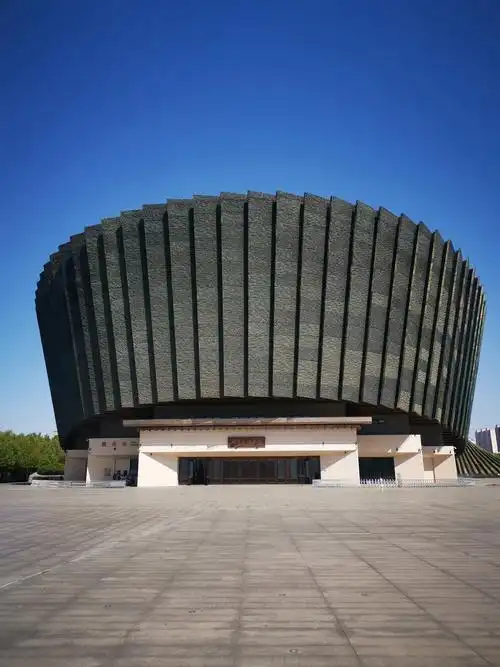
Housed within the sleek Handan Culture and Art Center, the museum spans roughly 15,000 square meters across four floors. Visitors enter beneath a monumental 210-square-meter forged-copper mural—one of the largest indoor works of its kind in China—whose sweeping bronze relief evokes the grandeur of Venice's Doge's Palace ceilings translated into industrial metal. The architecture balances contemporary glass-and-steel construction with deliberate references to ancient city walls, while a rooftop terrace frames panoramic views toward Congtai Park, where the legendary King Wuling of Zhao once drilled his cavalry.
The third-floor treasure gallery anchors the visit with seven signature artifacts. The lithe Warring States bronze horse rivals the famed Chinese museum horses of Xi'an and Tours, while the "Handan Smile" Buddhist attendants from the Northern Qi dynasty—a brief but culturally luminous era paralleling Europe's Merovingian period—radiate the same transcendent serenity found in the carved figures of Autun. A Han dynasty bronze wine vessel and intricate openwork gold dragon plaques round out a collection that distills the Zhao capital's former cosmopolitan brilliance into a single, breathtaking room.
Upstairs, the fourth-floor stone sculpture hall showcases Tang dynasty red-sandstone arhat figures whose anatomical realism and spiritual gravitas invite comparison with the painted saints of Giotto in Padua's Scrovegni Chapel. The adjacent Cizhou ware gallery presents black-on-white ceramics whose bold folk aesthetics prefigure by centuries the graphic punch of Dutch Delftware and English slipware. An interactive "Idiom Hall" links more than two thousand historical sayings—including "Hu Fu Qi She" (the cavalry reforms) and "Wan Bi Gui Zhao" (the returning jade)—to their originating events, transforming the museum into a living dictionary of Chinese wisdom.
Practical planning is straightforward. The museum sits at 399 Renmin East Road in Congtai District and is free to all visitors, though advance reservation through the official WeChat mini-program is required. It opens Tuesday through Sunday from 9:00 to 17:00 (last entry 16:30) and closes on Mondays. Foreign guests need only their original passport for entry and may request English audio guides or book a guided English tour in advance. Allow two to three hours for a comfortable visit, ascending from the third to the fourth floor to follow the curatorial logic.
The museum pairs naturally with a stroll to neighboring Congtai Park, where the remnants of King Wuling's ancient viewing platform and equestrian training ground bring the museum's stories full circle into the open air. Together they form a half-day cultural itinerary that rewards travelers seeking to understand China beyond its most famous capitals. Visitors should bring a light jacket, as the air-conditioning runs briskly, and may pause for refreshment at the ground-floor idiom-themed café or browse the well-curated museum shop before departing—a fitting conclusion to a journey through three thousand years of unbroken history.
Handan enjoys a distinction rare among world cities: it has held the same name for over three millennia, making it a peer of Athens and Rome in terms of continuous habitation. The museum's chronological galleries unfold across four chapters—Cishan Neolithic culture, the Zhao royal capital, the Wei-Jin Ye city, and the celebrated Cizhou kilns—offering visitors a layered narrative comparable to walking through the British Museum's Mediterranean collections, but focused tightly on a single region's evolution. The Cishan culture, dating to roughly 8000 BCE, ranks among the world's earliest agricultural societies, producing some of humanity's oldest millet and pottery.
Housed within the sleek Handan Culture and Art Center, the museum spans roughly 15,000 square meters across four floors. Visitors enter beneath a monumental 210-square-meter forged-copper mural—one of the largest indoor works of its kind in China—whose sweeping bronze relief evokes the grandeur of Venice's Doge's Palace ceilings translated into industrial metal. The architecture balances contemporary glass-and-steel construction with deliberate references to ancient city walls, while a rooftop terrace frames panoramic views toward Congtai Park, where the legendary King Wuling of Zhao once drilled his cavalry.
The third-floor treasure gallery anchors the visit with seven signature artifacts. The lithe Warring States bronze horse rivals the famed Chinese museum horses of Xi'an and Tours, while the "Handan Smile" Buddhist attendants from the Northern Qi dynasty—a brief but culturally luminous era paralleling Europe's Merovingian period—radiate the same transcendent serenity found in the carved figures of Autun. A Han dynasty bronze wine vessel and intricate openwork gold dragon plaques round out a collection that distills the Zhao capital's former cosmopolitan brilliance into a single, breathtaking room.
Upstairs, the fourth-floor stone sculpture hall showcases Tang dynasty red-sandstone arhat figures whose anatomical realism and spiritual gravitas invite comparison with the painted saints of Giotto in Padua's Scrovegni Chapel. The adjacent Cizhou ware gallery presents black-on-white ceramics whose bold folk aesthetics prefigure by centuries the graphic punch of Dutch Delftware and English slipware. An interactive "Idiom Hall" links more than two thousand historical sayings—including "Hu Fu Qi She" (the cavalry reforms) and "Wan Bi Gui Zhao" (the returning jade)—to their originating events, transforming the museum into a living dictionary of Chinese wisdom.
Practical planning is straightforward. The museum sits at 399 Renmin East Road in Congtai District and is free to all visitors, though advance reservation through the official WeChat mini-program is required. It opens Tuesday through Sunday from 9:00 to 17:00 (last entry 16:30) and closes on Mondays. Foreign guests need only their original passport for entry and may request English audio guides or book a guided English tour in advance. Allow two to three hours for a comfortable visit, ascending from the third to the fourth floor to follow the curatorial logic.
The museum pairs naturally with a stroll to neighboring Congtai Park, where the remnants of King Wuling's ancient viewing platform and equestrian training ground bring the museum's stories full circle into the open air. Together they form a half-day cultural itinerary that rewards travelers seeking to understand China beyond its most famous capitals. Visitors should bring a light jacket, as the air-conditioning runs briskly, and may pause for refreshment at the ground-floor idiom-themed café or browse the well-curated museum shop before departing—a fitting conclusion to a journey through three thousand years of unbroken history.