Handan Ancient City Wall
⭐ 3.80
Handan Ancient City Wall, Hanshan District, Handan City, Hebei Province, China
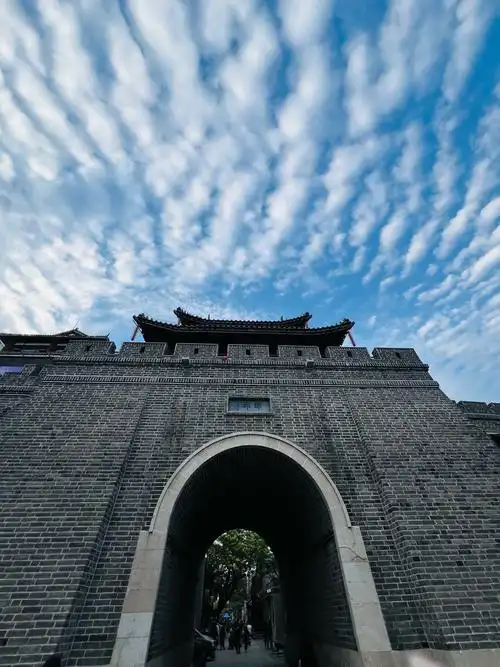 Guangfu's walls trace their origins to the Sui Dynasty (581-618 CE), though what stands today is largely a Ming-era reconstruction completed during the Jiajing reign (1522-1566)—contemporary with Elizabeth I's coastal defenses and the Italian Renaissance, the height of Europe's gunpowder age. Ming engineers rebuilt the walls specifically to withstand artillery, incorporating sloped profiles and thick brick facing. The result is a textbook example of late-imperial Chinese defensive design, comparable in ambition to the bastioned fortresses of northern Italy, yet uniquely preserved on the open plains of Hebei.
The walls stretch 4.5 kilometers in circumference, stand 12 meters tall, and measure 8 meters thick. Four monumental gates punctuate the cardinal directions, each reinforced with a defensive barbican and crowned by a multi-tiered gatehouse. Corner towers anchor the four angles, while 876 crenellations line the parapets—offering a continuous rhythm reminiscent of Carcassonne in France, though on more open terrain. A 100-meter-wide moat encircles the fortification, creating a true water city. Visitors can walk or cycle the entire circuit in roughly 90 minutes along broad, flat ramparts.
Beyond its military pedigree, Guangfu holds a singular place in martial arts heritage as the cradle of Yang-style and Wu-style Tai Chi. The former residences of the masters Yang Luchan (1799-1872) and Wu Yuxiang (1812-1880) sit within the old town—modest courtyard homes that nurtured what would become a global fitness phenomenon, with lineages now stretching worldwide. Together with the restored Guangping Prefecture Office, a small museum, and a water-street commercial district, the walls anchor a living cultural landscape where visitors can wander between battlements and birthplace heritage sites within a single afternoon.
Guangfu Ancient Town lies 25 kilometers south of Handan city center, most conveniently reached by car or taxi—a 40-minute drive from Handan East Railway Station. Old town streets are free to wander, while ascending the walls requires a ticket of approximately 20-25 RMB; combined tickets offer better value. Allocate at least half a day. Mornings or late afternoons are ideal during summer, when midday heat and wetland mosquitoes can be punishing. Wear sturdy, non-slip footwear—rampart surfaces grow slick after rain or morning dew. Those interested in Warring States archaeology may combine their visit with the Zhao Royal City ruins on Handan's southwestern outskirts, where earthen remnants rise only 3-8 meters and cannot be climbed.
Travelers seeking an authentic, crowd-free encounter with Ming-era military engineering will find Guangfu a rare gem—more intact than many sections of Xi'an's famous walls and less commercialized than Pingyao's ramparts. The combination of working fortifications, wetland scenery, and Tai Chi heritage creates a layered experience engaging both eye and imagination. Spring brings swaying reeds; summer unfolds lotus-filled ponds; dawn and dusk paint the battlements in honeyed tones. For Western visitors accustomed to European castle ruins, Guangfu offers something genuinely different: a complete, walkable Chinese city still wrapped in its original defensive embrace.
Guangfu's walls trace their origins to the Sui Dynasty (581-618 CE), though what stands today is largely a Ming-era reconstruction completed during the Jiajing reign (1522-1566)—contemporary with Elizabeth I's coastal defenses and the Italian Renaissance, the height of Europe's gunpowder age. Ming engineers rebuilt the walls specifically to withstand artillery, incorporating sloped profiles and thick brick facing. The result is a textbook example of late-imperial Chinese defensive design, comparable in ambition to the bastioned fortresses of northern Italy, yet uniquely preserved on the open plains of Hebei.
The walls stretch 4.5 kilometers in circumference, stand 12 meters tall, and measure 8 meters thick. Four monumental gates punctuate the cardinal directions, each reinforced with a defensive barbican and crowned by a multi-tiered gatehouse. Corner towers anchor the four angles, while 876 crenellations line the parapets—offering a continuous rhythm reminiscent of Carcassonne in France, though on more open terrain. A 100-meter-wide moat encircles the fortification, creating a true water city. Visitors can walk or cycle the entire circuit in roughly 90 minutes along broad, flat ramparts.
Beyond its military pedigree, Guangfu holds a singular place in martial arts heritage as the cradle of Yang-style and Wu-style Tai Chi. The former residences of the masters Yang Luchan (1799-1872) and Wu Yuxiang (1812-1880) sit within the old town—modest courtyard homes that nurtured what would become a global fitness phenomenon, with lineages now stretching worldwide. Together with the restored Guangping Prefecture Office, a small museum, and a water-street commercial district, the walls anchor a living cultural landscape where visitors can wander between battlements and birthplace heritage sites within a single afternoon.
Guangfu Ancient Town lies 25 kilometers south of Handan city center, most conveniently reached by car or taxi—a 40-minute drive from Handan East Railway Station. Old town streets are free to wander, while ascending the walls requires a ticket of approximately 20-25 RMB; combined tickets offer better value. Allocate at least half a day. Mornings or late afternoons are ideal during summer, when midday heat and wetland mosquitoes can be punishing. Wear sturdy, non-slip footwear—rampart surfaces grow slick after rain or morning dew. Those interested in Warring States archaeology may combine their visit with the Zhao Royal City ruins on Handan's southwestern outskirts, where earthen remnants rise only 3-8 meters and cannot be climbed.
Travelers seeking an authentic, crowd-free encounter with Ming-era military engineering will find Guangfu a rare gem—more intact than many sections of Xi'an's famous walls and less commercialized than Pingyao's ramparts. The combination of working fortifications, wetland scenery, and Tai Chi heritage creates a layered experience engaging both eye and imagination. Spring brings swaying reeds; summer unfolds lotus-filled ponds; dawn and dusk paint the battlements in honeyed tones. For Western visitors accustomed to European castle ruins, Guangfu offers something genuinely different: a complete, walkable Chinese city still wrapped in its original defensive embrace.