Congtai Park
⭐ 4.20
Wuling Congtai, Hanshan District, Handan, Hebei, China
 Stand on what was once the parade ground of a kingdom contemporary with Rome's early republic. Between 325 and 299 BCE, King Wuling of Zhao ordered the construction of this 27-meter reviewing platform to celebrate his military reforms. His "Hu clothing and mounted archery" decree — commanding troops to adopt nomadic-style trousers and cavalry tactics — paralleled Roman and Macedonian innovations elsewhere. The platform transformed Zhao from a weak neighbor into a regional power, much as Marius's reforms later professionalized Rome's legions or Philip II reshaped Macedonian infantry. The political climate of the era later served as the breeding ground for its most celebrated statesman dramas.
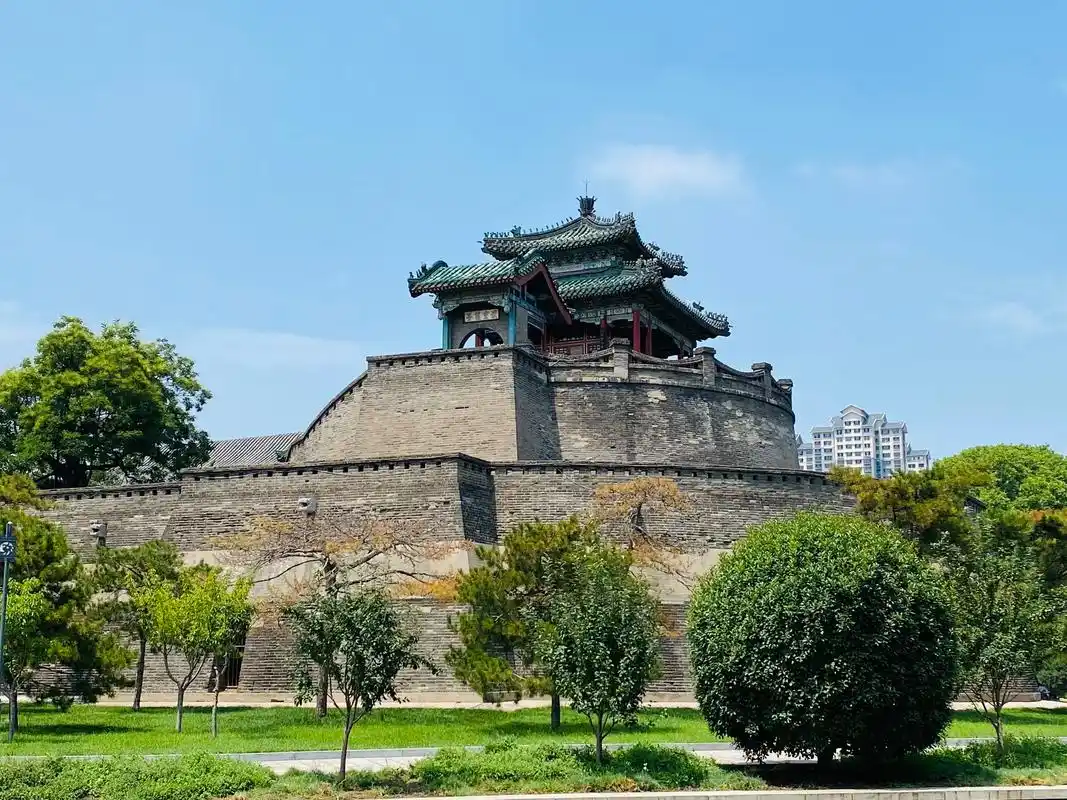
Today the tower rises in a sober three-tiered silhouette of dressed gray brick, the original earthen core rebuilt during the Qing Tongzhi era (1862–1874) yet still echoing Warring States proportions. Imagine a Norman keep softened by Chinese eaves: at the summit stands the octagonal Jusheng Pavilion, where visitors can take in a full 360° sweep of modern Handan. The middle tier holds the martial-themed Wuling Hall and the Huilan Pavilion, encircled by corridors whose carved balustrades recall the introspective calm of a Ming scholar's garden. Around the base spreads a contemplative park of steles and pines.
This is the spiritual heart of Handan's "City of Idioms" reputation — a place where China's most beloved chengyu were born. The carved-stone wall around the base preserves verse by the Qianlong Emperor and the modern poet Guo Moruo, while the nearby Seven Sages Shrine honors Warring States heroes including Lin Xiangru, the humble diplomat whose reconciliation with the bellicose general Lian Po gave rise to the saying "carrying thorns to apologize." Other associated idioms — plum blossoms bloom again, husband north wife south — turn this quiet park into a living literature class for visitors tracing the roots of classical Chinese rhetoric.
The tower is tucked inside Congtai Park, a free public green space at 159 North Zhonghua Street, Congtai District, central Handan. Park gates typically open from 5:30 AM to 10:00 PM; climbing the tower requires a modest ticket. Public bus routes 4, 17, and 202 stop right at the entrance. From Beijing or Zhengzhou by high-speed rail, Handan station connects to local transit in well under an hour. Plan for 90 minutes to two hours if you want to read the steles, climb the pavilion, and photograph the skyline. Mornings or golden hour offer the best light and cooler air.
Few Chinese sites pack so much historical layering into such a compact footprint. In one stroll you move from Warring States reform through Qing reconstruction to contemporary civic life, with intimate access to figures who later inspired operas, paintings, and idiom dictionaries. Foreign visitors gain an unrivalled lens on Chinese military modernization two centuries before the Han dynasty, set within a leafy urban park that also offers shaded benches for older travelers. Bring comfortable walking shoes, water, and a notebook — you will leave with a deeper grasp of why Handan remains the textbook capital of Chinese storytelling.
Stand on what was once the parade ground of a kingdom contemporary with Rome's early republic. Between 325 and 299 BCE, King Wuling of Zhao ordered the construction of this 27-meter reviewing platform to celebrate his military reforms. His "Hu clothing and mounted archery" decree — commanding troops to adopt nomadic-style trousers and cavalry tactics — paralleled Roman and Macedonian innovations elsewhere. The platform transformed Zhao from a weak neighbor into a regional power, much as Marius's reforms later professionalized Rome's legions or Philip II reshaped Macedonian infantry. The political climate of the era later served as the breeding ground for its most celebrated statesman dramas.
Today the tower rises in a sober three-tiered silhouette of dressed gray brick, the original earthen core rebuilt during the Qing Tongzhi era (1862–1874) yet still echoing Warring States proportions. Imagine a Norman keep softened by Chinese eaves: at the summit stands the octagonal Jusheng Pavilion, where visitors can take in a full 360° sweep of modern Handan. The middle tier holds the martial-themed Wuling Hall and the Huilan Pavilion, encircled by corridors whose carved balustrades recall the introspective calm of a Ming scholar's garden. Around the base spreads a contemplative park of steles and pines.
This is the spiritual heart of Handan's "City of Idioms" reputation — a place where China's most beloved chengyu were born. The carved-stone wall around the base preserves verse by the Qianlong Emperor and the modern poet Guo Moruo, while the nearby Seven Sages Shrine honors Warring States heroes including Lin Xiangru, the humble diplomat whose reconciliation with the bellicose general Lian Po gave rise to the saying "carrying thorns to apologize." Other associated idioms — plum blossoms bloom again, husband north wife south — turn this quiet park into a living literature class for visitors tracing the roots of classical Chinese rhetoric.
The tower is tucked inside Congtai Park, a free public green space at 159 North Zhonghua Street, Congtai District, central Handan. Park gates typically open from 5:30 AM to 10:00 PM; climbing the tower requires a modest ticket. Public bus routes 4, 17, and 202 stop right at the entrance. From Beijing or Zhengzhou by high-speed rail, Handan station connects to local transit in well under an hour. Plan for 90 minutes to two hours if you want to read the steles, climb the pavilion, and photograph the skyline. Mornings or golden hour offer the best light and cooler air.
Few Chinese sites pack so much historical layering into such a compact footprint. In one stroll you move from Warring States reform through Qing reconstruction to contemporary civic life, with intimate access to figures who later inspired operas, paintings, and idiom dictionaries. Foreign visitors gain an unrivalled lens on Chinese military modernization two centuries before the Han dynasty, set within a leafy urban park that also offers shaded benches for older travelers. Bring comfortable walking shoes, water, and a notebook — you will leave with a deeper grasp of why Handan remains the textbook capital of Chinese storytelling.