Kaiyuan Temple Pagoda
⭐ 3.80
Dingzhou City, Hebei Province, China
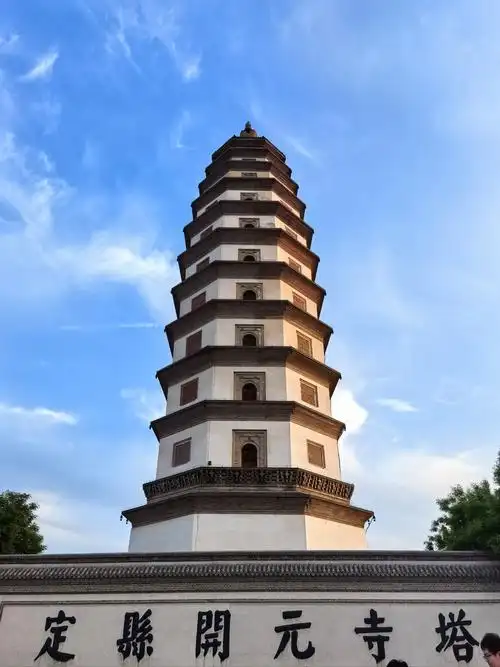 Built between 1001 and 1055 during the Northern Song dynasty, the Kaiyuan Temple Pagoda took shape during the same era when Norman England, the Holy Roman Empire under Henry II, and Kievan Rus were each forging their medieval identities. Its construction spanned 55 years, stretching from the reign of England's Æthelred the Unready to that of Edward the Confessor. The pagoda's unusual epithet, Liaodi or "Enemy-Spotting" Tower, reflects the precarious security of the Song-Liao frontier. While European cathedrals were being raised in stone with pioneering flying buttresses, Chinese builders were perfecting multi-story brick-and-wood construction that would not be matched in Europe for centuries.
Standing 83.7 meters tall—roughly the same height as Florence's famous Campanile—the pagoda rises in a stately octagonal silhouette of eleven tiers. Its most ingenious feature is a "pagoda within a pagoda" double-shell design, where an inner tower is entirely encased by the outer walls, an engineering feat rarely attempted in medieval architecture worldwide. Visitors climb a steep central staircase to access the upper levels, where original Song-dynasty murals, painted bracket sets, and inscribed stone tablets still survive. Twentieth-century architect Liang Sicheng considered the carved ceiling a perfect specimen of Song craftsmanship, on par with the wooden roof structures he later documented in Japan.
The Kaiyuan Pagoda represents a remarkable fusion of sacred Buddhist architecture and wartime military utility—a Chinese equivalent of a fortified cathedral bell tower used for both worship and defense. Its construction coincided with the spread of gunpowder weapons along the northern frontier, and chroniclers note it served as a key observation post monitoring Liao cavalry movements. Damaged by earthquakes in 1884, the structure was meticulously restored beginning in 1987 and reopened to visitors in 2002, earning it enduring fame as "China's Number One Pagoda" and making it an essential touchstone for understanding Song-period building arts and frontier geopolitics.
The pagoda is located inside the Dingzhou Cultural Park on Cangkoumen Street, a short walk from the Dingzhou Museum and the well-preserved Imperial Examination Hall (Gongyuan). Ground-level admission is around 30 yuan, while a climbing ticket costs approximately 100 yuan. Hours generally run from 8:30 AM to 5:30 PM, with final entry at 5:00 PM. Only about 60 climbers are permitted each day, and access is currently limited to the seventh tier, so be sure to call 0312-2391217 in advance to confirm the current climbing status before you go.
Plan to spend about 30 minutes admiring and photographing the pagoda from outside, or up to 1.5 hours if you intend to climb. The north plaza offers the best vantage point for photographs, and after dark the tower glows with golden illumination—an unforgettable sight. Inside, lighting is dim and the narrow staircases are steep, so sturdy, non-slip footwear and a flashlight are essential; the climb is not recommended for elderly visitors or young children. Pairing the pagoda with the excellent Dingzhou Museum and the atmospheric Gongyuan offers a full immersion into the city's layered past as a celebrated center of frontier civilization, Buddhist devotion, and imperial scholarship.
Built between 1001 and 1055 during the Northern Song dynasty, the Kaiyuan Temple Pagoda took shape during the same era when Norman England, the Holy Roman Empire under Henry II, and Kievan Rus were each forging their medieval identities. Its construction spanned 55 years, stretching from the reign of England's Æthelred the Unready to that of Edward the Confessor. The pagoda's unusual epithet, Liaodi or "Enemy-Spotting" Tower, reflects the precarious security of the Song-Liao frontier. While European cathedrals were being raised in stone with pioneering flying buttresses, Chinese builders were perfecting multi-story brick-and-wood construction that would not be matched in Europe for centuries.
Standing 83.7 meters tall—roughly the same height as Florence's famous Campanile—the pagoda rises in a stately octagonal silhouette of eleven tiers. Its most ingenious feature is a "pagoda within a pagoda" double-shell design, where an inner tower is entirely encased by the outer walls, an engineering feat rarely attempted in medieval architecture worldwide. Visitors climb a steep central staircase to access the upper levels, where original Song-dynasty murals, painted bracket sets, and inscribed stone tablets still survive. Twentieth-century architect Liang Sicheng considered the carved ceiling a perfect specimen of Song craftsmanship, on par with the wooden roof structures he later documented in Japan.
The Kaiyuan Pagoda represents a remarkable fusion of sacred Buddhist architecture and wartime military utility—a Chinese equivalent of a fortified cathedral bell tower used for both worship and defense. Its construction coincided with the spread of gunpowder weapons along the northern frontier, and chroniclers note it served as a key observation post monitoring Liao cavalry movements. Damaged by earthquakes in 1884, the structure was meticulously restored beginning in 1987 and reopened to visitors in 2002, earning it enduring fame as "China's Number One Pagoda" and making it an essential touchstone for understanding Song-period building arts and frontier geopolitics.
The pagoda is located inside the Dingzhou Cultural Park on Cangkoumen Street, a short walk from the Dingzhou Museum and the well-preserved Imperial Examination Hall (Gongyuan). Ground-level admission is around 30 yuan, while a climbing ticket costs approximately 100 yuan. Hours generally run from 8:30 AM to 5:30 PM, with final entry at 5:00 PM. Only about 60 climbers are permitted each day, and access is currently limited to the seventh tier, so be sure to call 0312-2391217 in advance to confirm the current climbing status before you go.
Plan to spend about 30 minutes admiring and photographing the pagoda from outside, or up to 1.5 hours if you intend to climb. The north plaza offers the best vantage point for photographs, and after dark the tower glows with golden illumination—an unforgettable sight. Inside, lighting is dim and the narrow staircases are steep, so sturdy, non-slip footwear and a flashlight are essential; the climb is not recommended for elderly visitors or young children. Pairing the pagoda with the excellent Dingzhou Museum and the atmospheric Gongyuan offers a full immersion into the city's layered past as a celebrated center of frontier civilization, Buddhist devotion, and imperial scholarship.