Purple Mountain
⭐ 3.80
Purple Mountain Scenic Area, Xindu District, Xingtai City, Hebei Province, China
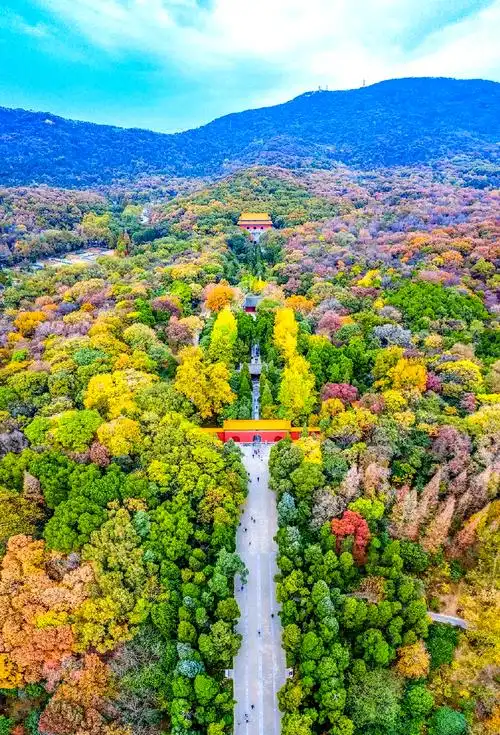 Rising from the eastern flanks of the Taihang Mountains—which stretch over 400 kilometers and form one of China's great geological spines, much as the Carpathians divide Eastern Europe—Zijin Mountain reveals a landscape sculpted by roughly 100 million years of erosion. Its red quartzite sandstone cliffs, part of the distinctive Zhangshiyan landform unique to this region, produce towering crimson walls and emerald pools that evoke the slot canyons of the American Southwest. The park's centerpiece, the Tianweng Cauldron, is a colossal natural rock formation over 20 meters wide and 50 meters tall, where suspended boardwalks spiral around its rim and waterfalls plunge dramatically into the void below.
With an average elevation of 1,300 meters and forest coverage exceeding 90 percent, Zijin Mountain functions as a natural air conditioner for the surrounding plains. Summer temperatures average a refreshing 9 to 12 degrees Celsius lower than Xingtai city below, making it a sought-after escape from the North China heat—comparable to retreating into the Swiss Jura during a hot European summer. Mossy streams thread through valleys of rare Qingtan trees and ancient oaks, while pools named Moon, Sun, and Black Dragon dot the landscape. Mist frequently shrouds the peaks, creating the atmospheric quality that has inspired Chinese landscape painters for centuries.
The mountain carries deep scholarly heritage through the Yuan Dynasty Zijin Academy, established in the 13th century during the reign of Kublai Khan—roughly contemporary with Europe's earliest universities. Five brilliant minds, often called the "Five Heroes of Zijin Mountain," studied and taught here: the astronomer-mathematician Guo Shoujing (whose calendar reforms advanced global chronology), the statesman Liu Bingzhong, and scholars Zhang Wenqian, Zhang Yi, and Wang Xun. Together they shaped the influential Xingzhou School of thought that helped govern the early Yuan empire. The site has drawn comparisons to a medieval studium generale for its outsized role in producing imperial administrators.
Today, the academy ruins and Heroes' Square preserve this intellectual legacy. The park actively celebrates Chinese scholarly traditions through seasonal events like the Zhuangyuan Cultural Festival, named for the top-scholar title in the imperial examination system. Visitors can don Hanfu robes, practice traditional archery, try the ancient game of touhu (pitch-pot), or receive cinnabar blessings—an experience with deeper historical roots than a Renaissance fair. The site also commemorates local resistance during the Anti-Japanese War, adding a 20th-century historical layer to the visit.
Entry costs approximately 50-60 RMB, with discounts during promotional periods. Allow 2 to 3 hours for a thorough visit. Peak season runs March through October (7:30 AM–6:30 PM); winter hours shorten to 8:00 AM–5:00 PM. Located 66 kilometers from central Xingtai, self-driving or a hired car remains the most practical option, as public transport is limited. Recommended route: begin at the Visitor Center, proceed through Heroes' Square and Qingtan Canyon to Qixing Pond, reach the Tianweng Cauldron and academy ruins, then climb Wangyue Terrace for panoramic Taihang views before descending via the slide or original path.
Wear sturdy non-slip hiking shoes—the stone steps become slick with mountain mist—and bring a light jacket even in summer, as temperatures drop sharply at altitude. Sun protection matters at exposed viewpoints, and cellular signal proves unreliable in deeper valleys, so download offline maps before arrival. Mornings offer thinner crowds and cooler conditions; arriving by 9 AM allows a comfortable pace and completion before afternoon heat builds. Pairing the visit with an overnight stay in a nearby village homestay rewards travelers with starlit skies and morning mountain light.
Rising from the eastern flanks of the Taihang Mountains—which stretch over 400 kilometers and form one of China's great geological spines, much as the Carpathians divide Eastern Europe—Zijin Mountain reveals a landscape sculpted by roughly 100 million years of erosion. Its red quartzite sandstone cliffs, part of the distinctive Zhangshiyan landform unique to this region, produce towering crimson walls and emerald pools that evoke the slot canyons of the American Southwest. The park's centerpiece, the Tianweng Cauldron, is a colossal natural rock formation over 20 meters wide and 50 meters tall, where suspended boardwalks spiral around its rim and waterfalls plunge dramatically into the void below.
With an average elevation of 1,300 meters and forest coverage exceeding 90 percent, Zijin Mountain functions as a natural air conditioner for the surrounding plains. Summer temperatures average a refreshing 9 to 12 degrees Celsius lower than Xingtai city below, making it a sought-after escape from the North China heat—comparable to retreating into the Swiss Jura during a hot European summer. Mossy streams thread through valleys of rare Qingtan trees and ancient oaks, while pools named Moon, Sun, and Black Dragon dot the landscape. Mist frequently shrouds the peaks, creating the atmospheric quality that has inspired Chinese landscape painters for centuries.
The mountain carries deep scholarly heritage through the Yuan Dynasty Zijin Academy, established in the 13th century during the reign of Kublai Khan—roughly contemporary with Europe's earliest universities. Five brilliant minds, often called the "Five Heroes of Zijin Mountain," studied and taught here: the astronomer-mathematician Guo Shoujing (whose calendar reforms advanced global chronology), the statesman Liu Bingzhong, and scholars Zhang Wenqian, Zhang Yi, and Wang Xun. Together they shaped the influential Xingzhou School of thought that helped govern the early Yuan empire. The site has drawn comparisons to a medieval studium generale for its outsized role in producing imperial administrators.
Today, the academy ruins and Heroes' Square preserve this intellectual legacy. The park actively celebrates Chinese scholarly traditions through seasonal events like the Zhuangyuan Cultural Festival, named for the top-scholar title in the imperial examination system. Visitors can don Hanfu robes, practice traditional archery, try the ancient game of touhu (pitch-pot), or receive cinnabar blessings—an experience with deeper historical roots than a Renaissance fair. The site also commemorates local resistance during the Anti-Japanese War, adding a 20th-century historical layer to the visit.
Entry costs approximately 50-60 RMB, with discounts during promotional periods. Allow 2 to 3 hours for a thorough visit. Peak season runs March through October (7:30 AM–6:30 PM); winter hours shorten to 8:00 AM–5:00 PM. Located 66 kilometers from central Xingtai, self-driving or a hired car remains the most practical option, as public transport is limited. Recommended route: begin at the Visitor Center, proceed through Heroes' Square and Qingtan Canyon to Qixing Pond, reach the Tianweng Cauldron and academy ruins, then climb Wangyue Terrace for panoramic Taihang views before descending via the slide or original path.
Wear sturdy non-slip hiking shoes—the stone steps become slick with mountain mist—and bring a light jacket even in summer, as temperatures drop sharply at altitude. Sun protection matters at exposed viewpoints, and cellular signal proves unreliable in deeper valleys, so download offline maps before arrival. Mornings offer thinner crowds and cooler conditions; arriving by 9 AM allows a comfortable pace and completion before afternoon heat builds. Pairing the visit with an overnight stay in a nearby village homestay rewards travelers with starlit skies and morning mountain light.