Mount Yunmeng
⭐ 2.80
130m North of Guiguzi Temple, Yijun County, Tongchuan City, Shaanxi Province, China
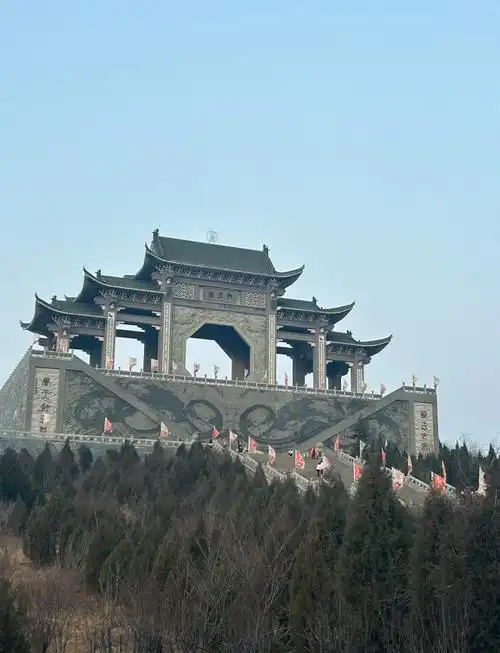 Yunmeng Mountain enters Chinese history as the legendary hermitage of Ghost Valley Master (Guiguzi), a shadowy philosopher-strategist of the Warring States period (475–221 BCE) whose school trained the era's most influential diplomats and tacticians. Comparable to the role of the Oracle at Delphi in shaping Greek city-state politics, or the influence of Renaissance thinkers like Machiavelli on European statecraft, the Guiguzi tradition taught the art of persuasion, alliance-building, and deception that defined the era. His disciples went on to mastermind wars, treaties, and coalitions that reshaped the map of ancient China, earning the mountain its enduring epithet as the cradle of Chinese strategic thought.
The spiritual heart of the mountain is the Guiguzi Memorial Hall, rebuilt in 2006, whose sober halls house statues of the master and his legendary pupils. A short walk uphill leads to a cluster of stone grottoes carved into the hillside, each containing rustic but expressive sculptures of the master and his disciples. Nearby, a stele corridor displays centuries of poems and inscriptions left by scholars and officials paying homage. The structures are modest in scale—closer to a small Benedictine monastery chapel than a great cathedral—but their unpretentious weight blends seamlessly with the surrounding pines.
Beyond its military reputation, Yunmeng Mountain carries a strong Taoist current, with legends of immortals, hermit sages, and mountain retreats that long predated the Ghost Valley tradition. The site offers a tangible link to pre-Qin philosophy, the diplomacy of the Warring States, and the development of Taoist mountain worship—themes that fascinated European scholars of comparative religion from Matteo Ricci onward. For visitors interested in how strategic thought, philosophy, and nature interwove in early China, the mountain functions as an open-air classroom.
Geographically, Yunmeng belongs to a branch of the Yanmen range, with its main summit at 1,535 meters and an exceptional 91% forest cover of pines, oaks, and birches. Summer brings the mists that gave the mountain its poetic name, rolling through the valleys like those described in classical Chinese landscape paintings. Walking trails wind gently through the woods with views of layered ridges, though visitors should not expect dramatic waterfalls or alpine meadows—the appeal lies in quiet forests, crisp air, and summer cool that escapes the basin heat.
The scenic area lies within Yijun County's Yunmeng Township, 25 to 33 km from Tongchuan city, and is best reached by private car or hired vehicle since public transport is limited. It is open year-round with no fixed closing days, and admission is inexpensive or free. Allow 3–4 hours for a relaxed visit following the suggested loop: entrance, Memorial Hall, stone cave complex, and South Heavenly Gate before returning the same way. Trails are moderate but can be slippery, so sturdy hiking shoes and rain gear in summer are essential.
Yunmeng Mountain rewards travelers drawn to ideas rather than spectacle—those who want to stand where the architects of ancient Chinese diplomacy once studied. Be aware that several mountains in China share this name, including larger, more developed sites in Hebi (Henan) and Xingtai (Hebei); confirm you are heading to the Tongchuan location. English interpretation is minimal, so a translation app or a local guide is highly recommended to unlock the rich Guiguzi lore that makes this quiet peak culturally significant.
Yunmeng Mountain enters Chinese history as the legendary hermitage of Ghost Valley Master (Guiguzi), a shadowy philosopher-strategist of the Warring States period (475–221 BCE) whose school trained the era's most influential diplomats and tacticians. Comparable to the role of the Oracle at Delphi in shaping Greek city-state politics, or the influence of Renaissance thinkers like Machiavelli on European statecraft, the Guiguzi tradition taught the art of persuasion, alliance-building, and deception that defined the era. His disciples went on to mastermind wars, treaties, and coalitions that reshaped the map of ancient China, earning the mountain its enduring epithet as the cradle of Chinese strategic thought.
The spiritual heart of the mountain is the Guiguzi Memorial Hall, rebuilt in 2006, whose sober halls house statues of the master and his legendary pupils. A short walk uphill leads to a cluster of stone grottoes carved into the hillside, each containing rustic but expressive sculptures of the master and his disciples. Nearby, a stele corridor displays centuries of poems and inscriptions left by scholars and officials paying homage. The structures are modest in scale—closer to a small Benedictine monastery chapel than a great cathedral—but their unpretentious weight blends seamlessly with the surrounding pines.
Beyond its military reputation, Yunmeng Mountain carries a strong Taoist current, with legends of immortals, hermit sages, and mountain retreats that long predated the Ghost Valley tradition. The site offers a tangible link to pre-Qin philosophy, the diplomacy of the Warring States, and the development of Taoist mountain worship—themes that fascinated European scholars of comparative religion from Matteo Ricci onward. For visitors interested in how strategic thought, philosophy, and nature interwove in early China, the mountain functions as an open-air classroom.
Geographically, Yunmeng belongs to a branch of the Yanmen range, with its main summit at 1,535 meters and an exceptional 91% forest cover of pines, oaks, and birches. Summer brings the mists that gave the mountain its poetic name, rolling through the valleys like those described in classical Chinese landscape paintings. Walking trails wind gently through the woods with views of layered ridges, though visitors should not expect dramatic waterfalls or alpine meadows—the appeal lies in quiet forests, crisp air, and summer cool that escapes the basin heat.
The scenic area lies within Yijun County's Yunmeng Township, 25 to 33 km from Tongchuan city, and is best reached by private car or hired vehicle since public transport is limited. It is open year-round with no fixed closing days, and admission is inexpensive or free. Allow 3–4 hours for a relaxed visit following the suggested loop: entrance, Memorial Hall, stone cave complex, and South Heavenly Gate before returning the same way. Trails are moderate but can be slippery, so sturdy hiking shoes and rain gear in summer are essential.
Yunmeng Mountain rewards travelers drawn to ideas rather than spectacle—those who want to stand where the architects of ancient Chinese diplomacy once studied. Be aware that several mountains in China share this name, including larger, more developed sites in Hebi (Henan) and Xingtai (Hebei); confirm you are heading to the Tongchuan location. English interpretation is minimal, so a translation app or a local guide is highly recommended to unlock the rich Guiguzi lore that makes this quiet peak culturally significant.