Qingfeng Tower
⭐ 4.00
Qingfeng Tower, Xiangdu District, Xingtai City, Hebei Province, China
 Qingfeng Lou’s story begins in the Tang and Song dynasties (7th–13th centuries), a period when China’s imperial capitals were flourishing and the Silk Road was a conduit of ideas between East and West. By the time the present wooden tower was reconstructed in 1467, Europe was emerging from the Late Middle Ages: the Medici were patronising the Florentine Renaissance, and cities such as Bruges and Prague were erecting their iconic belfries. In Xingtai, the tower served as a civic clock, a warning beacon and a venue for ritual sacrifices, making it the spiritual heart of the ancient prefecture much like a medieval European town hall or belfry anchored its community.
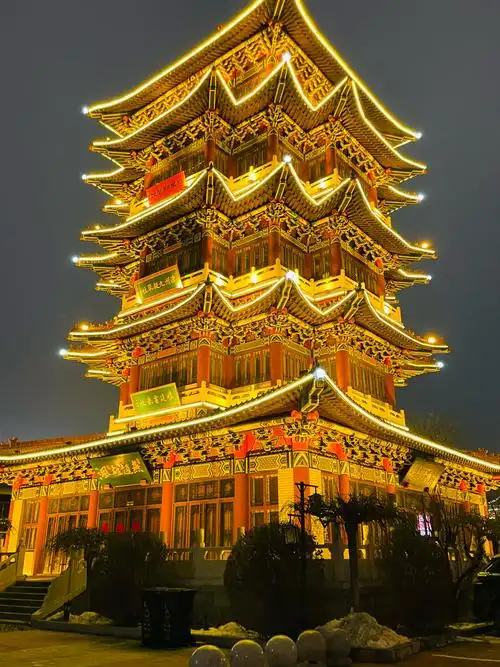
The tower rises roughly 23 metres in a classic Ming‑style double‑eave, hip‑and‑gable (xieshan) roof, a form that echoes the soaring timber roofs of Japan’s Himeji Castle and the half‑timbered façades of medieval German towns. Its ground floor is a solid brick base pierced by an arched passageway that once linked the north‑south streets of the ancient city. Above, two storeys of wooden galleries are supported by intricate dougong bracket sets, their flying eaves curving upward like the delicate tracery of a Gothic cathedral. Ornamental roof beasts line the ridges, a hallmark of imperial architecture that signals the building’s official status.
Beyond its structural elegance, Qingfeng Lou is a living museum of Chinese literary and philosophical heritage. The second floor still displays stone‑carved panels reproducing three of Tang poet Wang Wei’s famous landscape poems (the spring verse is lost), a practice reminiscent of medieval European cathedrals that wove poetry into their stained‑glass windows. In the adjoining Qingfeng Garden stands a Tang‑dynasty Daode Jing stone pillar—one of only three surviving in China—its ancient calligraphy echoing the moral foundations of Daoist thought. Together, tower and pillar form the spiritual axis of Xingtai, much as a cathedral and its adjoining cloister anchor a European town.
Visiting Qingfeng Lou is hassle‑free: there is no entrance fee, no ticket booth, and the exterior can be admired at any hour of the day. The interior is rarely open, so plan to enjoy the façade and the surrounding park; check on site for any special access. The site is a short walk from several bus stops—lines 1, 6, 9, 11, 18 and 20 all stop at “Qingfeng Tower” or “Wumei Department Store,” with walks ranging from 50 to 300 metres. For photographers, the soft light of late afternoon (after 4 pm) or the illuminated night view (around 7:30 pm) brings out the intricate eaves and dougong details.
To truly appreciate the tower, combine it with a leisurely cultural walk that includes the Qingfeng Garden’s Daode Jing pillar, the nearby Da Kaiyuan Temple and the Xingtai Museum—forming a “one tower, one pillar, one temple, one museum” heritage route that can be explored in two to three hours. Visitors who arrive during the lunar October 18 Fire God Temple Fair will be treated to lively opera performances and folk activities in front of the tower. Remember to respect the site: do not climb the structure or touch the stone carvings, and help preserve this living link to China’s past for future generations.
Qingfeng Lou’s story begins in the Tang and Song dynasties (7th–13th centuries), a period when China’s imperial capitals were flourishing and the Silk Road was a conduit of ideas between East and West. By the time the present wooden tower was reconstructed in 1467, Europe was emerging from the Late Middle Ages: the Medici were patronising the Florentine Renaissance, and cities such as Bruges and Prague were erecting their iconic belfries. In Xingtai, the tower served as a civic clock, a warning beacon and a venue for ritual sacrifices, making it the spiritual heart of the ancient prefecture much like a medieval European town hall or belfry anchored its community.
The tower rises roughly 23 metres in a classic Ming‑style double‑eave, hip‑and‑gable (xieshan) roof, a form that echoes the soaring timber roofs of Japan’s Himeji Castle and the half‑timbered façades of medieval German towns. Its ground floor is a solid brick base pierced by an arched passageway that once linked the north‑south streets of the ancient city. Above, two storeys of wooden galleries are supported by intricate dougong bracket sets, their flying eaves curving upward like the delicate tracery of a Gothic cathedral. Ornamental roof beasts line the ridges, a hallmark of imperial architecture that signals the building’s official status.
Beyond its structural elegance, Qingfeng Lou is a living museum of Chinese literary and philosophical heritage. The second floor still displays stone‑carved panels reproducing three of Tang poet Wang Wei’s famous landscape poems (the spring verse is lost), a practice reminiscent of medieval European cathedrals that wove poetry into their stained‑glass windows. In the adjoining Qingfeng Garden stands a Tang‑dynasty Daode Jing stone pillar—one of only three surviving in China—its ancient calligraphy echoing the moral foundations of Daoist thought. Together, tower and pillar form the spiritual axis of Xingtai, much as a cathedral and its adjoining cloister anchor a European town.
Visiting Qingfeng Lou is hassle‑free: there is no entrance fee, no ticket booth, and the exterior can be admired at any hour of the day. The interior is rarely open, so plan to enjoy the façade and the surrounding park; check on site for any special access. The site is a short walk from several bus stops—lines 1, 6, 9, 11, 18 and 20 all stop at “Qingfeng Tower” or “Wumei Department Store,” with walks ranging from 50 to 300 metres. For photographers, the soft light of late afternoon (after 4 pm) or the illuminated night view (around 7:30 pm) brings out the intricate eaves and dougong details.
To truly appreciate the tower, combine it with a leisurely cultural walk that includes the Qingfeng Garden’s Daode Jing pillar, the nearby Da Kaiyuan Temple and the Xingtai Museum—forming a “one tower, one pillar, one temple, one museum” heritage route that can be explored in two to three hours. Visitors who arrive during the lunar October 18 Fire God Temple Fair will be treated to lively opera performances and folk activities in front of the tower. Remember to respect the site: do not climb the structure or touch the stone carvings, and help preserve this living link to China’s past for future generations.