Kaiyuan Temple
⭐ 3.80
Kaiyuan Temple, Qiaodong District, Xingtai City, Hebei Province, China
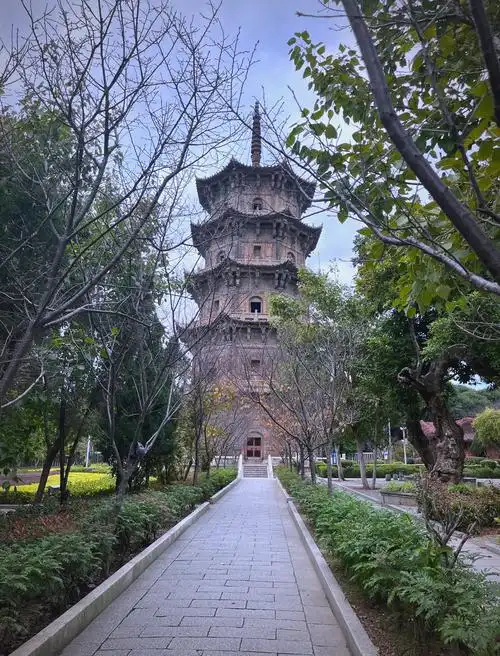 A Living Chronicle of Chinese Buddhism
Kaiyuan Temple predates most of Europe's medieval cathedrals, founded in 312 CE when the Later Zhao kingdom ruled northern China—a period when Roman emperors were still persecuting pagans across Eurasia. Renamed in 738 CE during the Tang dynasty's golden age of cosmopolitan culture, the temple reached its imperial zenith when Kublai Khan visited twice and bestowed the title "Great Kaiyuan Temple." Designated a National Key Cultural Heritage Site in 2006, it stands as one of China's oldest continuously functioning Buddhist complexes, with a lineage stretching back to the dawn of organized Zen practice.
The Three Sacred Treasures
The temple's treasures rival those found in Europe's great reliquaries. The seven-meter Tang-dynasty sutra pillar is the only surviving sixteen-sided stone scripture monument in China, inscribed with esoteric Buddhist mantras—a parallel to the unique manuscript traditions preserved in medieval European monasteries. Four Ming-era dragon columns, carved in deep relief with serpentine dragons whose heads protrude dramatically outward, are hailed as the pinnacle of northern stone-carving artistry, comparable to the finest Gothic sculptural programs. The 15-ton Jin-dynasty iron bell, cast in 1184, uniquely merges Chinese cosmology with the Western zodiac, an artifact of Silk Road-era cross-cultural exchange.
Sacred Heart of Zen Buddhism
For those interested in Eastern spiritual heritage, Kaiyuan Temple holds singular importance: Second Patriarch Huike, who received the dharma from Bodhidharma himself, transmitted his teachings here. The temple is also the ancestral cradle of the Caodong school—one of Zen Buddhism's two surviving lineages in China—making it equivalent in status to Canterbury Cathedral for Anglicans or Santiago de Compostela for Catholics. The modest architectural layout, with Ming and Qing halls arranged along a central axis, retains an intimate, contemplative atmosphere rare among Chinese tourist sites.
Planning Your Visit
The temple welcomes visitors free of charge, open daily from 08:30 to 16:00 or 17:00 depending on season. Located at 88 Kaiyuan North Road in central Xingtai, Hebei Province, it is accessible via bus route 24, or visitors can park at the adjacent Xingtai Museum. Unlike China's heavily commercialized temples, this site remains genuinely quiet—expect stone paths, weathered stelae, and the meditative trickle of the ancient Wild Fox Spring rather than souvenir stalls.
Combining the Experience
Plan a half-day cultural circuit: dedicate 90 minutes to the temple, allowing time to examine the dragon column reliefs and sutra pillar inscriptions in detail. Across the street, the Xingtai Museum provides excellent historical context for the region, while the nearby Qingfeng Tower and historic Xingtai Old Street offer a glimpse of traditional northern Chinese urban fabric. Dress modestly, speak softly, and respect active worshippers—this is a working monastery, not a museum, and that authenticity is precisely what makes it worth the journey.
A Living Chronicle of Chinese Buddhism
Kaiyuan Temple predates most of Europe's medieval cathedrals, founded in 312 CE when the Later Zhao kingdom ruled northern China—a period when Roman emperors were still persecuting pagans across Eurasia. Renamed in 738 CE during the Tang dynasty's golden age of cosmopolitan culture, the temple reached its imperial zenith when Kublai Khan visited twice and bestowed the title "Great Kaiyuan Temple." Designated a National Key Cultural Heritage Site in 2006, it stands as one of China's oldest continuously functioning Buddhist complexes, with a lineage stretching back to the dawn of organized Zen practice.
The Three Sacred Treasures
The temple's treasures rival those found in Europe's great reliquaries. The seven-meter Tang-dynasty sutra pillar is the only surviving sixteen-sided stone scripture monument in China, inscribed with esoteric Buddhist mantras—a parallel to the unique manuscript traditions preserved in medieval European monasteries. Four Ming-era dragon columns, carved in deep relief with serpentine dragons whose heads protrude dramatically outward, are hailed as the pinnacle of northern stone-carving artistry, comparable to the finest Gothic sculptural programs. The 15-ton Jin-dynasty iron bell, cast in 1184, uniquely merges Chinese cosmology with the Western zodiac, an artifact of Silk Road-era cross-cultural exchange.
Sacred Heart of Zen Buddhism
For those interested in Eastern spiritual heritage, Kaiyuan Temple holds singular importance: Second Patriarch Huike, who received the dharma from Bodhidharma himself, transmitted his teachings here. The temple is also the ancestral cradle of the Caodong school—one of Zen Buddhism's two surviving lineages in China—making it equivalent in status to Canterbury Cathedral for Anglicans or Santiago de Compostela for Catholics. The modest architectural layout, with Ming and Qing halls arranged along a central axis, retains an intimate, contemplative atmosphere rare among Chinese tourist sites.
Planning Your Visit
The temple welcomes visitors free of charge, open daily from 08:30 to 16:00 or 17:00 depending on season. Located at 88 Kaiyuan North Road in central Xingtai, Hebei Province, it is accessible via bus route 24, or visitors can park at the adjacent Xingtai Museum. Unlike China's heavily commercialized temples, this site remains genuinely quiet—expect stone paths, weathered stelae, and the meditative trickle of the ancient Wild Fox Spring rather than souvenir stalls.
Combining the Experience
Plan a half-day cultural circuit: dedicate 90 minutes to the temple, allowing time to examine the dragon column reliefs and sutra pillar inscriptions in detail. Across the street, the Xingtai Museum provides excellent historical context for the region, while the nearby Qingfeng Tower and historic Xingtai Old Street offer a glimpse of traditional northern Chinese urban fabric. Dress modestly, speak softly, and respect active worshippers—this is a working monastery, not a museum, and that authenticity is precisely what makes it worth the journey.