Jigong Mountain
⭐ 4.40
Jigong Mountain Scenic Area, Xinyang City, Henan Province, China
 Jigongshan's story begins in the late Qing Dynasty, when British missionaries escaping Shanghai's brutal summers discovered this cool highland sanctuary in the 1890s. Word spread through treaty-port networks, and soon diplomats, merchants, and clergy from Britain, America, Germany, Russia, and Japan were commissioning hillside villas. By the Republican era, the mountain had become a high-altitude "International Settlement"—a curious echo of Shanghai's Bund or Qingdao's German quarter, transplanted a thousand meters above the steamy Central Plains. The 212 surviving villas stand today as architectural witnesses to that extraordinary colonial-era encounter.
The mountain's architectural ensemble has been compared to a Chinese Sintra or a hill-station echo of British India—improbable clusters of colonial villas clinging to misty peaks. Buildings range from German timber-framed chalets and neo-Gothic chapels to elegant Sino-Western hybrids blending Chinese tile roofs with European bay windows. Standouts include the imposing Yilu—nicknamed the "Spirit Hall" for its grand scale; the refined Meiling Dance Hall, where Soong Mei-ling reportedly danced; and residences named for Marshall and Citibank officials. Many villas now serve as museums or photogenic cafés perfect for an afternoon pause.
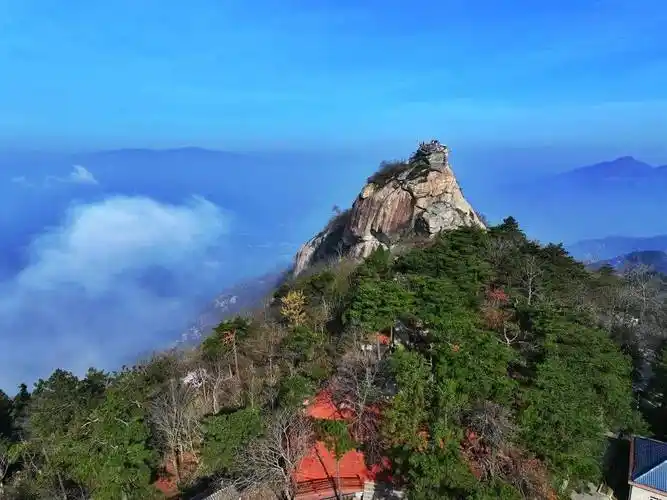
At sunrise from Baoxiao Peak, visitors witness one of central China's most theatrical spectacles: a churning sea of clouds spilling between peaks, occasionally pierced by a luminous Buddhist halo—a phenomenon that has inspired pilgrims and poets for centuries. The eight classic vistas include thundering waterfalls, the curiously balanced Eagle Pedestal Rock, and the romantic Lover's Stone. Forest cover exceeds 80%, and summer nights grow so cool that light jackets feel essential. Evenings bring cicada symphonies and starlit skies untouched by city glare.
Entry to the main scenic area costs around 60 yuan; the mandatory shuttle bus between the parking area and summit villages adds 40–50 yuan round-trip—private cars must park below. Bring your passport, as identity verification is required at the gate. Mountain-top restaurants charge a premium, so consider descending for dinner to sample Xinyang specialties: clay-pot stewed pork, chestnut-braised chicken, and refreshing stone jelly. Just below, Borden Forest Park offers century-old dawn redwoods, tranquil lakes, and a quaint narrow-gauge railway once linked to the historic Ping-Han line.
The best season is June through September for cool escapes, though November and December reward visitors with spectacular rime-frost scenery. Plan two days and one night: arrive by afternoon to wander the villa district at golden hour, ascend Baoxiao Peak for sunset, then rise before dawn for the cloud-sea spectacle. Spend the next morning hiking the gentle Changsheng Valley or strolling beneath Borden's towering redwoods. Pack a light rain jacket, sturdy shoes, and patience for fog—recent high-school graduates should also check summer free-entry promotions.
Jigongshan's story begins in the late Qing Dynasty, when British missionaries escaping Shanghai's brutal summers discovered this cool highland sanctuary in the 1890s. Word spread through treaty-port networks, and soon diplomats, merchants, and clergy from Britain, America, Germany, Russia, and Japan were commissioning hillside villas. By the Republican era, the mountain had become a high-altitude "International Settlement"—a curious echo of Shanghai's Bund or Qingdao's German quarter, transplanted a thousand meters above the steamy Central Plains. The 212 surviving villas stand today as architectural witnesses to that extraordinary colonial-era encounter.
The mountain's architectural ensemble has been compared to a Chinese Sintra or a hill-station echo of British India—improbable clusters of colonial villas clinging to misty peaks. Buildings range from German timber-framed chalets and neo-Gothic chapels to elegant Sino-Western hybrids blending Chinese tile roofs with European bay windows. Standouts include the imposing Yilu—nicknamed the "Spirit Hall" for its grand scale; the refined Meiling Dance Hall, where Soong Mei-ling reportedly danced; and residences named for Marshall and Citibank officials. Many villas now serve as museums or photogenic cafés perfect for an afternoon pause.
At sunrise from Baoxiao Peak, visitors witness one of central China's most theatrical spectacles: a churning sea of clouds spilling between peaks, occasionally pierced by a luminous Buddhist halo—a phenomenon that has inspired pilgrims and poets for centuries. The eight classic vistas include thundering waterfalls, the curiously balanced Eagle Pedestal Rock, and the romantic Lover's Stone. Forest cover exceeds 80%, and summer nights grow so cool that light jackets feel essential. Evenings bring cicada symphonies and starlit skies untouched by city glare.
Entry to the main scenic area costs around 60 yuan; the mandatory shuttle bus between the parking area and summit villages adds 40–50 yuan round-trip—private cars must park below. Bring your passport, as identity verification is required at the gate. Mountain-top restaurants charge a premium, so consider descending for dinner to sample Xinyang specialties: clay-pot stewed pork, chestnut-braised chicken, and refreshing stone jelly. Just below, Borden Forest Park offers century-old dawn redwoods, tranquil lakes, and a quaint narrow-gauge railway once linked to the historic Ping-Han line.
The best season is June through September for cool escapes, though November and December reward visitors with spectacular rime-frost scenery. Plan two days and one night: arrive by afternoon to wander the villa district at golden hour, ascend Baoxiao Peak for sunset, then rise before dawn for the cloud-sea spectacle. Spend the next morning hiking the gentle Changsheng Valley or strolling beneath Borden's towering redwoods. Pack a light rain jacket, sturdy shoes, and patience for fog—recent high-school graduates should also check summer free-entry promotions.