Site of the Zunyi Conference
⭐ 2.50
No. 96, Ziyin Road, Honghuagang District, Zunyi City, Guizhou Province, China
 The January 1935 Zunyi Conference ranks among the 20th century's most consequential political pivots—a Chinese counterpart to the strategic recalibrations that shaped the American Civil War or the Congress of Vienna. With Red Army forces encircled and exhausted during the Long March, an epic 8,000-mile retreat sometimes compared to Napoleon's retreat from Moscow, the Communist Party faced potential annihilation. The three-day meeting reversed catastrophic fortunes, established Mao Zedong's leadership, and set the movement on a path that would reshape East Asia. For travelers familiar with the homes-turned-museums of European revolutionary figures, this unassuming provincial mansion offers a parallel: an ordinary residence that became the crucible of history.
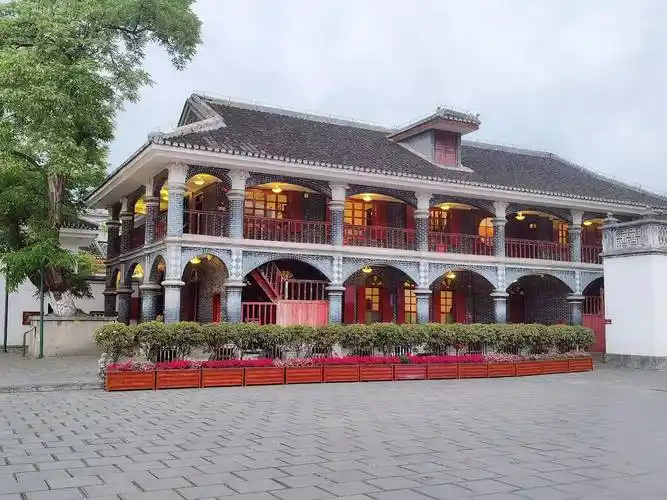
The conference building was constructed in the early 1930s as the private mansion of General Bai Huizhang, a regional Guizhou military commander. The two-story brick-and-wood structure marries the restraint of northern Guizhou vernacular architecture—red walls and dark tiled roofs recalling Tuscan hill towns—with Western symmetry reminiscent of colonial-era treaty port mansions along Shanghai's Bund. This Sino-European synthesis was fashionable among Republican-era provincial elites. Note that the main building's second floor is currently closed for restoration; visitors appreciate the architecture from the exterior and ground-floor context before moving to the exhibition hall.
The surrounding exhibition complex functions as a national first-class institution blending preserved historic spaces with thoroughly modern interpretation. The Zunyi Conference Exhibition Hall integrates original artifacts, period photographs, oil paintings, and bronze sculptures with VR reconstructions that seat visitors virtually at the conference table—a technique now standard at sites like Gettysburg or Sutton Hoo. Galleries trace the three-day meeting and the broader 368-day Long March, contextualizing Zunyi as the campaign's pivotal chapter. Visitors encounter China's living revolutionary memory: schoolchildren laying wreaths, families on pilgrimage, a memorial culture with few Western parallels beyond Normandy or Verdun.
Admission is free, but advance booking through the official WeChat public account is mandatory, similar to timed-entry systems at Rome's Colosseum or the 9/11 Memorial. International travelers without Chinese mobile numbers should arrange bookings through hotel concierges or local guides. Summer hours (July 13–August 31) extend to 21:00 with last entry at 20:30; notably, the museum does not close on Mondays. Photography is prohibited throughout. Audio guides and volunteer docents are available, though English is limited—pre-reading the Long March narrative dramatically enhances the experience.
A complete visit takes two to three hours. Begin at the historic residence, proceed to the exhibition hall, then walk to Red Army Street for Zunyi's signature lamb rice noodles—a soul-warming regional comfort food without a true Western equivalent. Continue to Laoxiang Lane for old-town atmosphere, then ascend Red Army Mountain's Martyrs' Cemetery for panoramic city views and a moving tribute to fallen soldiers. For travelers tracing China's revolutionary geography between Beijing and Yan'an, Zunyi is the indispensable mid-route stop where the Long March story turned from disaster to triumph.
The January 1935 Zunyi Conference ranks among the 20th century's most consequential political pivots—a Chinese counterpart to the strategic recalibrations that shaped the American Civil War or the Congress of Vienna. With Red Army forces encircled and exhausted during the Long March, an epic 8,000-mile retreat sometimes compared to Napoleon's retreat from Moscow, the Communist Party faced potential annihilation. The three-day meeting reversed catastrophic fortunes, established Mao Zedong's leadership, and set the movement on a path that would reshape East Asia. For travelers familiar with the homes-turned-museums of European revolutionary figures, this unassuming provincial mansion offers a parallel: an ordinary residence that became the crucible of history.
The conference building was constructed in the early 1930s as the private mansion of General Bai Huizhang, a regional Guizhou military commander. The two-story brick-and-wood structure marries the restraint of northern Guizhou vernacular architecture—red walls and dark tiled roofs recalling Tuscan hill towns—with Western symmetry reminiscent of colonial-era treaty port mansions along Shanghai's Bund. This Sino-European synthesis was fashionable among Republican-era provincial elites. Note that the main building's second floor is currently closed for restoration; visitors appreciate the architecture from the exterior and ground-floor context before moving to the exhibition hall.
The surrounding exhibition complex functions as a national first-class institution blending preserved historic spaces with thoroughly modern interpretation. The Zunyi Conference Exhibition Hall integrates original artifacts, period photographs, oil paintings, and bronze sculptures with VR reconstructions that seat visitors virtually at the conference table—a technique now standard at sites like Gettysburg or Sutton Hoo. Galleries trace the three-day meeting and the broader 368-day Long March, contextualizing Zunyi as the campaign's pivotal chapter. Visitors encounter China's living revolutionary memory: schoolchildren laying wreaths, families on pilgrimage, a memorial culture with few Western parallels beyond Normandy or Verdun.
Admission is free, but advance booking through the official WeChat public account is mandatory, similar to timed-entry systems at Rome's Colosseum or the 9/11 Memorial. International travelers without Chinese mobile numbers should arrange bookings through hotel concierges or local guides. Summer hours (July 13–August 31) extend to 21:00 with last entry at 20:30; notably, the museum does not close on Mondays. Photography is prohibited throughout. Audio guides and volunteer docents are available, though English is limited—pre-reading the Long March narrative dramatically enhances the experience.
A complete visit takes two to three hours. Begin at the historic residence, proceed to the exhibition hall, then walk to Red Army Street for Zunyi's signature lamb rice noodles—a soul-warming regional comfort food without a true Western equivalent. Continue to Laoxiang Lane for old-town atmosphere, then ascend Red Army Mountain's Martyrs' Cemetery for panoramic city views and a moving tribute to fallen soldiers. For travelers tracing China's revolutionary geography between Beijing and Yan'an, Zunyi is the indispensable mid-route stop where the Long March story turned from disaster to triumph.