Yudu Long March Starting Site
⭐ 4.60
Yudu Long March Starting Site, Yudu County, Ganzhou City, Jiangxi Province, China
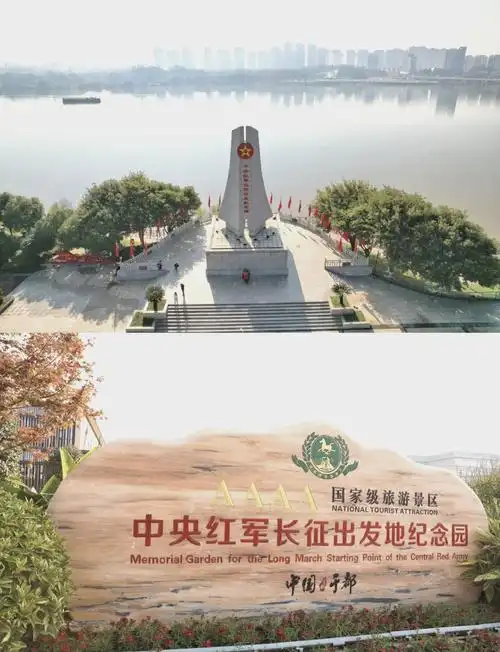 The Yudu Long March Departure Site occupies a pivotal place in twentieth-century history. In October 1934, 86,000 soldiers of the Chinese Red Army's First Front Army assembled here before crossing the Yudu River and beginning what would become a 25,000-li (12,500 km) strategic retreat. Scholars frequently compare this trek to Xenophon's "Anabasis" of 401 BC—one of history's most celebrated military marches—and to Hannibal's Alpine crossing. Yet in distance and duration, the Long March surpassed both, traversing eleven provinces through mountain passes, grasslands, and river crossings. After two years, fewer than 10,000 of the original marchers reached Shaanxi, where the survivors laid the groundwork for the People's Republic of China.
The memorial park commands a striking position along the Gong River, where the original crossing took place. A 19.34-meter twin-sail monument—its height deliberately marking the year 1934—rises beside the water, symbolizing the launch of a revolutionary voyage. Bronze sculpture clusters depicting soldiers and civilians parting at the riverbank convey the emotional weight of separation. A reconstructed pontoon bridge and a massive relief map of the entire Long March route allow visitors to grasp the journey's geographic scope at a glance. Together, these elements create a contemplative landscape that rivals European war memorials such as Normandy's beaches or Italy's Redipuglia military shrine.
The Central Red Army Long March Departure Memorial Hall is China's only museum devoted specifically to the launch phase of this historic march. Inside, visitors encounter grass-straw sandals worn by soldiers, original crossing boats, period photographs, and multimedia installations detailing the logistical feat of supplying and transporting an entire army across a river under enemy pressure. Beyond its scholarly value, the museum functions as a national classroom where study groups deepen their understanding of modern Chinese history. For international travelers, it offers an unfiltered window into the sacrifices that shaped contemporary China and the ideological foundations of the Communist state.
Adjacent to the memorial park stands the Long March Grand Theatre, home to "The First Crossing of the Long March"—a large-scale immersive epic performance. Using a 360-degree rotating stage, real water effects, and panoramic surround sound, the show dramatizes 86,000 individual farewells between soldiers and their families on the eve of departure. Audience reviews consistently describe the experience as "moving," "harrowing," and "weep-inducing," drawing emotional parallels to performances such as the Passion Play at Oberammergau. The ninety-minute production transforms historical statistics into deeply personal stories, giving visitors an emotional connection that static exhibits cannot match.
The memorial park and museum are free to enter but require advance online reservation with a passport or ID card; both close on Mondays. The "Long March First Crossing" performance ranges from 128 to 268 yuan depending on seating class. The optimal itinerary begins with a morning visit to the park and museum, followed by a riverside stroll along the Gong River Greenway in late afternoon, then the evening theater performance. Visitors should wear comfortable walking shoes, allow at least three hours for the outdoor sites, and arrive early for the show. The site lies within Ganzhou city, accessible by high-speed rail and local buses.
For Western travelers tracing the origins of modern China, Yudu offers an experience unavailable anywhere else. Unlike Beijing or Shanghai, where contemporary achievements dominate the narrative, this small Jiangxi city preserves the raw emotional origins of a nation-defining journey. The combination of monumental landscape architecture, intimate museum artifacts, and cutting-edge immersive theater creates multiple layers of engagement—appealing equally to history enthusiasts, families with school-age children, and those seeking deeper cultural insight. Few places in the world allow visitors to stand at the precise starting point of a 12,500-kilometer epic that reshaped a quarter of humanity.
The Yudu Long March Departure Site occupies a pivotal place in twentieth-century history. In October 1934, 86,000 soldiers of the Chinese Red Army's First Front Army assembled here before crossing the Yudu River and beginning what would become a 25,000-li (12,500 km) strategic retreat. Scholars frequently compare this trek to Xenophon's "Anabasis" of 401 BC—one of history's most celebrated military marches—and to Hannibal's Alpine crossing. Yet in distance and duration, the Long March surpassed both, traversing eleven provinces through mountain passes, grasslands, and river crossings. After two years, fewer than 10,000 of the original marchers reached Shaanxi, where the survivors laid the groundwork for the People's Republic of China.
The memorial park commands a striking position along the Gong River, where the original crossing took place. A 19.34-meter twin-sail monument—its height deliberately marking the year 1934—rises beside the water, symbolizing the launch of a revolutionary voyage. Bronze sculpture clusters depicting soldiers and civilians parting at the riverbank convey the emotional weight of separation. A reconstructed pontoon bridge and a massive relief map of the entire Long March route allow visitors to grasp the journey's geographic scope at a glance. Together, these elements create a contemplative landscape that rivals European war memorials such as Normandy's beaches or Italy's Redipuglia military shrine.
The Central Red Army Long March Departure Memorial Hall is China's only museum devoted specifically to the launch phase of this historic march. Inside, visitors encounter grass-straw sandals worn by soldiers, original crossing boats, period photographs, and multimedia installations detailing the logistical feat of supplying and transporting an entire army across a river under enemy pressure. Beyond its scholarly value, the museum functions as a national classroom where study groups deepen their understanding of modern Chinese history. For international travelers, it offers an unfiltered window into the sacrifices that shaped contemporary China and the ideological foundations of the Communist state.
Adjacent to the memorial park stands the Long March Grand Theatre, home to "The First Crossing of the Long March"—a large-scale immersive epic performance. Using a 360-degree rotating stage, real water effects, and panoramic surround sound, the show dramatizes 86,000 individual farewells between soldiers and their families on the eve of departure. Audience reviews consistently describe the experience as "moving," "harrowing," and "weep-inducing," drawing emotional parallels to performances such as the Passion Play at Oberammergau. The ninety-minute production transforms historical statistics into deeply personal stories, giving visitors an emotional connection that static exhibits cannot match.
The memorial park and museum are free to enter but require advance online reservation with a passport or ID card; both close on Mondays. The "Long March First Crossing" performance ranges from 128 to 268 yuan depending on seating class. The optimal itinerary begins with a morning visit to the park and museum, followed by a riverside stroll along the Gong River Greenway in late afternoon, then the evening theater performance. Visitors should wear comfortable walking shoes, allow at least three hours for the outdoor sites, and arrive early for the show. The site lies within Ganzhou city, accessible by high-speed rail and local buses.
For Western travelers tracing the origins of modern China, Yudu offers an experience unavailable anywhere else. Unlike Beijing or Shanghai, where contemporary achievements dominate the narrative, this small Jiangxi city preserves the raw emotional origins of a nation-defining journey. The combination of monumental landscape architecture, intimate museum artifacts, and cutting-edge immersive theater creates multiple layers of engagement—appealing equally to history enthusiasts, families with school-age children, and those seeking deeper cultural insight. Few places in the world allow visitors to stand at the precise starting point of a 12,500-kilometer epic that reshaped a quarter of humanity.