Ganzhou Navel Orange Park
⭐ 3.60
Zhanggong District, Ganzhou City, Jiangxi Province, China
 The navel orange's journey to southern China is a chapter in the great global traffic in food plants that has shaped agriculture since the Columbian Exchange. Originally a Brazilian mutation, the fruit reached California in the 1870s, where growers refined hardy Washington, Bonanza, and Newhall varieties. When Chinese agricultural pioneers brought these cultivars to Jiangxi's rust-colored soils in the early 1970s, few imagined that within half a century Ganzhou would surpass all rivals. The park's Mother Tree Garden preserves descendants of those first experimental plantings—living ancestors of an industry now worth billions.
Housed in a 6,000-square-meter pavilion, the Ganzhou Navel Orange Museum functions as the park's intellectual heart. Inside, 3D-projected orange groves, interactive sand-table models, and immersive multimedia exhibits trace the entire production chain, from hybridization and grafting to harvest and export. The design philosophy echoes the wine museums of Bordeaux or Burgundy, where agricultural heritage is elevated through sensory storytelling rather than static panels. Children can operate miniature sorting-line simulators while adults explore archives documenting four decades of horticultural innovation.
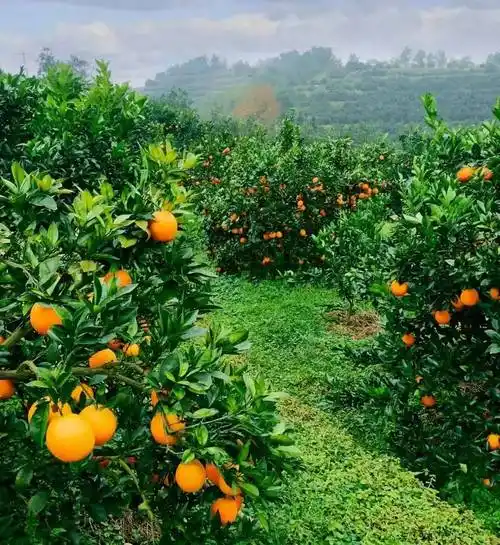
A climb to the park's observation tower rewards visitors with a sweeping panorama of 5,000 acres of standardized orchard—a green sea reminiscent of Tuscany's vineyard vistas or the orderly plots of Provence. From November through January, the rolling hills turn gold as millions of ripe fruits catch the low winter sun, a sight that photographers find irresistible. During the off-season, the uniform green canopy still impresses, though travelers should temper expectations of the signature golden glow.
Beyond the romantic orchards, the park reveals the technological sophistication behind modern fruit farming. Floor-to-ceiling glass walls allow guests to watch a working sorting facility where high-resolution cameras photograph each orange, robotic arms rotate them for inspection, and computer algorithms grade them by color, size, and surface flaw. The process echoes Europe's high-end whisky distilleries or Parmesan-aging cellars, where traditional craft meets industrial precision. Witnessing fruit transformed from branch to box in minutes is the park's most unexpected revelation.
The park sits in Anxi Town, Xinxian County, roughly 15 kilometers outside the county seat and a 40–50-minute drive from either Ganzhou West High-Speed Rail Station or Ganzhou Huangjin Airport. Self-driving or hiring a private car is strongly advised, since public transit is limited. Admission is free and gates open daily from 8:30 to 17:00, though shuttle rides and in-depth educational programs carry separate fees. The sorting-factory tour should be reserved by phone in advance. Summer visitors should pack sunscreen and water; the orchard offers little natural shade.
For Western travelers seeking a fresh perspective beyond China's imperial landmarks, the park offers a refreshing counterpoint of agricultural innovation, rural entrepreneurship, and edible landscapes. Peak-season visitors from mid-November to late December can hand-pick oranges straight from the branch and taste fruit still warm from the tree. Even outside harvest season, the museum, observation tower, and factory tour combine into a half-day excursion engaging all ages. It is, quite simply, the world's most comprehensive tribute to a single piece of fruit.
The navel orange's journey to southern China is a chapter in the great global traffic in food plants that has shaped agriculture since the Columbian Exchange. Originally a Brazilian mutation, the fruit reached California in the 1870s, where growers refined hardy Washington, Bonanza, and Newhall varieties. When Chinese agricultural pioneers brought these cultivars to Jiangxi's rust-colored soils in the early 1970s, few imagined that within half a century Ganzhou would surpass all rivals. The park's Mother Tree Garden preserves descendants of those first experimental plantings—living ancestors of an industry now worth billions.
Housed in a 6,000-square-meter pavilion, the Ganzhou Navel Orange Museum functions as the park's intellectual heart. Inside, 3D-projected orange groves, interactive sand-table models, and immersive multimedia exhibits trace the entire production chain, from hybridization and grafting to harvest and export. The design philosophy echoes the wine museums of Bordeaux or Burgundy, where agricultural heritage is elevated through sensory storytelling rather than static panels. Children can operate miniature sorting-line simulators while adults explore archives documenting four decades of horticultural innovation.
A climb to the park's observation tower rewards visitors with a sweeping panorama of 5,000 acres of standardized orchard—a green sea reminiscent of Tuscany's vineyard vistas or the orderly plots of Provence. From November through January, the rolling hills turn gold as millions of ripe fruits catch the low winter sun, a sight that photographers find irresistible. During the off-season, the uniform green canopy still impresses, though travelers should temper expectations of the signature golden glow.
Beyond the romantic orchards, the park reveals the technological sophistication behind modern fruit farming. Floor-to-ceiling glass walls allow guests to watch a working sorting facility where high-resolution cameras photograph each orange, robotic arms rotate them for inspection, and computer algorithms grade them by color, size, and surface flaw. The process echoes Europe's high-end whisky distilleries or Parmesan-aging cellars, where traditional craft meets industrial precision. Witnessing fruit transformed from branch to box in minutes is the park's most unexpected revelation.
The park sits in Anxi Town, Xinxian County, roughly 15 kilometers outside the county seat and a 40–50-minute drive from either Ganzhou West High-Speed Rail Station or Ganzhou Huangjin Airport. Self-driving or hiring a private car is strongly advised, since public transit is limited. Admission is free and gates open daily from 8:30 to 17:00, though shuttle rides and in-depth educational programs carry separate fees. The sorting-factory tour should be reserved by phone in advance. Summer visitors should pack sunscreen and water; the orchard offers little natural shade.
For Western travelers seeking a fresh perspective beyond China's imperial landmarks, the park offers a refreshing counterpoint of agricultural innovation, rural entrepreneurship, and edible landscapes. Peak-season visitors from mid-November to late December can hand-pick oranges straight from the branch and taste fruit still warm from the tree. Even outside harvest season, the museum, observation tower, and factory tour combine into a half-day excursion engaging all ages. It is, quite simply, the world's most comprehensive tribute to a single piece of fruit.