Zhangjiang Park
⭐ 3.80
Zhangjiang Park, Zhanggong District, Ganzhou City, Jiangxi Province, China
 **A Wetland Through Two Millennia**
The Zhangjiang corridor has been inhabited and cultivated for over two thousand years, but it was during the Southern Song Dynasty (1127–1279)—a period contemporary with Europe's Crusading era and Germany's Hohenstaufen emperors—that Ganzhou grew into a major southern trading hub. The neighboring Song City Wall and the celebrated Yugu Tai pavilion still testify to that age, when this stretch of the river was already a working waterway carrying merchants, salt barges, and mandarins. Today, the wetland park reclaims that riparian landscape as a public commons, layering contemporary ecological design atop an ancient port zone.
**Scale, Design, and Biodiversity**
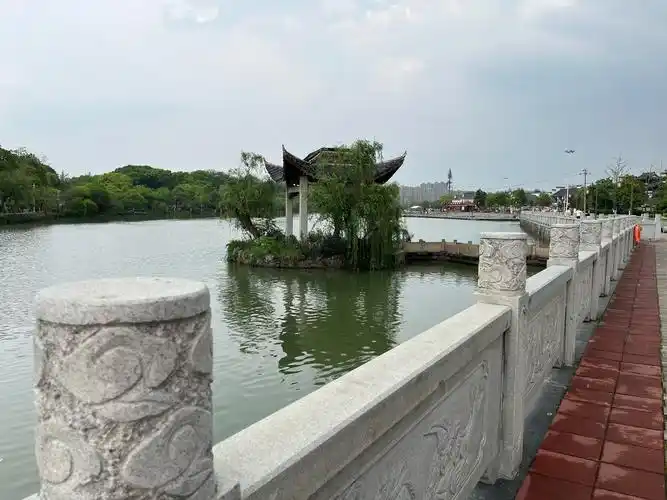
Imagine a green ribbon somewhere between Stockholm's Djurgården and a Dutch polder: 13.9 kilometers of marshes, reed beds, boardwalks, and riverside promenades woven across a 1,054-hectare floodplain—roughly double the surface area of Monaco. Planners have threaded red permeable jogging trails, lakeside running loops, waterside platforms, and even basketball and football pitches through the wetland. Over 470 plant species thrive alongside at least 80 tree and shrub varieties, while water quality meets China's strict Class II standard. Herons, egrets, and kingfishers nest in the reeds, producing dawn and dusk scenes reminiscent of a Scottish wetland reserve at peak migration season.
**Heritage Connections**
The park forms the natural prelude to Ganzhou's Song-era old town. A short walk from the Central City Park or Golden Square sections brings visitors to the weathered ramparts of the Song Dynasty City Wall, whose kiln-fired brickwork echoes contemporary European medieval fortifications, and onward to Yugu Tai, a hilltop pavilion immortalized in Southern Song poetry for its commanding views over the river. Linking a continuous urban wetland to a 900-year-old walled quarter creates a nature-plus-heritage itinerary that few Chinese provincial cities can match—cyclists can pedal from egrets on the marsh at sunrise to lantern-lit battlements by twilight.
**Practical Information**
The park is open 24 hours a day, year-round, with free entry and no reservation required. Public buses serve stops called "City Central Park" and "Golden Square," both adjacent to major attractions; drivers will find parking easiest near the Central City Park and MIXC area. August in Jiangxi brings temperatures above 33°C and frequent rain, so visitors should aim for the cool early-morning window of 6 to 9 a.m. or after 5:30 p.m., armed with drinking water, sun cream, and mosquito repellent. Feeding wildlife, picking plants, and entering protected zones are all forbidden.
**Why It's Worth a Visit**
Few cities of Ganzhou's size can claim a continuous 14-kilometer ecological artery flowing through their downtown, where herons stalk the marsh in the morning and commuters share paths with joggers. For travelers tired of the standard tour-bus circuit, this park delivers birdwatching, fitness, family-friendly nature education, and easy access to a well-preserved Song-era old town in a single walkable network. It is the ideal place to experience southern Jiangxi's rural character without ever leaving the city limits—especially at sunset, when the riverfront lighting shimmers across the broad waters of the Zhangjiang.
**A Wetland Through Two Millennia**
The Zhangjiang corridor has been inhabited and cultivated for over two thousand years, but it was during the Southern Song Dynasty (1127–1279)—a period contemporary with Europe's Crusading era and Germany's Hohenstaufen emperors—that Ganzhou grew into a major southern trading hub. The neighboring Song City Wall and the celebrated Yugu Tai pavilion still testify to that age, when this stretch of the river was already a working waterway carrying merchants, salt barges, and mandarins. Today, the wetland park reclaims that riparian landscape as a public commons, layering contemporary ecological design atop an ancient port zone.
**Scale, Design, and Biodiversity**
Imagine a green ribbon somewhere between Stockholm's Djurgården and a Dutch polder: 13.9 kilometers of marshes, reed beds, boardwalks, and riverside promenades woven across a 1,054-hectare floodplain—roughly double the surface area of Monaco. Planners have threaded red permeable jogging trails, lakeside running loops, waterside platforms, and even basketball and football pitches through the wetland. Over 470 plant species thrive alongside at least 80 tree and shrub varieties, while water quality meets China's strict Class II standard. Herons, egrets, and kingfishers nest in the reeds, producing dawn and dusk scenes reminiscent of a Scottish wetland reserve at peak migration season.
**Heritage Connections**
The park forms the natural prelude to Ganzhou's Song-era old town. A short walk from the Central City Park or Golden Square sections brings visitors to the weathered ramparts of the Song Dynasty City Wall, whose kiln-fired brickwork echoes contemporary European medieval fortifications, and onward to Yugu Tai, a hilltop pavilion immortalized in Southern Song poetry for its commanding views over the river. Linking a continuous urban wetland to a 900-year-old walled quarter creates a nature-plus-heritage itinerary that few Chinese provincial cities can match—cyclists can pedal from egrets on the marsh at sunrise to lantern-lit battlements by twilight.
**Practical Information**
The park is open 24 hours a day, year-round, with free entry and no reservation required. Public buses serve stops called "City Central Park" and "Golden Square," both adjacent to major attractions; drivers will find parking easiest near the Central City Park and MIXC area. August in Jiangxi brings temperatures above 33°C and frequent rain, so visitors should aim for the cool early-morning window of 6 to 9 a.m. or after 5:30 p.m., armed with drinking water, sun cream, and mosquito repellent. Feeding wildlife, picking plants, and entering protected zones are all forbidden.
**Why It's Worth a Visit**
Few cities of Ganzhou's size can claim a continuous 14-kilometer ecological artery flowing through their downtown, where herons stalk the marsh in the morning and commuters share paths with joggers. For travelers tired of the standard tour-bus circuit, this park delivers birdwatching, fitness, family-friendly nature education, and easy access to a well-preserved Song-era old town in a single walkable network. It is the ideal place to experience southern Jiangxi's rural character without ever leaving the city limits—especially at sunset, when the riverfront lighting shimmers across the broad waters of the Zhangjiang.