Bada Shanren Memorial Hall
⭐ 4.40
Bada Shanren Memorial Hall, Zhanggong District, Ganzhou City, Jiangxi Province, China
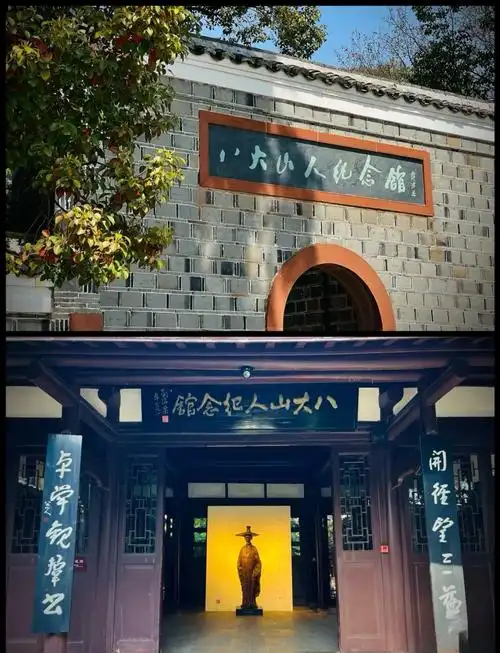 Bada Shanren — literally "Eight Great Mountains Man" — was the monastic name of Zhu Da, a prince of the fallen Ming dynasty whose life paralleled some of Europe's most turbulent artistic transitions. Born just four years before Velázquez completed Las Meninas, he watched his world collapse when Manchu armies captured Beijing in 1644, an upheaval as traumatic for China as the Thirty Years' War was for central Europe. Fleeing to Qingyunpu temple, he became a Daoist monk and poured his anguish into a radically minimalist ink-painting style. His cryptic "crying-laughing" personal seal has intrigued scholars as deeply as the haunting inscriptions Goya later scratched onto his Disasters of War etchings.
The memorial occupies a Qing-dynasty Daoist sanctuary, its layout following the cosmological principles of the Yijing. Think of it as the Chinese cousin of an Italian Carthusian charterhouse — a contemplative monastic compound that doubles as a meditation garden. Grey-brick halls with upturned eaves cluster around lotus-studded ponds, while covered walkways link pavilions draped in wisteria. Unlike the geometric severity of a European cloister, the architecture here drifts like calligraphy across the landscape, every turn framing a fresh vista of water, mossy stone, and centuries-old camphor trees.
Zhu Da's paintings — spare bamboo stalks, glaring one-eyed owls, withering lotuses — revolutionized Chinese xieyi, or "freehand" brushwork, just as J.M.W. Turner was liberating watercolor in England. The hall's treasures include his celebrated Ink Lotus hanging scroll and Twin Eagles, works whose economy of line anticipates Western modernism by two centuries. Beyond Bada Shanren himself, the galleries display Ming and Qing calligraphy and painting that trace the broader currents of early Qing artistic life, making the museum essential for understanding the lineage connecting Song-dynasty literati ideals to modern Chinese art.
The memorial sits at 259 Qingyunpu Road inside Meihu Scenic Area, roughly twenty minutes by taxi from Nanchang Railway Station. It opens Tuesday through Sunday from 9:00 a.m. to 5:00 p.m., with last entry at 4:30 p.m.; Mondays are closure days. Admission is free but requires advance reservation through the official WeChat account using a passport or ID. A clever AI-powered digital avatar guide, accessible via smartphone, walks visitors through the galleries in English. Note that 2026 marks the 400th anniversary of Bada Shanren's birth, and a rotating slate of blockbuster special exhibitions runs throughout the year.
Allow at least half a day to do the site justice. Begin at the front-gate bronze statue and orientation hall to view the famous Ge Shan Xiao Xiang portrait, then wander the temple's ancient corridors where Bada Shanren once roamed. Save the original-works gallery for last, when your eyes are attuned to its subtler revelations. No flash photography is permitted, and the mossy flagstone paths grow slippery after rain, so flat shoes are essential. For deeper context, consider hiring an English-speaking docent or reading up on the artist beforehand; his haunting imagery rewards visitors who arrive with some understanding of the Ming-Qing trauma that shaped it.
Bada Shanren — literally "Eight Great Mountains Man" — was the monastic name of Zhu Da, a prince of the fallen Ming dynasty whose life paralleled some of Europe's most turbulent artistic transitions. Born just four years before Velázquez completed Las Meninas, he watched his world collapse when Manchu armies captured Beijing in 1644, an upheaval as traumatic for China as the Thirty Years' War was for central Europe. Fleeing to Qingyunpu temple, he became a Daoist monk and poured his anguish into a radically minimalist ink-painting style. His cryptic "crying-laughing" personal seal has intrigued scholars as deeply as the haunting inscriptions Goya later scratched onto his Disasters of War etchings.
The memorial occupies a Qing-dynasty Daoist sanctuary, its layout following the cosmological principles of the Yijing. Think of it as the Chinese cousin of an Italian Carthusian charterhouse — a contemplative monastic compound that doubles as a meditation garden. Grey-brick halls with upturned eaves cluster around lotus-studded ponds, while covered walkways link pavilions draped in wisteria. Unlike the geometric severity of a European cloister, the architecture here drifts like calligraphy across the landscape, every turn framing a fresh vista of water, mossy stone, and centuries-old camphor trees.
Zhu Da's paintings — spare bamboo stalks, glaring one-eyed owls, withering lotuses — revolutionized Chinese xieyi, or "freehand" brushwork, just as J.M.W. Turner was liberating watercolor in England. The hall's treasures include his celebrated Ink Lotus hanging scroll and Twin Eagles, works whose economy of line anticipates Western modernism by two centuries. Beyond Bada Shanren himself, the galleries display Ming and Qing calligraphy and painting that trace the broader currents of early Qing artistic life, making the museum essential for understanding the lineage connecting Song-dynasty literati ideals to modern Chinese art.
The memorial sits at 259 Qingyunpu Road inside Meihu Scenic Area, roughly twenty minutes by taxi from Nanchang Railway Station. It opens Tuesday through Sunday from 9:00 a.m. to 5:00 p.m., with last entry at 4:30 p.m.; Mondays are closure days. Admission is free but requires advance reservation through the official WeChat account using a passport or ID. A clever AI-powered digital avatar guide, accessible via smartphone, walks visitors through the galleries in English. Note that 2026 marks the 400th anniversary of Bada Shanren's birth, and a rotating slate of blockbuster special exhibitions runs throughout the year.
Allow at least half a day to do the site justice. Begin at the front-gate bronze statue and orientation hall to view the famous Ge Shan Xiao Xiang portrait, then wander the temple's ancient corridors where Bada Shanren once roamed. Save the original-works gallery for last, when your eyes are attuned to its subtler revelations. No flash photography is permitted, and the mossy flagstone paths grow slippery after rain, so flat shoes are essential. For deeper context, consider hiring an English-speaking docent or reading up on the artist beforehand; his haunting imagery rewards visitors who arrive with some understanding of the Ming-Qing trauma that shaped it.