Tongtian Rock Scenic Area
⭐ 4.50
Tongtian Rock Scenic Area, Zhanggong District, Ganzhou City, Jiangxi Province, China
 Tongtianyan's grottoes were first carved during the Tang dynasty and expanded through the Northern Song, reaching their golden age between the 10th and 11th centuries, roughly contemporary with the great European Romanesque building campaigns at places like Speyer and Cluny. Later, the Ming-dynasty philosopher Wang Yangming, a figure often compared to Luther for his transformation of Eastern thought, lectured here on his School of Mind, lending the cliffs an intellectual gravity that matches their artistic distinction. Poets and scholars from Su Shi to Yang Xiaoben left their traces on the rock faces.
The cliff carvings themselves are remarkable for their Southern Song elegance: bodhisattvas in Cuiwei Cave display flowing drapery and serene expressions reminiscent of Italian Trecento painting, while the Dragon and Tiger Rock features bold, dynamic guardian figures. The layout, with shrines, meditation platforms, and panoramic viewing holes, invites comparison to France's Rocamadour chapels, though sculpted directly into red stone rather than built outward.
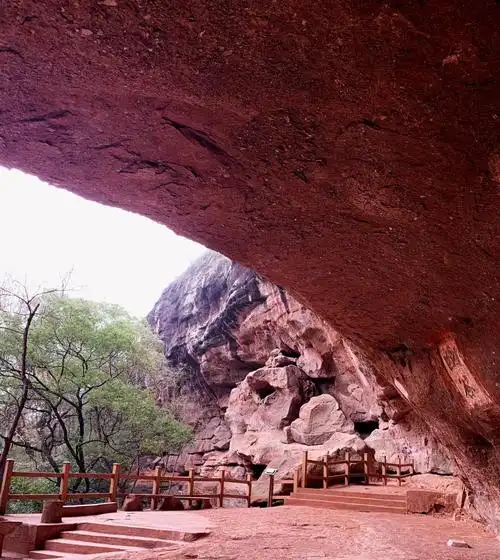
Geologically, the site is a textbook example of Danxia topography, the same rust-red formation that colors much of southeastern China. Weathered over millions of years, the cliffs glow like burnished copper against deep green forest, providing a dramatic natural canvas for the human artistry above. The interplay of crimson rock, ancient trees, and weathered sculpture creates one of China's most photogenic cultural landscapes.
Practical planning is straightforward: the scenic area is a 4A-rated national site and protected monument, located in Shuixi Town, Zhanggong District, about 30 yuan entry, with discounts for students and seniors. Opening hours run 8 a.m. to 5 p.m.; bring water, mosquito repellent, sun protection, and sturdy shoes, especially if tackling the steeper Wangjiang Pavilion climb. A guided cultural loop takes roughly two hours on easy paths, while fit hikers should allow four to six hours for the full mountain route.
For Western travelers, Tongtianyan offers something rarer than big-name attractions: an uncrowded site where Tang-era religion, Song-dynasty aesthetics, and Ming philosophy meet in one compact valley. Pair it with Ganzhou's old city walls and the historic Yugutai Pavilion to assemble a deeply satisfying day tracing the soul of southern Jiangxi, far from the usual tourist trail.
Tongtianyan's grottoes were first carved during the Tang dynasty and expanded through the Northern Song, reaching their golden age between the 10th and 11th centuries, roughly contemporary with the great European Romanesque building campaigns at places like Speyer and Cluny. Later, the Ming-dynasty philosopher Wang Yangming, a figure often compared to Luther for his transformation of Eastern thought, lectured here on his School of Mind, lending the cliffs an intellectual gravity that matches their artistic distinction. Poets and scholars from Su Shi to Yang Xiaoben left their traces on the rock faces.
The cliff carvings themselves are remarkable for their Southern Song elegance: bodhisattvas in Cuiwei Cave display flowing drapery and serene expressions reminiscent of Italian Trecento painting, while the Dragon and Tiger Rock features bold, dynamic guardian figures. The layout, with shrines, meditation platforms, and panoramic viewing holes, invites comparison to France's Rocamadour chapels, though sculpted directly into red stone rather than built outward.
Geologically, the site is a textbook example of Danxia topography, the same rust-red formation that colors much of southeastern China. Weathered over millions of years, the cliffs glow like burnished copper against deep green forest, providing a dramatic natural canvas for the human artistry above. The interplay of crimson rock, ancient trees, and weathered sculpture creates one of China's most photogenic cultural landscapes.
Practical planning is straightforward: the scenic area is a 4A-rated national site and protected monument, located in Shuixi Town, Zhanggong District, about 30 yuan entry, with discounts for students and seniors. Opening hours run 8 a.m. to 5 p.m.; bring water, mosquito repellent, sun protection, and sturdy shoes, especially if tackling the steeper Wangjiang Pavilion climb. A guided cultural loop takes roughly two hours on easy paths, while fit hikers should allow four to six hours for the full mountain route.
For Western travelers, Tongtianyan offers something rarer than big-name attractions: an uncrowded site where Tang-era religion, Song-dynasty aesthetics, and Ming philosophy meet in one compact valley. Pair it with Ganzhou's old city walls and the historic Yugutai Pavilion to assemble a deeply satisfying day tracing the soul of southern Jiangxi, far from the usual tourist trail.