Bajing Tower
⭐ 4.20
Bajing Tai, Zhanggong District, Ganzhou City, Jiangxi Province, China
 **A Northern Song Time Capsule**
Bajing Terrace was commissioned in 1056–1063 by Kong Zonghan, the prefect of Qianzhou (modern Ganzhou), an era roughly contemporary with the Norman Conquest of England and the zenith of the Holy Roman Empire. Kong had the rocky promontory carved into a viewing platform and, struck by the panoramic vistas, painted the seminal "Eight Views of Qianzhou." His friend, the poet Su Shi—one of the great literary figures of the age, comparable to Dante in stature—composed the accompanying verses, unwittingly establishing a cultural template that spread across East Asia for centuries.
**Architecture Worth Climbing For**
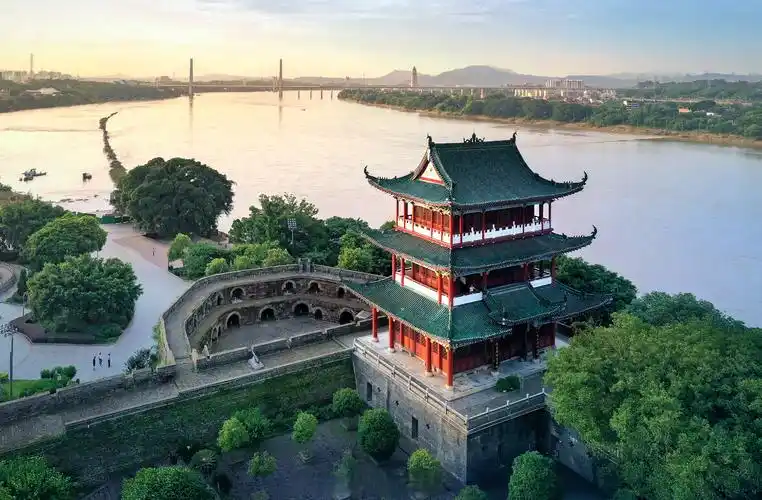
The pavilion you see today is a faithful 1983 reconstruction in reinforced concrete, but it follows the original Song blueprint with vermilion pillars, dougong bracket sets, sweeping upturned eaves, and a roof of greenish-yellow glazed tiles. Topping out at 28.5 meters, it sprouts directly from the ancient city wall, giving visitors the rare experience of walking on a working medieval-era fortification while ascending a classical Chinese pavilion. Think of it as a delicate Chinese counterpoint to a Norman-era watchtower.
**The Birthplace of "Eight Scenery" Culture**
Before Bajing Terrace, China had no formal tradition of cataloging a city's most beautiful views. Su Shi's poetic inscriptions on Kong's paintings invented that very concept, and the "Eight Views" formula—sunset over a mountain, a temple in autumn mist, a fisherman's lantern at night—soon spread from Ganzhou to Hanoi, Kyoto, and beyond. Scholars still study Bajing as the wellspring of a genre that shaped East Asian landscape painting for nearly a millennium.
**Planning Your Visit**
The terrace sits inside Bajing Park in the Zhanggong District, which is free to enter. Climbing the pavilion itself costs around 20 RMB (verify before travel). Opening hours typically run 08:00 to 20:00. From Ganzhou West Railway Station, a taxi or ride-share takes 20–30 minutes; city buses K2 and K3 also stop nearby. The immediate area is compact and walkable, with English signage minimal but locals generally helpful.
**Why It Belongs on Your Itinerary**
Most travelers to Jiangxi rush to the terraced fields of Longji or the mountain villages of Wuyuan, but Ganzhou's "Living Song City" offers something rarer: a complete urban landscape preserved from the 11th century, complete with intact city walls, a floating bridge, and the neighboring Yugu Terrace. Bajing Terrace is the crown jewel of this ensemble, and unlike China's blockbuster sites, you may well have it largely to yourself. Time your visit for late afternoon, when the three rivers turn molten gold and the old wall glows amber in the setting sun.
**A Northern Song Time Capsule**
Bajing Terrace was commissioned in 1056–1063 by Kong Zonghan, the prefect of Qianzhou (modern Ganzhou), an era roughly contemporary with the Norman Conquest of England and the zenith of the Holy Roman Empire. Kong had the rocky promontory carved into a viewing platform and, struck by the panoramic vistas, painted the seminal "Eight Views of Qianzhou." His friend, the poet Su Shi—one of the great literary figures of the age, comparable to Dante in stature—composed the accompanying verses, unwittingly establishing a cultural template that spread across East Asia for centuries.
**Architecture Worth Climbing For**
The pavilion you see today is a faithful 1983 reconstruction in reinforced concrete, but it follows the original Song blueprint with vermilion pillars, dougong bracket sets, sweeping upturned eaves, and a roof of greenish-yellow glazed tiles. Topping out at 28.5 meters, it sprouts directly from the ancient city wall, giving visitors the rare experience of walking on a working medieval-era fortification while ascending a classical Chinese pavilion. Think of it as a delicate Chinese counterpoint to a Norman-era watchtower.
**The Birthplace of "Eight Scenery" Culture**
Before Bajing Terrace, China had no formal tradition of cataloging a city's most beautiful views. Su Shi's poetic inscriptions on Kong's paintings invented that very concept, and the "Eight Views" formula—sunset over a mountain, a temple in autumn mist, a fisherman's lantern at night—soon spread from Ganzhou to Hanoi, Kyoto, and beyond. Scholars still study Bajing as the wellspring of a genre that shaped East Asian landscape painting for nearly a millennium.
**Planning Your Visit**
The terrace sits inside Bajing Park in the Zhanggong District, which is free to enter. Climbing the pavilion itself costs around 20 RMB (verify before travel). Opening hours typically run 08:00 to 20:00. From Ganzhou West Railway Station, a taxi or ride-share takes 20–30 minutes; city buses K2 and K3 also stop nearby. The immediate area is compact and walkable, with English signage minimal but locals generally helpful.
**Why It Belongs on Your Itinerary**
Most travelers to Jiangxi rush to the terraced fields of Longji or the mountain villages of Wuyuan, but Ganzhou's "Living Song City" offers something rarer: a complete urban landscape preserved from the 11th century, complete with intact city walls, a floating bridge, and the neighboring Yugu Terrace. Bajing Terrace is the crown jewel of this ensemble, and unlike China's blockbuster sites, you may well have it largely to yourself. Time your visit for late afternoon, when the three rivers turn molten gold and the old wall glows amber in the setting sun.