Yelang Valley
⭐ 4.20
Huaxi Yelang Valley, Huaxi District, Guiyang City, Guizhou Province, China
 **A Modern Myth Forged in Stone**
Yelang Valley is not an archaeological site but a singular artistic vision that began in 1997. Song Peilun, who studied art in the United States before returning to his Guizhou homeland, poured his personal savings and roughly twenty-five years of labor into transforming a karst ravine into a personal mythology. Think of it as a Chinese answer to the visionary environments of outsider artists like Ferdinand Cheval's Ideal Palace in France or the rock-hewn churches of Lalibela in Ethiopia — a place where one person's obsession becomes architecture. The result is less monument than manifesto: a "one man, one valley" experiment in raw, handmade art.
**Architecture Born from the Landscape**
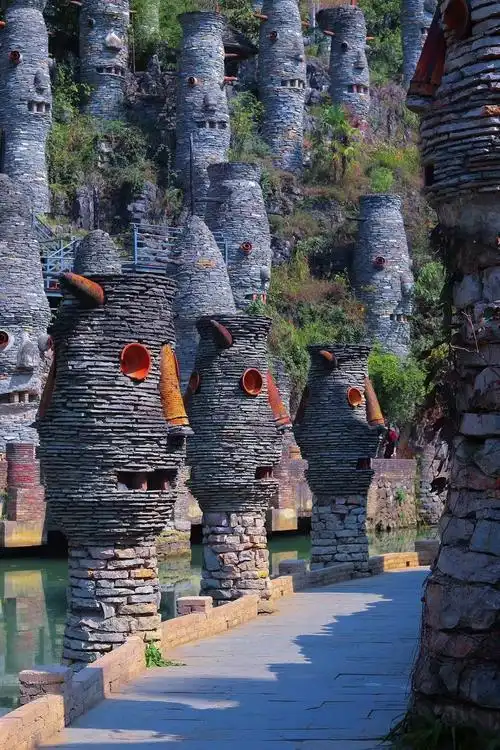
Spanning some 200 mu (about 33 acres), the valley's stone figures and fortress-like structures follow the natural contours of the karst terrain, tumbling down the hillsides in jagged tiers. The faces are exaggerated and fierce — bug-eyed, grimacing, almost mythological — while the limbs are crude and powerful, radiating a totem-like intensity that recalls the moai of Easter Island or the carved guardians of Angkor. A stream threads through the compound, crossed by stone bridges that merge seamlessly with cliffs and outcrops. The cold gray of the sculptures plays beautifully against the surrounding emerald hills, giving photographers striking contrast from every angle.
**Echoes of Nuo Opera and Ancient Yelang**
The sculptures draw their visual DNA from Nuo theater, often called the "living fossil of Chinese drama" for its roots in pre-Han ritual and shamanic performance. Song channeled the eerie mystery of Nuo masks and the imposing gravitas of local deities into stone, turning the valley into a three-dimensional expression of Guizhou folk culture. Visitors may be lucky enough to catch an occasional Nuo performance on-site, a rare chance to glimpse a folk tradition stretching back more than two millennia — older than most European cathedrals. It is, in essence, regional heritage reimagined through contemporary sculpture.
**Planning Your Visit**
The park sits in Dangwu Township, Huaxi District, a 30-minute drive from central Guiyang. Admission is a remarkably modest 20 yuan for adults, 10 yuan for students and children, with free entry for seniors over 70. It is open daily from 8:30 a.m. to 7:00 p.m., though no new visitors are admitted after 6:00 p.m. Allow 1.5 to 2.5 hours; the terrain involves many stone steps, so sturdy non-slip shoes are essential. Most visitors arrive by taxi or rental car, as public transit is infrequent. Payment and signage are primarily in Chinese, so bringing translation apps and a mobile payment setup is wise. Pairing Yelang Valley with the nearby Ming-era Qingyan Ancient Town makes a rewarding half- or full-day excursion.
**Why It Belongs on Your Itinerary**
In a country overflowing with ancient wonders, Yelang Valley offers something different: the thrill of encountering art that is unmistakably contemporary yet feels older than memory. It is a place for travelers tired of polished museum exhibits and reconstructed heritage sites — somewhere to wander among strange stone faces, listen to water rushing over rock, and feel the presence of a single artist's decades-long devotion. Come for the photos; stay for the rare atmosphere of a world entirely invented from imagination, stone, and stubbornness.
**A Modern Myth Forged in Stone**
Yelang Valley is not an archaeological site but a singular artistic vision that began in 1997. Song Peilun, who studied art in the United States before returning to his Guizhou homeland, poured his personal savings and roughly twenty-five years of labor into transforming a karst ravine into a personal mythology. Think of it as a Chinese answer to the visionary environments of outsider artists like Ferdinand Cheval's Ideal Palace in France or the rock-hewn churches of Lalibela in Ethiopia — a place where one person's obsession becomes architecture. The result is less monument than manifesto: a "one man, one valley" experiment in raw, handmade art.
**Architecture Born from the Landscape**
Spanning some 200 mu (about 33 acres), the valley's stone figures and fortress-like structures follow the natural contours of the karst terrain, tumbling down the hillsides in jagged tiers. The faces are exaggerated and fierce — bug-eyed, grimacing, almost mythological — while the limbs are crude and powerful, radiating a totem-like intensity that recalls the moai of Easter Island or the carved guardians of Angkor. A stream threads through the compound, crossed by stone bridges that merge seamlessly with cliffs and outcrops. The cold gray of the sculptures plays beautifully against the surrounding emerald hills, giving photographers striking contrast from every angle.
**Echoes of Nuo Opera and Ancient Yelang**
The sculptures draw their visual DNA from Nuo theater, often called the "living fossil of Chinese drama" for its roots in pre-Han ritual and shamanic performance. Song channeled the eerie mystery of Nuo masks and the imposing gravitas of local deities into stone, turning the valley into a three-dimensional expression of Guizhou folk culture. Visitors may be lucky enough to catch an occasional Nuo performance on-site, a rare chance to glimpse a folk tradition stretching back more than two millennia — older than most European cathedrals. It is, in essence, regional heritage reimagined through contemporary sculpture.
**Planning Your Visit**
The park sits in Dangwu Township, Huaxi District, a 30-minute drive from central Guiyang. Admission is a remarkably modest 20 yuan for adults, 10 yuan for students and children, with free entry for seniors over 70. It is open daily from 8:30 a.m. to 7:00 p.m., though no new visitors are admitted after 6:00 p.m. Allow 1.5 to 2.5 hours; the terrain involves many stone steps, so sturdy non-slip shoes are essential. Most visitors arrive by taxi or rental car, as public transit is infrequent. Payment and signage are primarily in Chinese, so bringing translation apps and a mobile payment setup is wise. Pairing Yelang Valley with the nearby Ming-era Qingyan Ancient Town makes a rewarding half- or full-day excursion.
**Why It Belongs on Your Itinerary**
In a country overflowing with ancient wonders, Yelang Valley offers something different: the thrill of encountering art that is unmistakably contemporary yet feels older than memory. It is a place for travelers tired of polished museum exhibits and reconstructed heritage sites — somewhere to wander among strange stone faces, listen to water rushing over rock, and feel the presence of a single artist's decades-long devotion. Come for the photos; stay for the rare atmosphere of a world entirely invented from imagination, stone, and stubbornness.