Qingyan Ancient Town
⭐ 4.00
South Gate Visitor Center, Qingyan Town, Huaxi District, Guiyang, Guizhou Province, China
 Founded in the eleventh year of the Ming Hongwu reign (1378), Qingyan was conceived as a strategic bulwark controlling the southern gateway to Guiyang, much as the fortified bastide towns of Languedoc once anchored medieval France's frontier defenses. Initially a purely military outpost—part of the vast tunpu garrison system that settled Han troops along the empire's southwestern marches—the settlement gradually evolved into a thriving market town as traders, craftsmen, and traveling merchants transformed the camp into a cosmopolitan crossroads. The result is a remarkably intact urban fabric where Ming defensive planning meets Qing commercial vitality, offering visitors a living archive of how China's frontier communities adapted and endured.
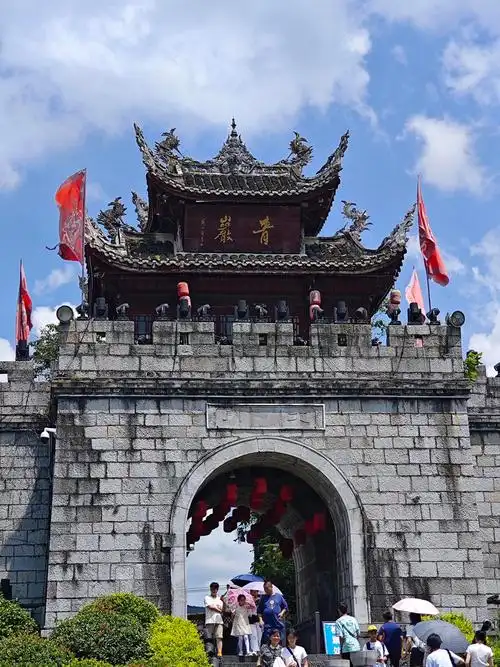
The town's architectural signature is its relentless use of local bluestone: cobbled lanes, courtyard walls, gate towers, and house foundations all share the same cool grey hue, earning Qingyan the epithet "Symphony in Stone." The visual effect recalls the limestone villages of Italy's Puglia or the grey Cotswold hamlets of England, though the building logic is unmistakably Chinese. Three landmarks anchor any visit: the Dingguang Gate tower at the southern wall, offering panoramic sunset views over tiled rooftops and rice paddies; Back Street (Bei Jie), whose layered stone walls were immortalized in director Lu Chuan's 2002 film "The Missing Gun"; and the former residence of Zhao Yijiong, Guizhou's first zhuangyuan (top imperial examination graduate), whose 1886 triumph made him a regional folk hero.
What distinguishes Qingyan from many Chinese heritage towns is its remarkable religious pluralism. Within a single stroll one encounters the exquisitely carved Wanshou Palace—a Jiangxi merchant guild hall with elaborate wooden reliefs—alongside the Buddhist Ciyun Temple, the Taoist Longquan Monastery, and a quietly preserved Catholic chapel. Confucian stone archways stand nearby, reminding visitors of imperial examination culture. This coexistence of Buddhist, Taoist, Confucian, and Christian worship spaces mirrors the syncretic tolerance found in old Mediterranean port cities such as Jaffa or Rhodes, and reflects centuries of peaceful cultural mingling on Guizhou's multiethnic frontier.
Practical planning is straightforward. Admission to the historic district itself costs roughly 10 RMB per person, while a combined ticket for the principal interior sites (Zhao residence, Wanshou Palace, and others) runs about 60 RMB. The streets are open daily from 08:10 to 22:00. Public Bus 203 from central Guiyang takes around 40 minutes and drops visitors near the west gate; drivers should navigate to "Qingyan Ancient Town West Gate Parking Lot." Half a day suffices for the highlights, though a leisurely full-day visit rewards those who linger over local specialties such as zhuangyuan braised pig's trotters (the scholar's celebratory dish), crispy tofu balls, and the sweet rice pudding called gaoba xifan.
The best moments in Qingyan arrive in the early morning or golden hour before sunset, when day-trippers thin out and the stone walls take on a honeyed warmth. After midsummer rains the lanes gleam and the surrounding rice fields turn vivid green—an atmospheric counterpoint to the ancient grey masonry. Wear sturdy non-slip shoes, as flagstones can be slick, and carry an umbrella between June and August. For travelers seeking an accessible, uncrowded slice of old China within easy reach of a modern provincial capital, Qingyan delivers an exceptionally rewarding half-day escape that feels worlds away from urban Guiyang.
Founded in the eleventh year of the Ming Hongwu reign (1378), Qingyan was conceived as a strategic bulwark controlling the southern gateway to Guiyang, much as the fortified bastide towns of Languedoc once anchored medieval France's frontier defenses. Initially a purely military outpost—part of the vast tunpu garrison system that settled Han troops along the empire's southwestern marches—the settlement gradually evolved into a thriving market town as traders, craftsmen, and traveling merchants transformed the camp into a cosmopolitan crossroads. The result is a remarkably intact urban fabric where Ming defensive planning meets Qing commercial vitality, offering visitors a living archive of how China's frontier communities adapted and endured.
The town's architectural signature is its relentless use of local bluestone: cobbled lanes, courtyard walls, gate towers, and house foundations all share the same cool grey hue, earning Qingyan the epithet "Symphony in Stone." The visual effect recalls the limestone villages of Italy's Puglia or the grey Cotswold hamlets of England, though the building logic is unmistakably Chinese. Three landmarks anchor any visit: the Dingguang Gate tower at the southern wall, offering panoramic sunset views over tiled rooftops and rice paddies; Back Street (Bei Jie), whose layered stone walls were immortalized in director Lu Chuan's 2002 film "The Missing Gun"; and the former residence of Zhao Yijiong, Guizhou's first zhuangyuan (top imperial examination graduate), whose 1886 triumph made him a regional folk hero.
What distinguishes Qingyan from many Chinese heritage towns is its remarkable religious pluralism. Within a single stroll one encounters the exquisitely carved Wanshou Palace—a Jiangxi merchant guild hall with elaborate wooden reliefs—alongside the Buddhist Ciyun Temple, the Taoist Longquan Monastery, and a quietly preserved Catholic chapel. Confucian stone archways stand nearby, reminding visitors of imperial examination culture. This coexistence of Buddhist, Taoist, Confucian, and Christian worship spaces mirrors the syncretic tolerance found in old Mediterranean port cities such as Jaffa or Rhodes, and reflects centuries of peaceful cultural mingling on Guizhou's multiethnic frontier.
Practical planning is straightforward. Admission to the historic district itself costs roughly 10 RMB per person, while a combined ticket for the principal interior sites (Zhao residence, Wanshou Palace, and others) runs about 60 RMB. The streets are open daily from 08:10 to 22:00. Public Bus 203 from central Guiyang takes around 40 minutes and drops visitors near the west gate; drivers should navigate to "Qingyan Ancient Town West Gate Parking Lot." Half a day suffices for the highlights, though a leisurely full-day visit rewards those who linger over local specialties such as zhuangyuan braised pig's trotters (the scholar's celebratory dish), crispy tofu balls, and the sweet rice pudding called gaoba xifan.
The best moments in Qingyan arrive in the early morning or golden hour before sunset, when day-trippers thin out and the stone walls take on a honeyed warmth. After midsummer rains the lanes gleam and the surrounding rice fields turn vivid green—an atmospheric counterpoint to the ancient grey masonry. Wear sturdy non-slip shoes, as flagstones can be slick, and carry an umbrella between June and August. For travelers seeking an accessible, uncrowded slice of old China within easy reach of a modern provincial capital, Qingyan delivers an exceptionally rewarding half-day escape that feels worlds away from urban Guiyang.