Small Wild Goose Pagoda
⭐ 4.20
Yanta District, Xi'an, Shaanxi, China
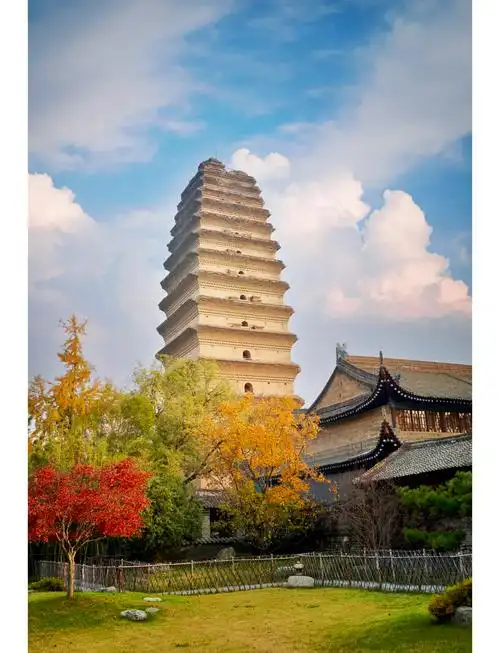 Standing in the western suburbs of Xi'an since 707 AD, the Small Wild Goose Pagoda was originally commissioned as the relic tower of the Jianfu Temple, a major Buddhist monastery during the height of the Tang Dynasty—one of the most cosmopolitan eras in world history. Built just 35 years after the founding of Japan's Nara period and contemporaneous with the early Islamic caliphates, it represents the cultural apex of an empire that stretched from Korea to Persia. Together with its larger sibling, the Big Wild Goose Pagoda, it has defined Xi'an's skyline for over 1,300 years and is now a key node of the UNESCO World Heritage site "Silk Roads: the Routes Network of Chang'an-Tianshan Corridor."
The pagoda is a masterpiece of Tang-era "dense-eave" brick construction, an East Asian counterpart to the Romanesque towers of medieval Europe yet distinct in its slender, tapering silhouette. Originally rising through fifteen stories, the structure lost its top two tiers to a powerful earthquake, leaving thirteen floors of beautifully weathered brick that retain remarkable elegance. A square-plan ziggurat in form, its compact proportions remind visitors of Italian campaniles such as Pisa's baptistery, though its spiritual purpose places it firmly in the great tradition of Buddhist reliquary monuments that spanned Asia from Sri Lanka to Japan.
What truly sets this pagoda apart is its legendary "three cracks, three reunions" phenomenon: across several major earthquakes over the centuries, including devastating tremors in 1556 and 1569, the tower's walls appeared to split and then mysteriously heal. Modern engineers attribute this resilience to the structure's semi-spherical foundation, the flexible mortar joints between its bricks, and subtle optical illusions that play tricks on the observer. Locals christened it the "Miraculously Self-Healing Pagoda," and geologists, architects, and curious travelers still flock here to witness a phenomenon that bridges ancient wisdom and modern seismology.
Sharing its grounds with the Xi'an Museum, the site offers a remarkably rich cultural experience at no cost. Inside the museum, visitors encounter treasures such as a luminous Tang three-color glazed horse captured mid-gallop—a masterpiece equal in craftsmanship to any European equestrian sculpture of the Renaissance. The grounds also preserve the historic Yancha Bell, one of the celebrated "Eight Scenes of the Guanzhong Plain," whose morning toll once awakened the medieval capital. Unlike the often-crowded environs of the Big Wild Goose Pagoda, this enclave remains a quiet oasis of ancient cypresses, courtyards, and weathered stone—perfect for unhurried contemplation.
Practical planning is straightforward but requires forethought. Admission is free, yet visitors must reserve a slot in advance through the "Xi'an Museum" WeChat public account, ideally one to three days ahead during spring and autumn high seasons. Hours run 8:30 AM to 6:00 PM, with last entry at 5:00 PM; the entire complex closes on Tuesdays for maintenance. Foreign visitors should bring their original passport, as the passport number is required at booking and checked at the gate. Take Metro Line 2 or Line 5 to Nanshaomen Station, then enjoy an eight- to ten-minute walk through tree-lined streets to reach the entrance.
For first-time visitors to China, this site offers an unusually complete glimpse of layered history in a single half-day: an active Buddhist heritage site, a panoramic model of the ancient Chang'an city, exquisite Tang sculpture, and shaded gardens where the past feels genuinely alive. Arrive between 9 and 11 AM, or after 3:30 PM, to enjoy the softest light on the brickwork and to avoid both the midday heat and the largest tour groups. Allow two to two and a half hours to appreciate the pagoda, browse the museum, and savor a moment beneath the thousand-year-old scholar tree in the old Jianfu Temple courtyard—an afternoon well spent in the old capital of the world.
Standing in the western suburbs of Xi'an since 707 AD, the Small Wild Goose Pagoda was originally commissioned as the relic tower of the Jianfu Temple, a major Buddhist monastery during the height of the Tang Dynasty—one of the most cosmopolitan eras in world history. Built just 35 years after the founding of Japan's Nara period and contemporaneous with the early Islamic caliphates, it represents the cultural apex of an empire that stretched from Korea to Persia. Together with its larger sibling, the Big Wild Goose Pagoda, it has defined Xi'an's skyline for over 1,300 years and is now a key node of the UNESCO World Heritage site "Silk Roads: the Routes Network of Chang'an-Tianshan Corridor."
The pagoda is a masterpiece of Tang-era "dense-eave" brick construction, an East Asian counterpart to the Romanesque towers of medieval Europe yet distinct in its slender, tapering silhouette. Originally rising through fifteen stories, the structure lost its top two tiers to a powerful earthquake, leaving thirteen floors of beautifully weathered brick that retain remarkable elegance. A square-plan ziggurat in form, its compact proportions remind visitors of Italian campaniles such as Pisa's baptistery, though its spiritual purpose places it firmly in the great tradition of Buddhist reliquary monuments that spanned Asia from Sri Lanka to Japan.
What truly sets this pagoda apart is its legendary "three cracks, three reunions" phenomenon: across several major earthquakes over the centuries, including devastating tremors in 1556 and 1569, the tower's walls appeared to split and then mysteriously heal. Modern engineers attribute this resilience to the structure's semi-spherical foundation, the flexible mortar joints between its bricks, and subtle optical illusions that play tricks on the observer. Locals christened it the "Miraculously Self-Healing Pagoda," and geologists, architects, and curious travelers still flock here to witness a phenomenon that bridges ancient wisdom and modern seismology.
Sharing its grounds with the Xi'an Museum, the site offers a remarkably rich cultural experience at no cost. Inside the museum, visitors encounter treasures such as a luminous Tang three-color glazed horse captured mid-gallop—a masterpiece equal in craftsmanship to any European equestrian sculpture of the Renaissance. The grounds also preserve the historic Yancha Bell, one of the celebrated "Eight Scenes of the Guanzhong Plain," whose morning toll once awakened the medieval capital. Unlike the often-crowded environs of the Big Wild Goose Pagoda, this enclave remains a quiet oasis of ancient cypresses, courtyards, and weathered stone—perfect for unhurried contemplation.
Practical planning is straightforward but requires forethought. Admission is free, yet visitors must reserve a slot in advance through the "Xi'an Museum" WeChat public account, ideally one to three days ahead during spring and autumn high seasons. Hours run 8:30 AM to 6:00 PM, with last entry at 5:00 PM; the entire complex closes on Tuesdays for maintenance. Foreign visitors should bring their original passport, as the passport number is required at booking and checked at the gate. Take Metro Line 2 or Line 5 to Nanshaomen Station, then enjoy an eight- to ten-minute walk through tree-lined streets to reach the entrance.
For first-time visitors to China, this site offers an unusually complete glimpse of layered history in a single half-day: an active Buddhist heritage site, a panoramic model of the ancient Chang'an city, exquisite Tang sculpture, and shaded gardens where the past feels genuinely alive. Arrive between 9 and 11 AM, or after 3:30 PM, to enjoy the softest light on the brickwork and to avoid both the midday heat and the largest tour groups. Allow two to two and a half hours to appreciate the pagoda, browse the museum, and savor a moment beneath the thousand-year-old scholar tree in the old Jianfu Temple courtyard—an afternoon well spent in the old capital of the world.