Qujiang Ocean World
⭐ 4.00
Northwest side of the intersection of Furong South Road and Furong West Road, Qujiang New District, Yanta District, Xi'an City, Shaanxi Province, China
 Set in the heart of Xi'an—capital of thirteen Chinese dynasties and the eastern terminus of the ancient Silk Road that once linked Constantinople, Baghdad, and Rome—the park enjoys a setting steeped in over three millennia of history. Just steps from the 1,300-year-old Big Wild Goose Pagoda, built in 652 AD to house Buddhist scriptures brought back by the monk Xuanzang, the attraction offers a striking juxtaposition: a high-tech marine habitat embedded within a landscape once traveled by Tang Dynasty merchants. Comparable in historical weight to Rome or Istanbul, Xi'an makes the aquarium an unexpectedly modern counterpoint to monuments such as the ancient city walls and the Terracotta Warriors, only 40 kilometers east.
Opened in two phases—the marine hall in 2005 and the polar hall in 2013—the complex covers roughly 18,600 square meters of built space and circulates some 6,000 tons of seawater supporting more than 12,000 individual animals across 300-plus species. Visitors move from a humid Tropical Rainforest Hall evoking the Amazon into cooler waters via a fully transparent 80-meter acrylic underwater tunnel. The scale is comparable to the Lisbon Oceanário or Istanbul's Turkuazoo, though smaller than giants like Monterey Bay or the Georgia Aquarium. The science-education wing features digital interactives designed for school groups and curious travelers alike.
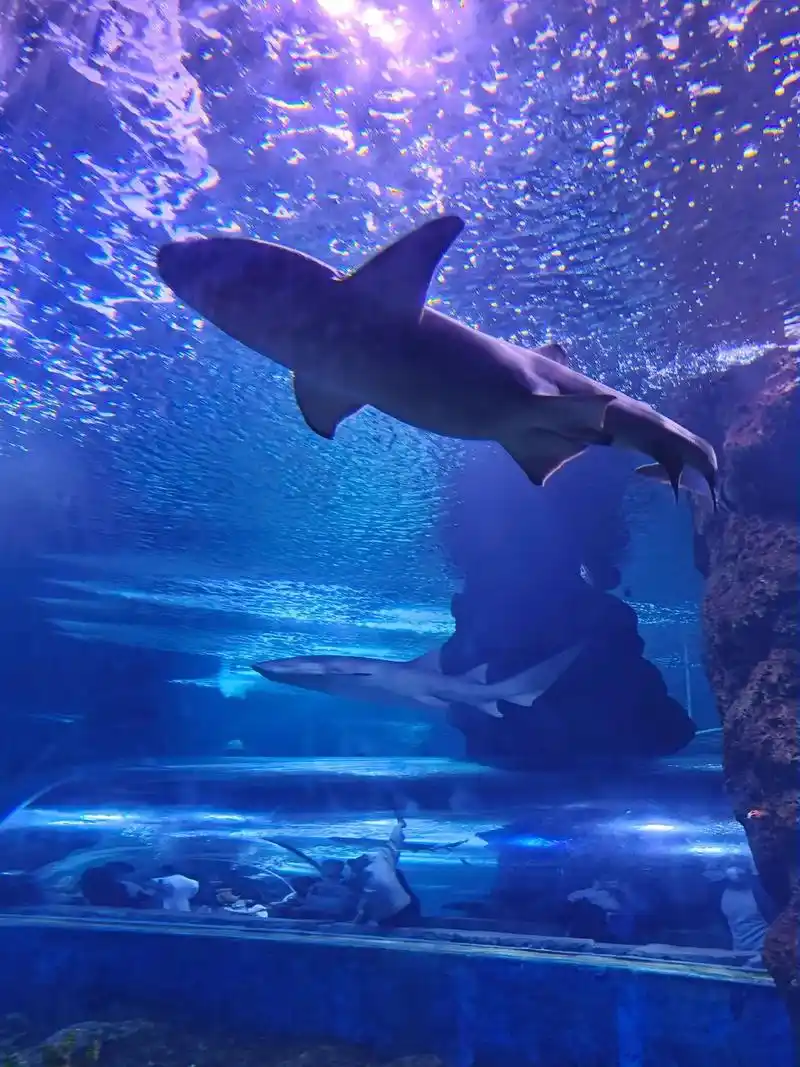
The undisputed highlight is the 80-meter panoramic tunnel, where blacktip reef sharks, guitarfish, and schooling jacks swim directly overhead and to either side. Immersive LED lighting simulates shifting surface reflections, producing a sensation of strolling across the seabed—a beloved photo location for couples and families alike. Comparable immersion can be found at Genoa's aquarium in Italy or Valencia's Oceanogràfic, but few venues pair this experience with such ready access to imperial Chinese monuments just outside the gates. Photography enthusiasts should bring phones and patience.
Show programming runs roughly 11 a.m. to 5 p.m., with rotating dolphin and sea lion acts, a mermaid theatrical sequence, and themed diving performances staged in the marine theater. Arrive early to claim shaded seats and check the daily schedule posted at the entrance. The adjacent polar hall introduces species rarely seen in Northwest China: waddling gentoo penguins at Penguin Cove and a popular polar bear observation deck—an attraction especially meaningful for inland visitors who otherwise have little contact with Arctic wildlife and may never travel to the polar regions themselves.
The science-education gallery punches well above the average aquarium, displaying a taxidermied 13.5-meter Bryde's whale specimen—one of the largest such mounts in inland Asia—alongside backlit jellyfish cylinders and virtual-reality touchscreen stations that let children pilot digital fish through marine ecosystems. Constant climate control keeps interiors around 22°C year-round, transforming the complex into a popular refuge during Xi'an's hot, humid summers when daytime temperatures regularly exceed 35°C. Parents and teachers regularly cite it as one of the region's best rainy-day or heat-wave destinations.
A combined adult ticket runs approximately 180–190 RMB (roughly US $25), with free entry for children under 1.2 meters and discounted rates for students, seniors, and disabled visitors holding valid ID. The park is a roughly one-kilometer walk from Beichitou Station on Metro Line 3 or Datang Furongyuan Station on Line 4, with multiple buses serving the Qujiang Ocean World stop. Plan three to four hours for a complete visit. To avoid the heaviest crowds, arrive at opening (typically 9 a.m.) on weekends or visit midweek during school terms.
Set in the heart of Xi'an—capital of thirteen Chinese dynasties and the eastern terminus of the ancient Silk Road that once linked Constantinople, Baghdad, and Rome—the park enjoys a setting steeped in over three millennia of history. Just steps from the 1,300-year-old Big Wild Goose Pagoda, built in 652 AD to house Buddhist scriptures brought back by the monk Xuanzang, the attraction offers a striking juxtaposition: a high-tech marine habitat embedded within a landscape once traveled by Tang Dynasty merchants. Comparable in historical weight to Rome or Istanbul, Xi'an makes the aquarium an unexpectedly modern counterpoint to monuments such as the ancient city walls and the Terracotta Warriors, only 40 kilometers east.
Opened in two phases—the marine hall in 2005 and the polar hall in 2013—the complex covers roughly 18,600 square meters of built space and circulates some 6,000 tons of seawater supporting more than 12,000 individual animals across 300-plus species. Visitors move from a humid Tropical Rainforest Hall evoking the Amazon into cooler waters via a fully transparent 80-meter acrylic underwater tunnel. The scale is comparable to the Lisbon Oceanário or Istanbul's Turkuazoo, though smaller than giants like Monterey Bay or the Georgia Aquarium. The science-education wing features digital interactives designed for school groups and curious travelers alike.
The undisputed highlight is the 80-meter panoramic tunnel, where blacktip reef sharks, guitarfish, and schooling jacks swim directly overhead and to either side. Immersive LED lighting simulates shifting surface reflections, producing a sensation of strolling across the seabed—a beloved photo location for couples and families alike. Comparable immersion can be found at Genoa's aquarium in Italy or Valencia's Oceanogràfic, but few venues pair this experience with such ready access to imperial Chinese monuments just outside the gates. Photography enthusiasts should bring phones and patience.
Show programming runs roughly 11 a.m. to 5 p.m., with rotating dolphin and sea lion acts, a mermaid theatrical sequence, and themed diving performances staged in the marine theater. Arrive early to claim shaded seats and check the daily schedule posted at the entrance. The adjacent polar hall introduces species rarely seen in Northwest China: waddling gentoo penguins at Penguin Cove and a popular polar bear observation deck—an attraction especially meaningful for inland visitors who otherwise have little contact with Arctic wildlife and may never travel to the polar regions themselves.
The science-education gallery punches well above the average aquarium, displaying a taxidermied 13.5-meter Bryde's whale specimen—one of the largest such mounts in inland Asia—alongside backlit jellyfish cylinders and virtual-reality touchscreen stations that let children pilot digital fish through marine ecosystems. Constant climate control keeps interiors around 22°C year-round, transforming the complex into a popular refuge during Xi'an's hot, humid summers when daytime temperatures regularly exceed 35°C. Parents and teachers regularly cite it as one of the region's best rainy-day or heat-wave destinations.
A combined adult ticket runs approximately 180–190 RMB (roughly US $25), with free entry for children under 1.2 meters and discounted rates for students, seniors, and disabled visitors holding valid ID. The park is a roughly one-kilometer walk from Beichitou Station on Metro Line 3 or Datang Furongyuan Station on Line 4, with multiple buses serving the Qujiang Ocean World stop. Plan three to four hours for a complete visit. To avoid the heaviest crowds, arrive at opening (typically 9 a.m.) on weekends or visit midweek during school terms.